
On September 25, a developer dug up a PROMAX field in ChatGPT's web source code, leading outsiders to speculate that OpenAI is preparing a subscription tier priced at $500–600 per month — 2.5 times the current $200 Pro tier. OpenAI has made no official announcement, and the name, features, and pricing remain unconfirmed. The more telling development came two weeks earlier: the $200 tier was just halted to new sign-ups because of strained compute capacity. The most expensive tier hasn't even lined up yet, and the middle tier has already been put on hold.
One line of source code, one name no one has claimed
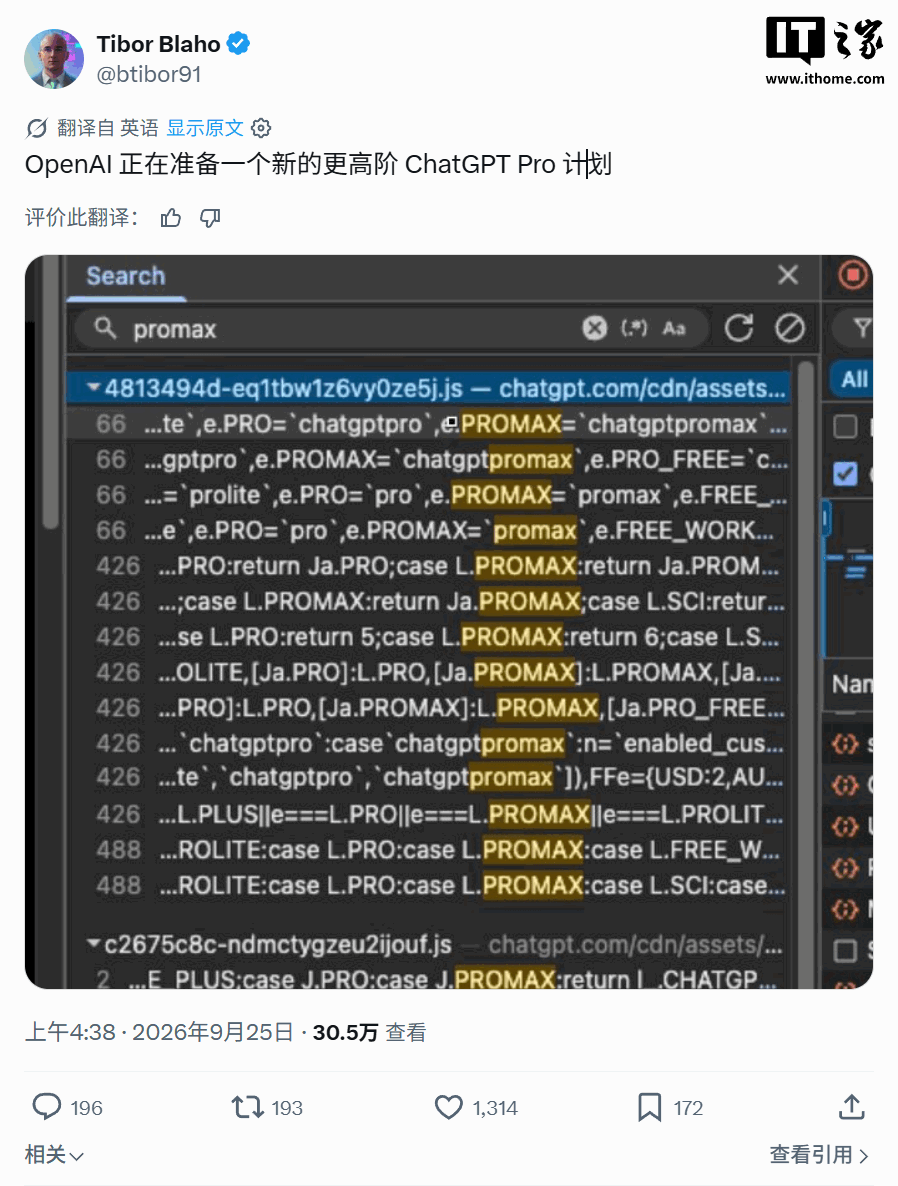
Developer Tibor Blaho found the field in question inside the developer tools of ChatGPT's web client.
He shared the discovery on social media, and it was quickly picked up by industry outlets: OpenAI is preparing a subscription tier more expensive than Pro.
Why is a source code field worth reporting as news? Because it appeared in the client itself — not a fan-made mockup.
No launch event, no announcement page, no official timeline. The only thing that can be confirmed: the word PROMAX surfaced in OpenAI's client. Everything else is speculation.
Where the extra hundred dollars in the $600 figure comes from
$500 is the base price. $600 is the ceiling once a 20% channel markup is stacked on top. Neither figure has been officially acknowledged — the entire gap is that middleman surcharge.
IT Home (ITHome), citing developer Tibor Blaho's assessment, gave a price range of $500–600. 36Kr broke the figures down further: $500 is the product's base monthly fee, while $600 represents a ceiling price after a 20% "channel tax" is stacked on top.
The "channel tax" isn't set by OpenAI itself. Third-party distributors add another layer of revenue-sharing when reselling or processing subscriptions, which pushes up the final price paid by the end user. The leaker has only seen the code field so far, not OpenAI's own official price list — both numbers are still speculation.
Looking horizontally, Claude Max and Google AI Ultra currently sit around $250. If Pro Max is confirmed, it would immediately reset the ceiling for mainstream personal AI subscriptions.
The priciest tier isn't even on shelves, and the $200 tier is already frozen
The most expensive tier isn't even a glimmer — so why was the middle one shut down first?
On September 10, OpenAI suspended new sign-ups and upgrades to the $200 Pro tier. The reason was stated plainly: GPT-6 Astra (the pool of computing resources that keeps AI systems running) overwhelmed the compute cluster, and seats needed to be freed up for existing users.
The official help center language is firm: during the suspension, upgrades from Free, Go, Plus, or the $100 Pro are all blocked — only those already on the plan are protected. No timeline for resumption was given.
At $200, the tier is underwater relative to the true cost of (the process of having an AI model compute and produce an answer from a given input) — OpenAI's own framing is that this tier places the heaviest load on its systems. The $200 price means the platform is subsidizing heavy users, and when it can't sustain that, it shuts the gate.
OpenAI faces two paths: either push the $200 tier back up to a cost-covering price, or carve out — as it appears to be doing now — a premium tier that justifies its cost. This is interpretation, not official language. The lone selling point attributed to the Pro Max rumor — "the fastest Work and Codex" — means assigning compute priority by willingness to pay. That 2.5× price gap isn't buying more quota; it's buying a way to push others behind you in line.
That is, if Pro Max actually lands as rumored. First Pro gets choked, then Pro Max gets a price hike — this isn't an upgrade, it's a budget-based triage.
What it's changing isn't the model — it's the queuing rules
Higher bidders get to run inference first. For anyone burning GPU hours all day, that means the queue stops being a queue and starts being a price.
The earlier suspension turned the $200 tier into a closed game. With a $500–600 Pro Max now rumored on top of that, the underlying logic boils down to one sentence: on the same pool of GPUs, whoever pays more runs first.
This runs in a different direction from the existing price ladder. Upgrading from the $100 tier to the $200 tier gets you 5–20× more call volume — you're still buying usage. From $200 to $500–600, you're buying something else: Work and Codex-style tasks can run continuously for hours, and every reduction in latency maps directly to time cost. In a heavy productivity user's ledger, time is profit, and "speed" becomes a service that can be priced.
There are three signals worth watching.
First: whether OpenAI posts a Pro Max page on its official help center or on Twitter (X).
Second: whether the $200 tier suspension is lifted — the pace of that resumption is itself an indicator of compute recovery.
Third: whether the next-generation model (rumored under the codename Bel, not yet officially confirmed) launches tied to Pro Max, or continues through the $200 tier.
If two of those three stay quiet, Pro Max remains nothing more than a line in the source code.
Pro Max has no entry point — here's how to check it yourself
You can't sign up for Pro Max, and OpenAI hasn't announced it. But you can check the help page and the source code — today.
Pro Max has no clickable entry point. In IT Home's original report, OpenAI's response was blank — "not yet officially announced," "the product name, features, and final pricing remain highly uncertain."
The only selling point circulating is a single line: the fastest Work and Codex capabilities. What they share is heavy lifting — tasks that often run continuously for hours.
Once Pro Max launches, the real difference will most likely be queuing priority rather than quota: pay more, and your task jumps to the front of the compute line. Note that this is interpretation based on leaks — not language OpenAI has put in any documentation.
Another distinction worth digesting early: the $200 Pro tier has already hit the brakes as a "quota" tier; if Pro Max exists, it would be a "speed" tier. The two solve different problems.
If you're stuck outside the $200 tier waiting for it to reopen, Pro Max's arrival won't automatically free you — it's most likely a standalone new tier, not the key that unlocks $200. OpenAI's help center currently lists only Pro $100 and Pro $200, with no Pro Max field anywhere.
Two ways to verify. First: watch the "About ChatGPT Pro tiers" page on help.openai.com (the page updates frequently — the original was marked "3 days ago") for any new tier descriptions. Second: watch ChatGPT's web frontend code itself — that's how Tibor Blaho originally dug it out. But that can only confirm whether the string is still there, not when it will launch or what it will cost.
And be clear on one thing: if you're not currently a heavy Work or Codex user, waiting makes no difference. For most readers, this tier is worth watching, not chasing.
Open help.openai.com, search for the Pro tiers page, and note that it currently lists only $100 and $200 as your baseline for future comparison.
To replicate Tibor Blaho's move, open chatgpt.com, press F12 to open developer tools, and search for the PROMAX field to see if the string is still there — it can only tell you "whether," not "when."
Follow OpenAI's official accounts and help.openai.com updates — any Pro Max announcement will appear there first.
Decide whether you're a heavy Work or Codex user — the kind whose tasks often run continuously for over an hour. If not, the new tier is irrelevant to you.
Treat the resumption of new sign-ups to the $200 Pro tier as a separate signal to watch — whether and when it returns will shape Pro Max's real positioning.
Sources: IT Home (RSS), citing developer Tibor Blaho's discovery in ChatGPT's web source code; as of publication, OpenAI has not officially confirmed "Pro Max." The price range is the leaker's speculation, and the $600 figure includes a 20% "channel tax."