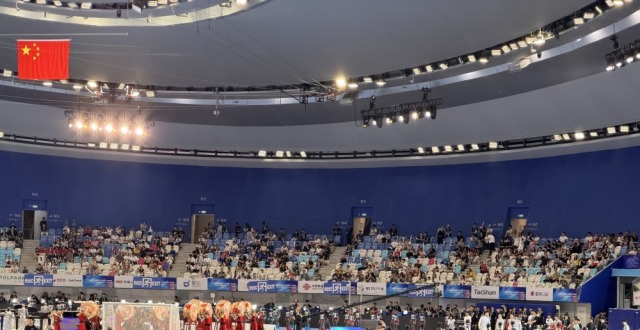
On the evening of August 22, 2,056 humanoid robots walked into the National Speed Skating Oval—"Ice Ribbon"—for the opening of the 2nd World Humanoid Robot Games. In the 100-meter sprint, the Tianzhuo team shattered last year's record of 21.50 seconds with a 9.39-second run, outpacing even Usain Bolt's human limit. But the real story this year is that the remote controls are gone: robots must now see, run, and stop on their own. That's where the difference lies.
Remote Controls Gone: 2,056 Robots Race Side by Side
On the evening of August 22, the 2nd World Humanoid Robot Games kicked off at the National Speed Skating Oval—"Ice Ribbon." 666 teams from 16 countries, fielding 2,056 robots, would compete across 51 events over five days. Team count rose 138% from the previous edition, with the number of robots quadrupling.
Behind these numbers lies the starting line of industrial supply. 666 teams and 2,056 robots competing simultaneously means that upstream—from joint modules and complete machine solutions to foundation models大模型(general-purpose AI brains that let robots understand their environment and make decisions)—can now mass-produce competition-ready units. A year ago, the best 100-meter time on this track was 21.50 seconds; this year, the Tianzhuo team pushed it to 9.39 seconds, surpassing Bolt's human record of 9.58. Standing high jump leaped from 95.64 cm to 2.8843 meters, with Beijing's Tiangong Ultra also clearing the human line.
The format changed: multiple events dropped manual remote control and ran fully autonomously, directly testing the robot's ability to perceive the environment and make independent decisions. The opening ceremony itself was a collective self-check—80 Accelerated Evolution T2 robots autonomously rearranged formations to assemble the games' emblem, 50 Tiangong Embodied Intelligence 3.0 robots navigated curves on their own, 25 Galbot G1 from Galaxy General entered home, retail, and catering scenarios for long-horizon tasks, and the Tiangong that sat upright on a robotic horse to draw a bow and light the "Smart Core" wasn't handed its bow by anyone either. 36 Linkerbot robots with dexterous five-finger hands performed "Future Movement" alongside human artists; robots rallied with Zheng Jie, played table tennis with Ding Ning, and took on Yang Chen in shooting—all 21 scenario-based events pulled nine major sectors including home, hospitality, and logistics into the exam hall. With remote controls gone, only one test of embodied intelligence remains: autonomous operation in the real world.
After the Remote Controls Were Removed, What Robots Must Do for Themselves
Behind the 9.39-second 100-meter sprint and 2.88-meter standing high jump, the real change is this: the robot's brain has been pushed to the front line for the first time, and actions previously backed up in real time by a human pressing a remote must now be completed autonomously.
Over the past year, the biggest difference for humanoid robots on the competition field hasn't been joints or speed—it's been the rules. As People's Daily reported: "This edition of the games has achieved a comprehensive upgrade, with multiple competitive events eliminating manual remote control and running fully autonomously throughout, truly testing the comprehensive capabilities of humanoid robot foundation models in perceiving the environment and making independent decisions."
After the referee's whistle, the robot has no "second life"—no one watching a screen in the background, propping up its posture, correcting its direction. Fully autonomous operation (the robot sees, judges, and acts on its own, with no human remote backup throughout).
To achieve this, the robot must take over an entire chain previously handled by humans: continuously sensing the environment through visual, force, and other sensors (the robot's "eyes/skin," converting external information into digital signals); using a decision model to choose the next action within a few hundred milliseconds; then feeding instructions into joint modules (core motion units like the robot's "knees/hips") for execution. In an interview, Ye Qian broke this year's changes into two tracks: hardware capability (efficiency, speed, robustness (the ability to keep running stably despite bumps and errors)) and model iteration advancing simultaneously—the former is hardware that runs steady without falling, the latter is a brain that truly figures out which leg to step next.
Once this chain works, the leap in scores follows as a knock-on effect. The best 100-meter time at the first games was 21.50 seconds; the preliminary round this edition clocked 9.39 seconds. Standing high jump stretched from 0.956 meters to 2.88 meters. The numbers are surface-level; the underlying cause is the continuous alignment of joint modules, algorithms, and hardware.
Events like running and high jump that "look like sports meets" happen to serve as concentrated testing grounds for fundamental performance. The moment explosive power is unleashed, joint module output, whole-body control algorithms, and real-time hardware response are stress-tested simultaneously. As Ye Qian put it directly, the speed numbers on the field "are actually a concentrated test of the robot's fundamental performance."
At the same time, the shape of competition is shifting from "can it perform one action" to "can it run an entire task from start to finish." At the opening ceremony, 80 T2 robots autonomously completed formation changes to assemble the emblem, 50 Tiangong Embodied Intelligence 3.0 robots navigated curves on their own, and 25 Galbot G1 completed fully autonomous long-horizon tasks in home, retail, and catering scenarios. This edition's 21 scenario-based events span nine major sectors including home, hospitality, and logistics—single-action results are ceding ground to whether perception, decision-making, locomotion, and manipulation can work together as a whole.
Removing Remote Controls: A Harder Test Than Breaking 10 Seconds
The elimination of manual remote control is the real threshold of this edition's games: out on the track, no one is pressing the accelerator for the robot anymore.
Record-breaking numbers grab the most attention, but the rule change more worth noting is that multiple competitive events eliminated manual remote control and run fully autonomously. The robot is no longer controlled by a person in the background pressing buttons to manage weight shifts, arm swing rhythm, or takeoff timing—it has to see the starting line, hear the starting pistol, and decide which leg to step on its own.
At last year's inaugural event, behind the 21.50-second 100-meter time, a significant portion of the movements relied on human intervention—the robot's "running" was closer to a remote-controlled electric toy. This year's track requires foundation models to complete perception-decision-execution in milliseconds, letting the robot independently judge "how to run" with its own brain—rather than waiting for foundation models (AI brains that can understand the environment and make judgments) to issue commands.
Why is this shift more critical than the speed gain? Ye Qian said it directly: this year's changes are one, hardware; two, models—and some movements that previously had high failure rates are now smoother. Speeding things up depends on hardware iteration; removing the remote depends on models moving from single-action control to comprehensive environmental understanding. These are two different dimensions.
A more intuitive contrast comes from the scenario-based events. This edition's 21 scenario events span nine major sectors including home, hospitality, and logistics. Once robots enter these scenarios, their movements actually slow down compared to the 100-meter track. The 100m only tests locomotion; entering a home means facing "a chain of tasks": first identify where objects are, then decide which one to reach for, while also avoiding obstacles and handling surprises. Between single-event records and comprehensive capability lies what Ye Qian calls "comprehensive ability"—combining multiple basic movements to reliably deliver a specific function.
The segments where robots rallied with Zheng Jie, Ding Ning, and Yang Chen at the opening ceremony get mentioned repeatedly for exactly this reason: in the moment of exchanging shots with a human athlete, the robot must judge ball trajectory, adjust paddle angle, and generate return power in milliseconds—that's a live demonstration of comprehensive capability. With the remote gone, the robot has to play the whole match on its own.
The Robot Fired. Now Comes the Wait.
A robot on a robotic horse drew a bow in Beijing's Ice Ribbon, and its beam joined three others to ignite the cauldron. The relay hooked robot demonstrations to industry settings. The scores that matter won't come until the games close on August 26.
The climax of the opening ceremony was a beam of light. The flame was lit in Milan, Italy; fingertips picked tea leaves in Fujian's tea mountains; dragon boat crews paddled in Sichuan; horseback archery ran through Xinjiang. After the four-station relay, the beam returned to the Ice Ribbon, where a robot sat upright on a robotic horse, drew a bow, and fired. The beams converged to ignite the "Smart Core" installation.
"Smart Core" symbolizes "intelligence, innovation, and symbiosis"—the 2nd Humanoid Robot Games' own sacred flame. The four-station relay doubled as a global roadshow, hooking robot capabilities to specific industry scenarios.
Milan's leg took place at a Winter Olympics venue, focused on "real-scene challenges." The other three legs embedded robots in China's geographic signatures—tea mountains, dragon boats, and mounted archery. Fujian's fingertip picking maps to the dexterous-hand and fine-control supply chain; Sichuan's dragon boat paddling maps to multi-robot coordination and water-surface adaptation; Xinjiang's horseback archery targets dynamic balance and object tracking. That tie-in turned the spectacle into a product launch.
Specific products are already on-site. At the opening ceremony, 50 Tiangong Embodied Intelligence 3.0 robots autonomously navigated curves; 25 Galaxy General Galbot G1 wheeled robots demonstrated fully autonomous tasks in home, retail, and catering scenarios; and a dexterous-hand world model achieved globally-first autonomous pen-spinning and other generalized in-hand dexterous manipulation.
The organizing committee's numbers also emphasize scale: 666 teams from 16 countries across six continents, 2,056 robots, and 51 events overall. Robot count quadrupled. Twenty-one scenario-based events cover nine major sectors, including home, hospitality, and logistics. "A thousand robots in sync" is itself a full-dimensional stress test of swarm control and collaborative perception technologies.
The roadshow's payoff will come from the scoreboard and scenario-event data at the close of the games on August 26. Two signals matter. First, after eliminating manual remote control, whether robots' results in purely competitive events like the 100m and high jump are stable—if 9.39 seconds and 2.8843 meters can be reproduced multiple times, the hardware-algorithm chain holds. Second, in the 21 scenario events, the success rate and speed of robots completing home, hospitality, and logistics tasks determine how far the gap is between "track records" and "actually usable." Ye Qian of First Cheng Holdings judges that service robot products could enter homes in batches in the next two to three years, provided foundational capabilities are first packaged into specific functions after two to three generations of hardware iteration.
Following This Edition, Watch These Four Specific Things
The games don't end until August 26, and most exciting results aren't out yet. What readers can do now is keep an eye on a few official milestones and understand one key distinction.
The 9.39-second 100m is a preliminary result from the opening ceremony, not the final. The source doesn't give ordinary readers a way to verify on-site. Sprint results can be broken at any moment; the best move is to wait for the official results on closing day and put them side by side with last year's 21.50 seconds—the gap itself is an echo of the industry's investment this year.
Don't get carried away by "breaking Bolt's 9.58 seconds." That 9.58 was Bolt's 2009 Berlin World Championships human极限, backed by 27 years of professional training and top-tier biomechanics; the Tianzhuo team's 9.39 is a constant-speed straight-line sprint, against air. Placing those two numbers side by side is promotional rhetoric, not scientific comparison. What carries real information is the running form details—center-of-mass oscillation, acceleration curve, foot-strike posture—those reflect whether hardware iteration is real.
What deserves the most attention is the scenario-based events. The 21 scenario events cover nine major sectors including home, hospitality, and logistics—they're where "remote controls are removed" really gets tested this edition. The source gives a clear statement: "multiple competitive events eliminated manual remote control and run fully autonomously"—but doesn't name specifically which ones. When watching official releases, focus on two numbers: autonomous completion rate, and single-task success rate. The former measures whether the robot can work independently; the latter measures whether it can work successfully.
As for buying one to take home, don't rush. The most grounded line in the source is: "after two or three product generations, the product will gradually stabilize." Current robots are still in a period of rapid hardware iteration; consumer products need at least another two to three years of waiting. The best move is to treat this window as an observation period, watching three directions: packaging progress in B-end industrial scenarios, the first batch of functional lists in C-end home scenarios, and model iteration speed—these three things determine the mass-production timeline.
Check the official 100m and high jump final results, compare with the opening ceremony preliminary data, and look at stability rather than peak numbers.
Find the official list of events that have clearly removed remote control, and track two metrics: autonomous completion rate and single-task success rate.
Pay attention to completion details in life-scenario events within the 21 scenario events—home, hospitality, logistics—rather than speed-event numbers.
Compare the progress gap between B-end industrial scenarios (e.g., logistics) and C-end life scenarios (e.g., home, hospitality) to understand different companies' path choices.
Source: Lightning News (People's Daily Beijing Channel). The original centers on the games' opening, covering scale, results, rules, and human-robot interactions. The 9.39-second 100m and 2.8843m high jump are preliminary/display results; scenario event counts reflect the organizing committee's published figures.