On August 27, Anthropic, together with HHMI Janelia, released MHS — an interface specification that lets AI agents uniformly control hardware like microscopes and robotic arms. Its goal is to compress device integration time from weeks down to hours or even minutes. For now, only invited research and manufacturing partners have access; there's no sign of an open-source release yet.
From weeks to hours: who got first access to MHS?
Getting lab instruments connected and calibrated used to take weeks or even months; MHS compresses this to hours or minutes. The era of custom interfaces for each device is over.
Anthropic co-developed MHS with HHMI Janelia Research Campus (a neuroscience research center under the Howard Hughes Medical Institute, specializing in advanced imaging and instrument automation) — originally to let AI operate real hardware in the lab.
MHS introduces a standardized driver (the software layer that lets computers command hardware) using minimal primitives like read and write (the lowest-level, indivisible commands, like “read temperature”) to talk to AI uniformly. Any device with a programmable interface can connect; it's model-agnostic, and agents (AI programs that can autonomously plan and execute multi-step operations) can connect via MCP (Model Context Protocol, an open standard for AI to call external tools and data sources), command line, or API (interfaces for software to call each other) — three options.
A protocol is only the first step: some new products will ship with MHS pre-installed, others will be retrofitted upgrades. This path determines whether MHS can truly scale — or stays stuck at the demo stage.
Partners include Genentech and Danaher in biology, Universal Robots, Doosan Robotics, and Hugging Face in robotics, QuEra and Carnegie Mellon University in quantum computing, with cloud and compute backed by AWS.
One driver, and AI gets the manual on first meet
MHS uses a unified driver so any agent can operate any instrument out of the box — the key is writing natural-language labels inside the driver.
How does AI know what a device can do? Each device installs an MHS driver (a small piece of software on the device that translates computer commands to hardware), containing a set of natural-language labels: what it can measure, what it can adjust, where the safety boundaries are. This information used to be scattered across paper manuals, operators' heads, and someone's local folder; now it's written in natural language (everyday speech and writing) directly inside the driver. Too lazy to type it out? Chat with an agent and let it ask item by item.
Once labels are written, the driver outputs a reference file on its own: a clear list of the instrument's capabilities, restricted zones, and hard constraints. When an agent gets this file, it's like getting a complete manual on first meeting. Take the weight of a robotic arm as an example — code can't read it, but safe operation absolutely needs to know it.
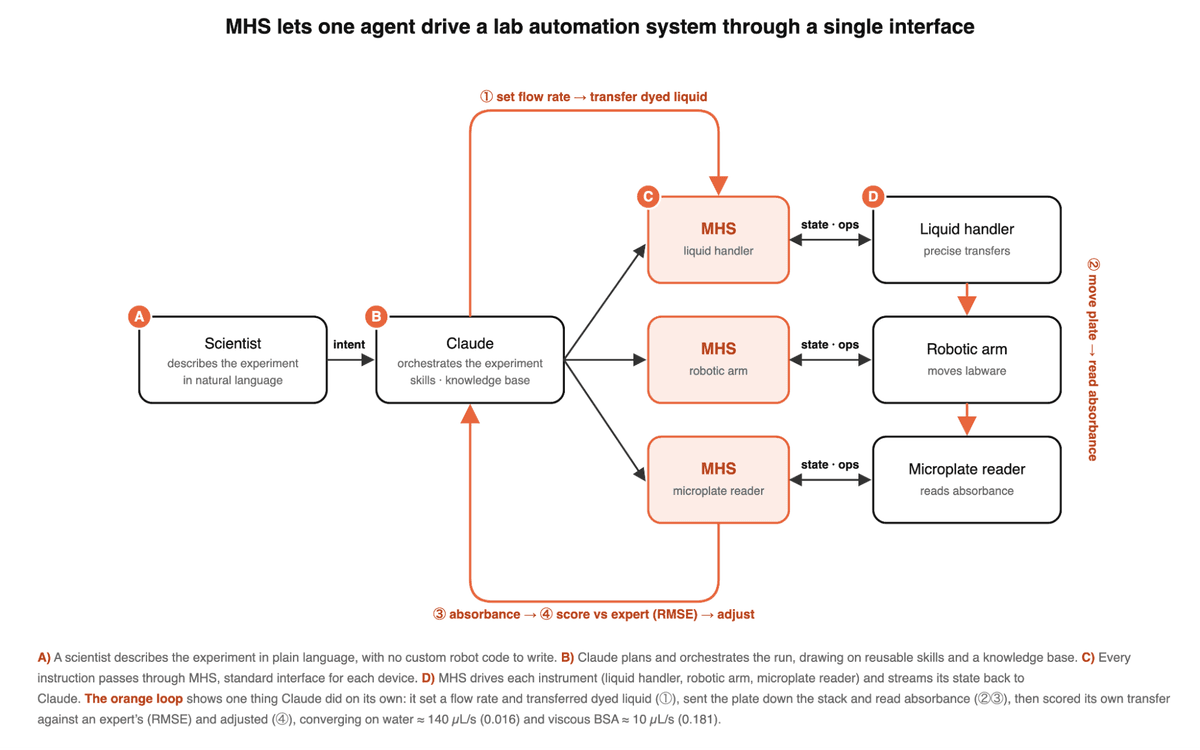
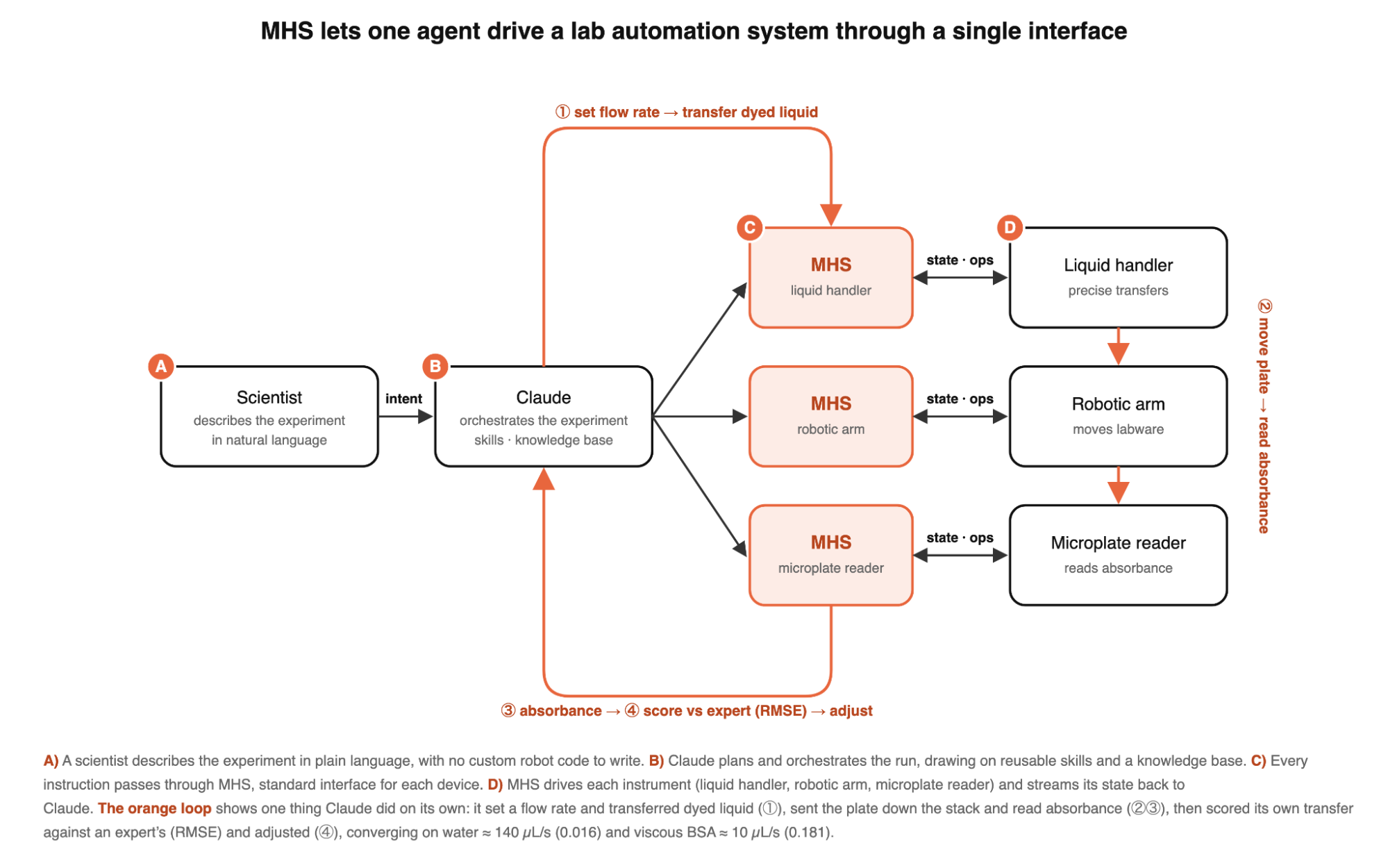
How are commands issued? MHS compresses all operations into two primitive instructions: read ("read temperature") and write ("set temperature"). Any hardware with a programmable interface can map to this layer. Devices announce themselves in a standard format and discover each other on the network — no more middleman writing translation programs.
How are multiple devices orchestrated? MHS leaves three channels open: MCP (Model Context Protocol, Anthropic's own agent communication protocol), command line, and API (standard interfaces for software to call each other). All three work together — one line of code can run multiple devices in parallel.
Claude packages the exploration process into a deterministic script (a fixed workflow where every step's outcome is predictable). It strings driver commands into code files and stores them, letting devices run automatically according to the script. In Anthropic's tests, they observed: Claude first adjusts the laser, then uses a camera to check the spot position, iteratively fine-tuning until alignment, then packages it. Next time, one command reproduces the whole sequence.
AI takes over the bench, and the order is reversed
MHS lets AI first explore like a human, then freeze the exploration results into code — AI sits in the learning layer, not the execution layer.
In an internal laser-alignment test at Anthropic, Claude didn't get an operations manual. It took a photo, checked whether the spot was off, made an adjustment, took another photo, looped over and over — almost exactly what a researcher would do on first encounter with this instrument.
Anthropic stated it plainly in the blog post: Claude "interacts with experiments and hardware in an exploratory manner, much as a scientist would."
After exploration, Claude packages the steps into a deterministic script (code that produces identical results every run, not relying on real-time AI inference). From then on, aligning the laser takes one command, no need for the model to reason through every step. Anthropic explains that when an agent runs time-consuming tasks or operates devices faster than online inference speed, multiple driver commands can be chained in a code file — letting the device run on its own, with the model absent for every step.
AI's point of intervention is the learning layer: its job isn't to run experiments for the lab, but to compile the experiments themselves into replayable code.
Genentech's BCA protein assay workflow already runs on this path: liquid handler, robotic arm, and plate reader collaborating. The "weeks" of hardware integration were eliminated — essentially, the translation layer between humans and instruments is replaced by AI doing the exploration on-site, compressing integration from weeks to hours.
How stable this "explore first, then freeze" pattern runs in production still lacks third-party verification. Anthropic defines it as a research preview, open to invited research and manufacturing partners; no open-source release has been announced.
Three unexploded mines: open-source timeline, safety audit, MCP boundary
MHS is still in research preview (an early stage where it's not officially released, only tested with a small audience), with no open-source date. Don't treat it as a formal standard until these three mines are defused.
Before going open source, it has to pass the safety check. The spec's "natural-language device parameters + auto-generated reference files from labels" currently relies mainly on manual entry or chatting with an agent — it hasn't gone through large-scale audits. If a laser's safety limit is off by an order of magnitude, the consequence is a physical accident, not an output hallucination.
Another mine is the relationship between MHS and the Model Context Protocol (MCP) (a universal protocol letting AI tools call each other).
MHS treats MCP as one of three control mechanisms, and Anthropic is extending it from "AI calling software" to "AI operating hardware." Whether the two standards fit together, who maintains them, and how third-party agent frameworks adapt — the primary sources don't elaborate.
Three checkpoints are enough to watch.
First, see if an open-source timeline is announced, with independent reference implementations and test suites — if yes, it's moving from "Anthropic-led" to "community-maintained"; if not, it remains a single point of risk.
Second, see if mainstream instrument vendors like Thermo Fisher, Beckman, and Keysight list MHS as a natively supported interface on their product pages — that's the watershed from "usable" to "installed by default."
Third, see if third-party models not fine-tuned for MHS can complete initial device onboarding using only plain-text instructions; if it works, MHS is truly model-agnostic and usable beyond Anthropic.
For now, application only — regular users watch two things
MHS has no public download, no self-service onboarding — the only channel is a form application. Regular users can only do two things right now.
The preview targets only research labs and advanced manufacturing partners; the open-source version is still on the way — the most honest move right now is to wait, not to install.
Only the organizations on the list can verify directly. The early access roster, including Genentech, Carnegie Mellon University, QuEra, Universal Robots, Amazon Web Services, Doosan Robotics, Danaher, and Hugging Face. What these organizations are currently doing is integrating their own equipment to MHS specifications, and Anthropic is working with device makers on two things: pre-installing MHS on new devices, and retrofitting existing ones.
MHS is not Anthropic's proprietary protocol — it's model-agnostic, with no model restrictions. Any agent can connect via standard protocols, including Anthropic's own heavily promoted Model Context Protocol (MCP) (a universal communication protocol letting AI call external tools). Open-source models on Hugging Face, other large language models on AWS — theoretically all could talk to the same microscope or robotic arm in the future. This property determines its value, and also why the open-source version matters.
Whether it works is currently only described by Anthropic unilaterally. The "weeks compressed to hours," laser alignment, and agent autonomous hardware-error-recovery figures and examples in the primary source all come from the vendor's internal tests and early partner feedback, with no third-party verification. Until independent benchmarks are published, treat it as a directional promise, not a scorecard.
Visit the bottom of Anthropic's official announcement page, submit a research preview application via the form, noting your lab or factory's equipment type.
On Genentech, QuEra, Universal Robots, and Hugging Face's official websites and GitHub pages, subscribe to MHS integration updates, watching for when they publish onboarding data and benchmarks.
Confirm whether your equipment has a "programmable interface" — this is MHS's hard threshold; only code-controllable instruments are covered.
Follow the Model Context Protocol's official repository; MHS's device control layer depends on MCP, so getting familiar with MCP first is more realistic than rushing to use MHS.
Watch two things: the open-source release timeline, and independent third-party verification results for the "hours to integrate" claim.
Source: Anthropic Newsroom official release, dated 2026-08-27. Disclosure: MHS is still in research preview, open only to invited research and manufacturing partners; the Genentech section was written by the Genentech team and reposted by Anthropic; performance and efficiency data come from Anthropic's own statements and partner case studies, with no independent third-party verification.