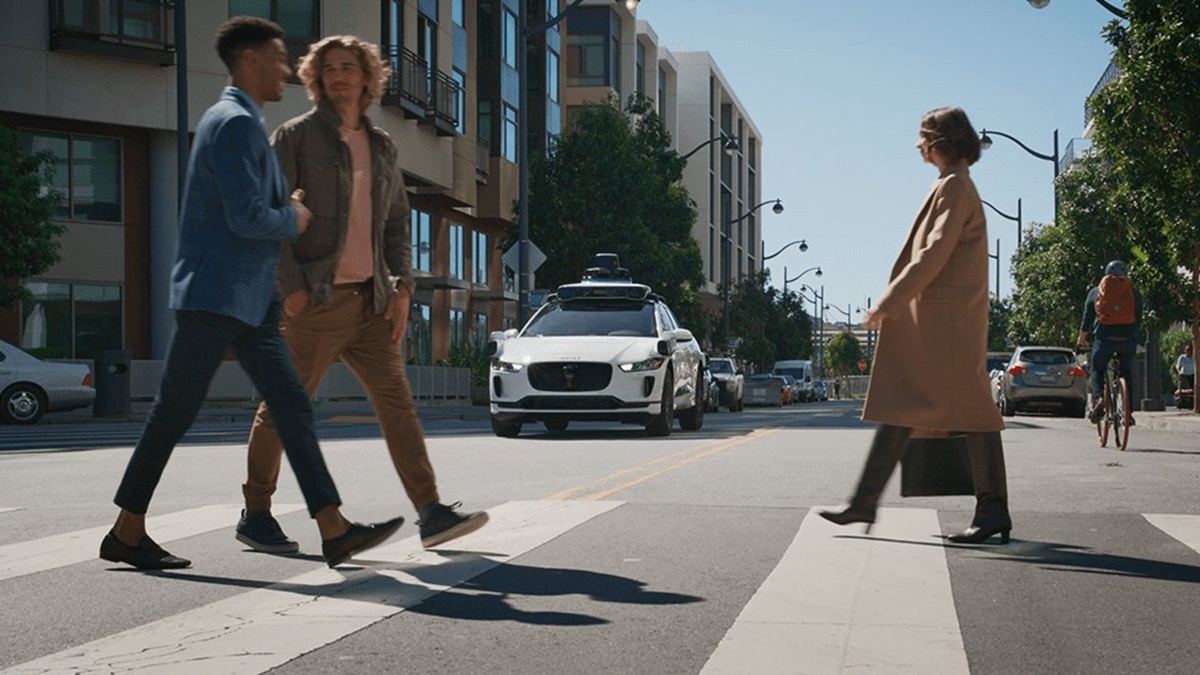
Waymo has chosen the Madrid region as its first European stop, announcing the move officially on October 20. The earliest passengers won't board until 2027. In the days ahead, electric Jaguar I-PACE vehicles will take to the streets with human drivers behind the wheel—collecting data only, not carrying riders. Waymo is banking its 400 million kilometers of fully driverless mileage as its calling card, but whether the EU and Spanish regulators sign off is the real variable that will determine if 2027 actually happens.
Three Steps Before Madrid Ever Sees a Riderless Car
Waymo's electric Jaguar I-PACEs will start appearing on Madrid streets in the next few days, rooftop sensors logging data. The rollout runs in three steps: manual driving first, then locally trained autonomous-driving specialists take the driver's seat for technical validation, and only then does Waymo Driver learn the area's traffic patterns and road conditions.
Waymo co-CEO Tekedra Mawakana put it plainly: Madrid is a city of innovation and a non-negotiable piece of their global footprint—zero emissions and broader accessibility align with local goals.
The company has already completed 20 million trips, and it says it is in talks with national, regional, and municipal governments, is proactively briefing emergency services, and is investing in a local operations team.
Madrid Has Three Gatekeepers. Waymo Hasn't Said When It Clears Them.
Waymo is moving its U.S. playbook to Madrid. The difference isn't the method. It's who signs off.
In the U.S., supervised autonomous driving (a human sits in the driver's seat monitoring the system, but the car drives itself) gets approved state by state. In Madrid, the same operation has to clear Spain's national, regional, and local governments, all inside the EU's regulatory framework.
Waymo says it is already in talks with all three tiers and is walking emergency services through the technology before anything hits the road. The Madrid region's zero-emission commitment shows up in both sides' official statements—the all-electric Jaguar I-PACE is the hook.
What Waymo won't say is when any of it happens. There is no public timeline for the middle stages. The only date on the record is 2027 for first riders.
The safety case is being made by others. Ignacio Lijarcio, president of Spain's road-safety foundation FESVIAL, said technology only fulfills its true purpose when it serves people. Mar Cogollos, director of Spain's spinal-cord-injury research association AESLEME, put it more directly: over 90% of road crashes stem from human error, and autonomous driving's job is to systematically eliminate the usual culprits—distraction, fatigue, drunk driving, and speeding.
Three things stay blank: fleet size, the local operations partner in Madrid, and how fares will be set. Until they're filled in, the open question is whether Waymo's oft-cited U.S. data still holds up after crossing the Atlantic.
400 Million Kilometers Is a U.S. Report Card—Madrid Still Has to Retake the Test
Waymo is leading its Madrid announcement with "20x safer" and 400 million cumulative kilometers of fully driverless driving. That 95% lower serious-injury-or-worse crash rate is real—and it was earned somewhere else.
Those last few words pin down the boundary of the sample: it's U.S. operating environments. The tight alleys, steep hills, and dense motorcycle traffic typical of Southern European roads are not included. Waymo's announcement offers no Madrid-specific benchmark and no commitment to publish a European comparison anytime soon. The numbers haven't changed; the applicable scope has.
Then there's the mileage itself. The 400 million kilometers refer to fully driverless distance—not supervised driving with a safety operator, and not equivalent to real passenger kilometers. A different figure in the same announcement: 20 million+ cumulative passenger trips, with weekly commercial rides in the "hundreds of thousands."
Distance and trips are not the same thing. Mixing them inflates the apparent depth of commercialization.
Hundreds of thousands of rides per week sounds substantial, but spread across the four open cities—San Francisco, Phoenix, Los Angeles, and Austin—the announcement provides no per-city breakdown, so the real per-city, per-day passenger density remains unclear.
Tokyo Already Ran This Playbook. Madrid Is the Harder Test.
Waymo has run this exact script before—in Tokyo. Madrid is the first time it tries the same playbook inside continental Europe's regulatory system.
Over the past 12 months, the company paired with a local partner in Tokyo, collected data manually first, then shifted to supervised autonomous driving. Madrid has to replicate that full timeline—from "data collection" to "removing the safety driver"—not just the launch itself. Tokyo proved the process can leave the U.S.; Madrid has to prove it can enter a different regulatory system.
The 400 million fully driverless kilometers Waymo has already racked up in the U.S. earn it no transfer credit in Europe. The EU currently has no continent-wide approval for autonomous-driving systems, and nothing resembling California's CPUC state-by-state licensing framework.
Waymo says in the announcement it is "actively engaging with national, regional, and local authorities." That's not a single template.
What to watch over the next 12 months:
One: Whether the EU grants Waymo Driver a reusable, continent-wide approval. Today's arrangement is a two-layer deal—"Spanish national + Madrid regional." If Brussels only offers the old "each member state approves individually" rule, European expansion gets throttled to a renegotiate-every-border pace.
Two: Whether the Madrid region limits where the first operations can run. The announcement only says "electric Jaguar I-PACEs will soon be on the road," with no specific routes. The approved routes are the earliest signal of whether 2027 passenger service is realistic.
Three: Whether Waymo will line up a European joint-venture partner to handle data compliance and vehicle maintenance. It paired with a local operator in Japan. Whether GDPR demands a similar "local JV" arrangement—and whether Waymo has one in the works—is a question the company hasn't answered.
What Can You Actually Do Right Now?
Not much—and that's the honest answer. The email list is the only channel Waymo has opened to the public in Spain.
Head to waymo.com/waymo-in-spain and register an email for updates. That's all it is—a subscription to Waymo's official Spain progress feed. Which phase opens next, which users get early access—everything will funnel through that entry point.
Then there's the spotting. Waymo's electric Jaguar I-PACE (Jaguar's now-discontinued all-electric SUV, typically sporting a distinctive raised sensor array on the roof) will start showing up on Madrid-region streets in the coming days, initially with a human driver collecting data.
The body style won't help you much—plenty of electric Jaguars look alike. The roof is the tell: that sensor housing is Waymo's signature visual marker, and it's the one thing a data-collection car can't hide.
Anyone tracking the legal progress can only watch for official announcements on both fronts. Waymo itself says it's in talks with Spain's national, regional, and local governments, and is familiarizing emergency responders with vehicle operations, but has given no specific timeline. The timeline for EU autonomous-driving regulation(the EU's unified safety-approval and road-permission framework, which determines whether Waymo can deploy in any member state) is unpublished too. First riders have to wait until 2027, and three steps come first.
Go to waymo.com/waymo-in-spain and register your email for official updates.
When you're out in Madrid, look for electric Jaguars with a sensor housing on the roof—and learn to tell the manual-driving phase apart from later stages.
Stash the self-reported "400 million km, 95% reduction in serious-injury crashes" figure for now, and wait for EU autonomous-driving regulators or independent bodies to verify it before taking it at face value.
Follow EU autonomous-driving rules and Spanish regional sign-off news—those are the real variables that determine whether 2027 actually delivers passenger service.
Source: Waymo official blog, "¡Llegamos a Madrid! Waymo is coming to Spain" (2026-10-20). Note on sourcing: All data and timelines in this article come from Waymo's own corporate press release—a first-party company source. Safety comparisons and cumulative mileage are Waymo's own internal statistics, as self-reported in the blog post.