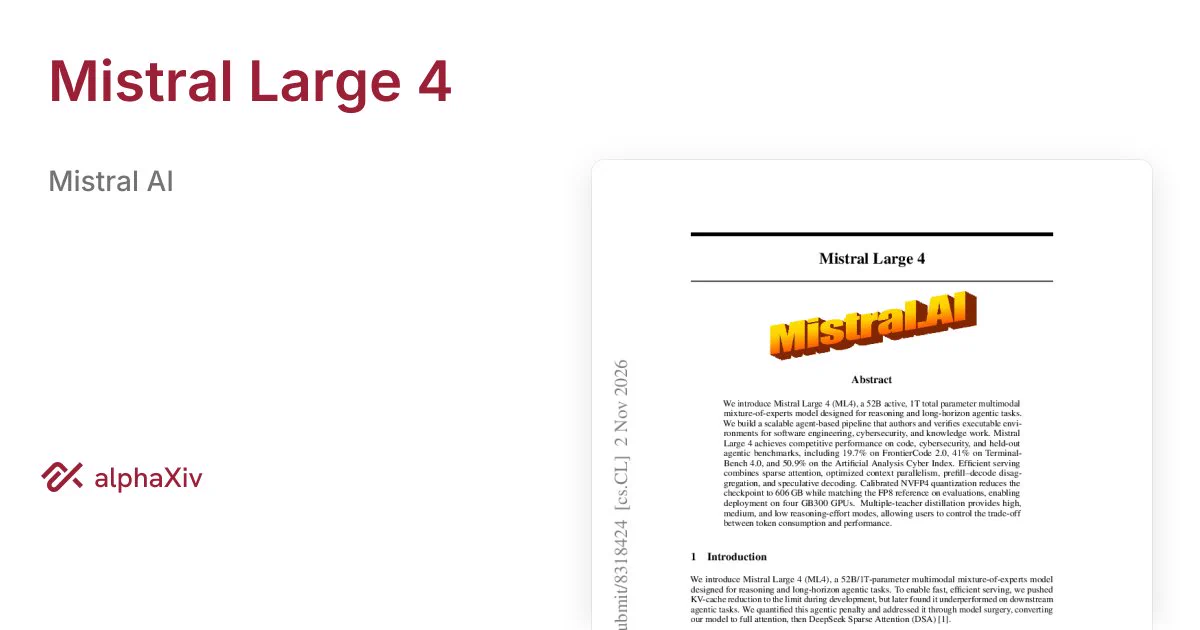
Before developers download the model weights locally and have ML4 manipulate code, make tool calls, and run network security tests, there are two things to distinguish first. Mistral Large 4 was indeed released this time as open weights, and a technical report was published at the same time. However, the officially touted "frontier capabilities" and "more efficient and compact" claims cannot be directly treated as verified conclusions, because there are still no public scores or third-party reproduction tests.
[FIX] Still Chinese: developers, weights, manipulate, calls, release, run [FIX] Still Chinese: developers, weights, manipulate, calls, release, runSo the weights are actually out?
Yes. The model weights sit on Mistral's official account page on Hugging Face, where anyone can pull them down. A technical report ships alongside.
Model weights are the parameter files a trained model carries inside and uses to produce outputs(the set of parameters formed through training). What's out is the file itself — not permission to call the vendor's API.
Pierre Stock said on X that the team would explain how the model was built and release that write-up with the open weights.
What a downloader can conclude: the file is there, and the report exists. What they can't: how it deploys, how it tunes, how it holds up in real work. That takes the model page and hands-on testing.
Are the weights actually out?
Yes. ML4's weights are downloadable from Hugging Face, and the official post links to the page. You don't have to wait for an API.
Mistral calls ML4 an open-weight model. Open weights(model parameter files that developers can obtain and use) mean the parameter files are in your hands, running on your machines or cloud, on your tasks. Pierre Stock put the release in plain terms on X: the weights are out, and the report is out alongside them.
What that buys you is a test you run yourself — output quality, resource use, fit with your existing systems. What it doesn't buy you is a guarantee. Whether ML4 handles your specific task only shows up after deployment.
Mistral's official research page describes the organization as advancing the open AI frontier. Open weights are how that policy shows up in ML4: the parameters go to developers, and the judgment call goes with them.
Focus on code agents and cybersecurity
Mistral team member Pierre Stock stated candidly in the release post: ML4 has "frontier capabilities in code agents & cyber."
Frontier capabilities(model capabilities that reach the current state of the art) means that model capabilities have already begun to touch the current state of the art. Code agents (agents that can autonomously plan and execute coding tasks) are responsible not only for generating code snippets but also for a continuous series of operations in the development process.
Cybersecurity (the ability to discover, assess, and respond to security risks) is also one of the capability areas explicitly named by the officials. The two tasks share a common thread: the model must not only answer questions but also understand context, call tools, and complete multi-step work.
The official research page states that ML4 is state-of-the-art among open-weight models in the fields of cybersecurity, finance, and manufacturing(the highest standard among comparable models). This is Mistral's official position, and as of now there are no third-party reproduction test results. What can be confirmed is that the official lists these as its main areas. Whether it is comprehensively leading in actual deployments cannot be determined from the currently available information alone.
Three weeks after the preview, what did Mistral Large 4 actually change?
Mistral Large 4 is out of preview. The only public comparison with the three-week-old build is one line from Pierre Stock at Mistral AI, posted on X(the social platform formerly called Twitter): "way more efficient and compact."
Efficient, and smaller. That is the whole of the claim. The post names the two builds being compared and the update policy behind them, and stops there.
No numbers. Nothing on which stage of the work the refinement applies to, nothing on how the shipped model measures against the preview it replaces.
So the direction is on the record and the cost is not. Anyone weighing a local deployment has nothing here to weigh it with.
Treat every ML4 claim as unverified until someone outside Mistral runs the tests
Everything out so far is vendor-only: Mistral's official post and excerpts from the model page. They say what ML4 released and what the company says it can do. No third-party benchmark results, no third-party reproduction tests. Developers can already download the weights, read the model page, and start checking for themselves.
"Efficiency" needs a defined metric before it means anything — compute, memory, or inference speed per response; devices or energy per task. The official text names no metric and gives no figures, so one comparison cannot be converted into deployment cost. Parameter count does not settle it either: model pages list total and activated parameters per token, but those specs are not actual hardware load.
For code agents, the question is whether they finish real tasks. For cybersecurity, it is whether the test results hold up in a controlled environment. Neither kind of independent task result is in the sources we have. Vendor benchmark numbers on the model page rest on the vendor's own criteria; they do not replace third-party reproduction testing.
ML4 hands developers open weights, target capabilities, a technical report, and a deployable entry point all at once. Pierre Stock's one-line pitch — "way more efficient and compact" — remains an official claim until someone reproduces it.
Can independent evaluation reproduce ML4's official claims?
Source: Mistral AI's official X account and team member Pierre Stock's release post, as well as the Mistral AI model page and the entry point to the AlphaXiv technical report. The release method and capability direction have been confirmed, but efficiency, compactness, and frontier-level performance await independent reproduction tests.