On August 4th, Tencent Hunyuan unveiled the new generation of its speech recognition model, Hy ASR 3.0 preview. Here are the results upfront: on open-source evaluation sets, the model achieved a 3.34% word error rate (WER) for Mandarin, 2.62% for English, and 3.12% for Cantonese—pushing all three languages below the 3% mark. But the real highlight this time is not the numbers, but the approach it takes: letting a large language model handle the "understanding" part.
Trilingual Word Error Rates All Below 3%, Can Understand Context
First, let's talk about the release itself. Hy ASR 3.0 preview is Tencent Hunyuan's new generation speech recognition model. The official positioning is not about "more accurate transcription," but about evolving from "verbatim transcription and point optimization" to "understanding context, compatible with scenarios, and direct output." Translating this official jargon into plain language: it no longer just converts sound into text, but first understands what you say, then decides how to write it down.
Performance-wise (manufacturer's claim): On open-source evaluation sets, the multilingual word error rate (WER, the number of words incorrectly recognized out of every 100 words, the lower the better) is controlled at around 3%—Mandarin 3.34%, English 2.62%, Cantonese 3.12%. On Tencent's self-built evaluation sets, the error rates for general recognition, dialects, contextual understanding, professional terms, high-noise and whisper scenarios also remain low, with the lowest WER on the comprehensive evaluation set.
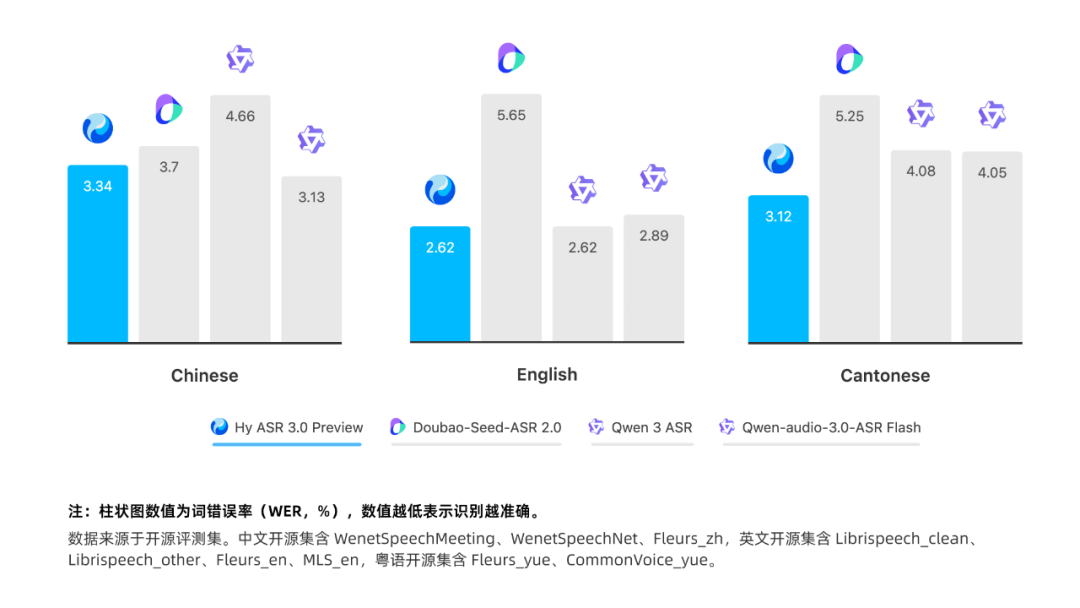
The official comparison chart holds one detail worth noting: on Mandarin alone, Alibaba's Qwen-audio-3.0-ASR Flash (3.13) actually edges it out (3.34), and on English the two tie at 2.62 — the official "leading overall" refers to the combined three-language picture, not first place in every category. That's the kind of nuance to keep in mind when reading vendor benchmarks.
Implementation-wise: The model has been launched on Tencent Cloud to provide API services for scenarios such as intelligent customer service, content understanding, and voice search; Tencent Yuanbao deeply participated in co-research and was the first to integrate it, allowing users to experience dialect recognition, contextual error correction, and complex environment transcription for free by long-pressing to speak; other products such as WorkBuddy are also gradually integrating it.
Incorporating Large Language Models into Speech Recognition Is the Common Path for This Generation
How does it achieve "understanding"? Looking at the architecture, there are three components stacked together.
First component: Large language model foundation. Hy ASR 3.0 leverages the language understanding capabilities of Tencent Hunyuan's latest generation large language model, Hy3. Traditional speech recognition is a "speech model" solo act—sound comes in, and it is matched frame by frame into words; now, there is an additional step of "semantic review": the candidate words identified are passed through the language model for understanding, and the most reasonable one is selected based on the context. If you were talking about network equipment earlier, the subsequent "lùyóu" will be written as "route" instead of "travel."
Second component: MoEMoE architecture(splits the model into many expert modules and activates only the ones needed each time) architecture and a self-developed speech encoder. The company claims that its self-developed unsupervised speech encoder(an encoder that compresses sound waves into representations the model can read), trained on tens of millions of hours of speech data, lays a solid foundation for the "listening" aspect.
Third component: Multi-stage reinforcement learning(training repeatedly with reward and penalty signals so the model improves through trial and error). On top of supervised fine-tuning(targeted re-training of an already trained model), multi-stage reinforcement learning is added to steer the recognition strategy towards "real-world usability."
"Clarity" Has Been Pushed to the Limit, the Real Gap Is in "Understanding"
If you only look at the 3.34% figure, you might not feel much—as word error rates in speech recognition have been declining for years, mainstream products are already in the single digits. So, what is the significance of this release?
It lies in where the remaining 3% of errors occur. For recognizers that do verbatim transcription, the errors often occur in the most critical places: choosing the wrong homophone ("弃权" instead of "期权"), unfamiliar professional terms (brand names, personal names, industry jargon), and collapsing in noisy environments. These errors cannot be reduced by continuing to pile up data in the acoustic model—because they are not "not heard," but "not understood."
So, the direction of this generation has changed: outsourcing language understanding to large models, letting "understanding" cover for "not heard clearly." The four types of capability upgrades listed by the official are all based on this idea—reducing typos and omissions in general recognition, contextual homophone error correction, hot word injection (feeding brand names, personal names, and terms to the model in advance for special attention) to enhance professional term recognition, and special optimization for high-noise and whisper scenarios. Tencent is not the first to do this—integrating LLM into speech recognition is the common path for this round of ASR upgrades.
The focus of competition in speech recognition is shifting from "how accurate the acoustics are" to "how deep the language understanding is." In the era of 3% WER, whoever can eliminate the remaining homophones and professional terms in that 3% will have a discontinuous lead in user experience.
Free Initial Release on Yuanbao: The Battle for AI Entry Points
Looking at Tencent's choice of implementation: Hy ASR 3.0 was first integrated not into some enterprise customer, but into its own Yuanbao App—all features such as dialect recognition, contextual error correction, and complex environment transcription are free to use. This move is worth pondering.
Voice input is the most natural entry point for ordinary people to interact with AI every day: typing requires learning, attention, and staring at the screen, while speaking does not. Whoever's voice input is more accurate and understands you better will gain more user stickiness. Releasing the latest generation of recognition capabilities for free into its own assistant is tantamount to using "understanding" as a customer-acquisition feature.
On the other hand, there is business: the model is simultaneously launched on Tencent Cloud API, targeting paid scenarios such as intelligent customer service, content understanding, and voice search. Free C-end for reputation, paid B-end for profit, walking on two legs. The cold water that needs to be poured here is that the current release is still a preview version, all performance metrics are based on the manufacturer's open-source and self-built evaluation sets, and third-party independent verification has not yet been seen; the claim of "overall leading competitors" also needs to wait for public comparison data to speak.
Who Should Try It Now, Who Should Wait
For you and me, there are two situations:
If you are a heavy voice input user (WeChat voice-to-text, dictating notes): Open Yuanbao, long-press to speak, and try this generation's contextual error correction and dialect recognition for free, and compare it with your current input method.
If you are in customer service, meeting minutes, or voice search product development: Add Tencent Cloud Hy ASR 3.0 API to your selection comparison, and focus on testing your own scenarios—professional terms, noise, dialects, don't just look at public performance metrics.
If you care about data compliance: API means audio is uploaded to the cloud, so before evaluating, first review the service provider's data terms.
If you want to wait for certainty: Currently it is a preview version, waiting for the official version and third-party evaluation to come out before making a decision is also not too late.
The "clarity" competition in speech recognition has reached a close distance, the real gap is in "understanding." Hy ASR 3.0, connected to the Hy3 large model foundation, pushes the competition focus from acoustics to language understanding. Heavy voice input users are worth trying this generation's contextual error correction for free on Yuanbao; for those doing related products, put the API on your selection list and let your own real scenarios do the talking.
The facts in this article come from the Tencent Hunyuan official press release and have been cross-checked with reports from multiple media outlets such as Sohu, Sina Tech, TechWeb, and PChome, with consistent numbers. The WER performance metrics are based on the manufacturer's open-source and self-built evaluation sets and have not yet been independently verified by third parties; please base your experience conclusions on your own scenario tests.