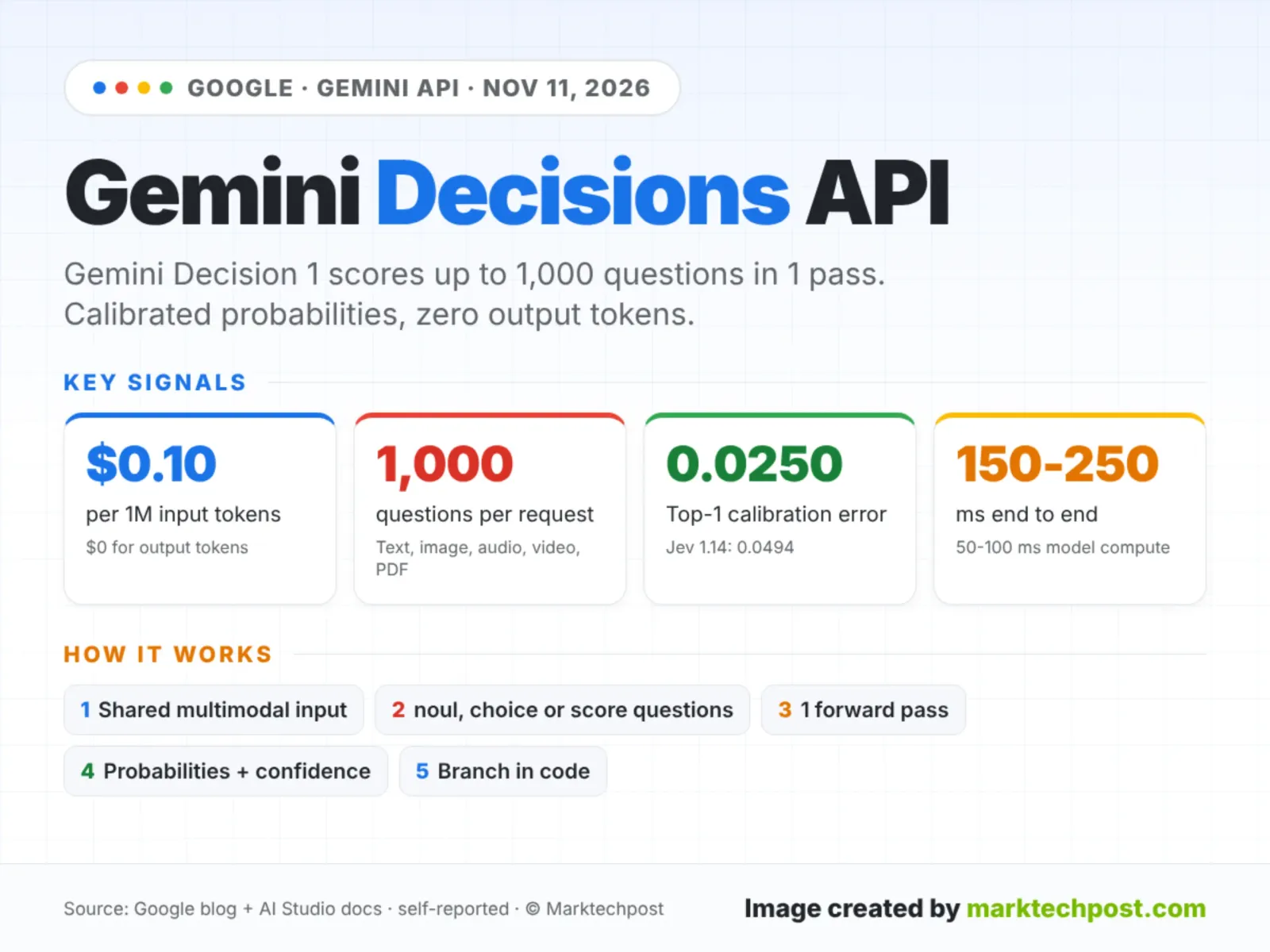
Given a call recording, a photo, or a scanned PDF, a program must decide which tool to use, whether to escalate to a human, and what score to assign. Google’s new Gemini Decisions API does not write answers: a single request can evaluate up to 1,000 closed-ended questions, returning probabilities and confidence scores directly. Judgments extracted from text become numbers that code can read.
Read Five Media Types, Calculate 1,000 Judgments in One Request
Rather than generating a single answer, the Gemini Decisions API assigns a probability to every candidate option in a single request, targeting moments when a system must decide which option to select or whether something complies with a policy.
Google DeepMind launched the Gemini Decisions API on November 11, 2026. Its underlying model, Gemini Decision 1, uses the model identifier gemini-decision-1(the model name available through the Gemini API). It is integrated with the Gemini API and Google AI Studio, with initial use cases including tool selection, policy checks, model routing, and content scoring. Here, “routing”(assigning requests to different models based on the task) does not mean having the model write an answer. Instead, the program uses the returned scores to decide which model or tool to invoke next, or whether to approve the request.
A single request can include text, images, audio, video, and PDFs, sharing an input limit of 256K tokens(the unit used to measure text processed by a model). Resolution can be adjusted for images and video, trading visual detail for lower input costs. A single piece of content can be paired with up to 1,000 independent questions, including yes-or-no questions, multiple-choice questions, and scale ratings. Every candidate result receives a probability and confidence score.
Text, images, audio, video, and PDFs share a single input.
Each candidate receives a probability and confidence score.
Total input is measured in tokens.
The most visible difference from a standard generative API is that it does not generate an answer token by token. Gemini Decision 1 scores every candidate in a single forward pass(one round of computation across the full input), then hands the scores to the program to execute the appropriate branch. Google reports end-to-end latency of 150—250 milliseconds, with a median model computation time of 50—100 milliseconds. Latency increases very little with the number of questions, provided the count stays within the officially tested range of 1—100. The materials do not indicate whether latency remains stable at 1,000 questions.
This API combines understanding content with making selections in a single request. After a developer submits content and questions, the response contains not a natural-language answer but a set of actionable selection signals. Google has not provided comparative data showing whether judgment quality changes with the number of questions at the 1,000-question scale.
The Answer Is Not a Paragraph but a Number You Can Use Directly in Code
One piece of input can carry many independent closed-ended questions. Each one comes back as a 0–1 confidence score your code can branch on.
Developers can submit the same material to Gemini Decision 1 and ask multiple independent questions in a single request, including yes-or-no judgments, multiple-choice questions, and ratings on a scale. Each item returns a confidence score from 0 to 1, allowing the program to choose a path: continue automatic processing, hand off the task to another tool, use a more powerful model, or send it for human review. This confidence score reflects the model’s judgment of the options; it does not guarantee an “answer accuracy rate.”
Such an interface targets the “branching points” inside AI agents. Determining whether an image violates moderation rules, which classifier is best suited to process an audio recording, or which level content falls under on a rating scale does not require the model to generate an answer word by word. Probabilities can feed directly into code, eliminating the layer where developers must parse natural-language responses and convert them into branching conditions.
The less output, the better suited it is to automated systems. Gemini Decision 1 does not decode answers token by token; instead, it scores candidates in a single forward pass. This removes a layer of intermediate text intended for human reading and prone to misinterpretation—automated systems have never needed an explanation, only a number they can use to branch.
Testing covered inputs of up to 16K tokens, with latency remaining largely unchanged as the number of questions increased from 1 to 100. Billing is likewise based on input: output tokens are not charged, and each request is billed only for its input regardless of how many questions it evaluates. There are no separate speech transcription or OCR charges.
Google’s official comparison says the model is nearly five times cheaper than Gemini 3.5 Flash-Lite with the Interactions API on a shared benchmark suite. This ratio comes from Google’s own testing and should be recalculated for cases with very short inputs and few questions.
The impact on ordinary users will be felt behind the scenes: images will be routed through moderation sooner, voice requests will reach the appropriate path more quickly, and content ratings will no longer be trapped in prose that cannot be parsed consistently. But confidence scores are not facts in themselves: a low score does not automatically mean a violation, and a high score does not justify eliminating human oversight.