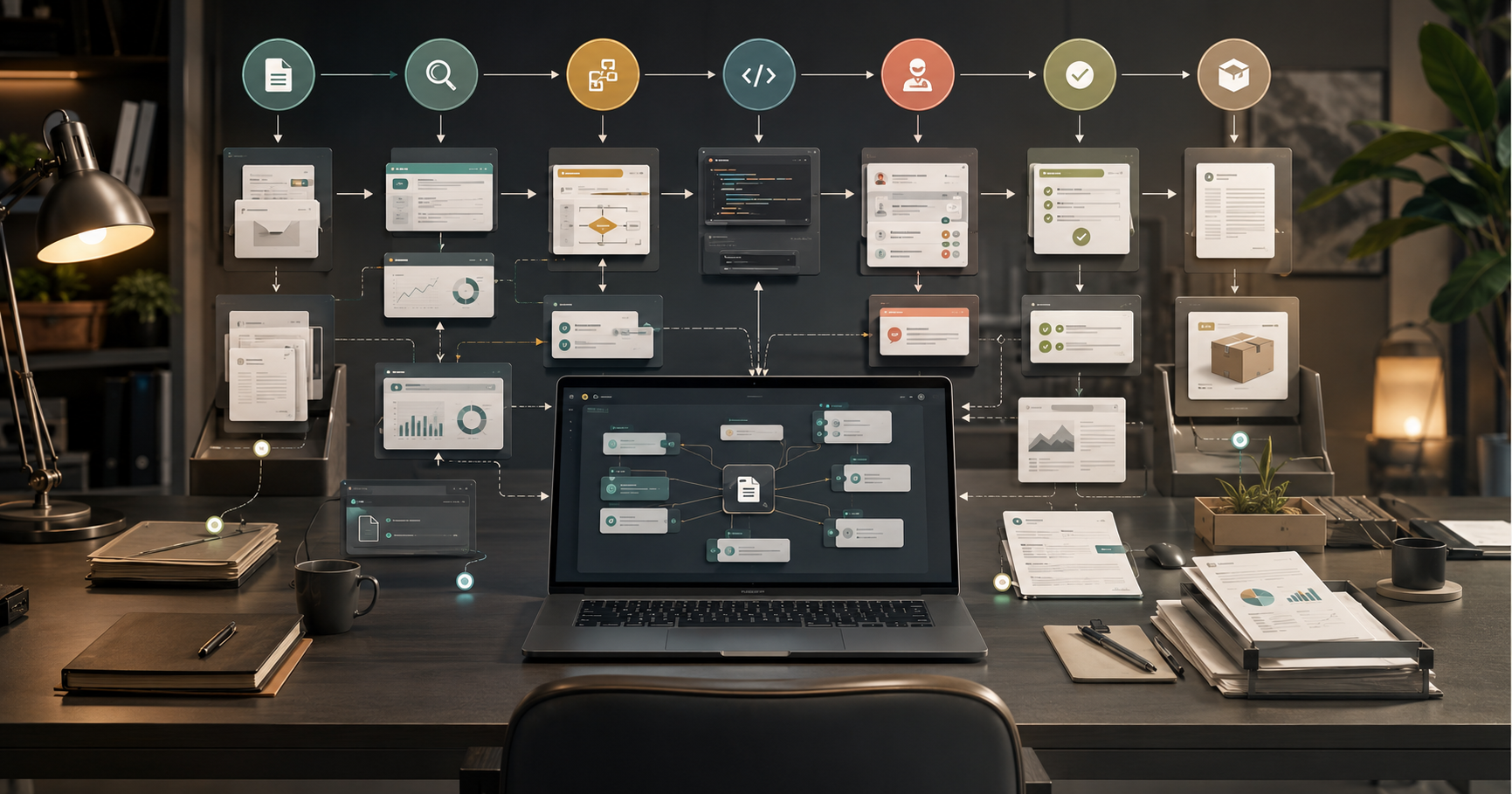
On day 2 of ChatGPT Work's launch, OpenAI says it can read your Gmail, Google Drive, Slack, and SharePoint, picking up your catchphrases, fixed sign-offs, and capitalization quirks. But the very first demo image in its promotional post gave itself away — it contains an em dash, the most recognizable fingerprint of AI-generated text. Before it learned to mimic you, it slipped up.
The thing that learns your "haha" first rifled through four work tools
It reads your writing in Gmail, Google Drive, Slack, and SharePoint, picks up your catchphrases and capitalization — ChatGPT Work has turned "personal writing style" into a toggleable feature.
On September 7, OpenAI's official account posted on X: it can capture the details in your writing — catchphrases, sign-off habits, capitalization quirks. The four tools currently named for sample extraction are the ones listed above.
This capability runs on GPT-5.6, which OpenAI calls its smartest model line yet, purpose-built for professional work, available in three tiers: Sol, Terra, and Luna.
Rollout timeline: available on macOS desktop for all plans starting September 7, Windows desktop in the coming days, with web and mobile versions subsequently pushed to Plus, Pro, Business, Enterprise, and Edu.
Hit one switch, and everything you've written becomes the model's reading material
Style mimicry isn't new. What's new is skipping the questionnaire — the model now reads your work tools directly.
Two steps, and the first needs your approval. When users authorize access to daily work tools like Gmail, Google Drive, Slack, and SharePoint, the model's context window (all the background information a model can read in a single pass) pulls corpus from those sources. OpenAI's official page puts it plainly: "Pull together context from your team's tools, turn scattered notes, drafts, and ideas into complete output." Skip authorization, and the model is guessing in the dark.
What it reads matters most. Greg Brockman offered examples on X: your go-to catchphrases, your fixed sign-off, those odd capitalization habits. OpenAI's official page ties style learning to its flagship model. Bigger models extract style patterns from fewer examples. Nothing mysterious there.
What shifts for you: before, you'd introduce yourself, tick "formal" or "casual," then pick a template. Now those options are gone — the model reads your past emails and documents directly. Where you put your em dash, the closing line at the end of every paragraph, the catchphrases that never follow grammar rules — all of it becomes style sample material.
How granular does the mimicry get? Three points to keep straight:
The trade is simple: you stop describing yourself, but the model has to read everything you've ever written first.
Before it learned you, it gave itself away
ChatGPT Work promotes itself as learning your catchphrases and sign-off habits, yet its own promotional image flaunts the most common punctuation fingerprint of AI text. Commenters then exposed a deeper problem: the very corpus it's learning from was likely written by AI in the first place.
On September 7, Greg Brockman posted on X introducing ChatGPT Work's ability to learn your catchphrases, sign-off habits, and capitalization quirks ("Your favorite phrases. Your very specific sign-off. your capitalizations quirks."). A user named Hassan pulled out a magnifying glass on the promo image and spotted an em dash — a long dash — which is precisely one of the most common hallmarks of AI-generated text. It learned everyone's writing style except the one detail that gives AI away. That comment racked up 53 likes.
Another high-engagement comment (139 likes) came from Tatenda Zhou: if you already use ChatGPT to write, whose "personal style" is the model ultimately learning? When you get a copy of your own style back, is that "you" still you?
Both comments point to the same hidden risk. ChatGPT Work needs to connect to Gmail, Google Drive, Slack, and SharePoint to harvest your corpus — but how much of that corpus was originally written by ChatGPT for you?
OpenAI's official page doesn't explain how this learning mechanism distinguishes "AI ghostwritten content" from "human-written content," nor whether it filters out its own model's output. The closer the mimicry, the deeper the echo.
User David Stark (@stark4833) raised another point: a lot of people are still mourning 4o, still mourning the old version that got replaced. More than wanting the model to "be more like you," what users may care about is "is it still itself?" Before OpenAI can sell personalization, it has to answer "who's using me" and "am I still me."
The better it mimics, the more clearly the consent should be spelled out
The more convincingly it learns your style, the more identity ownership becomes a thread that snaps at a single pull. It will write your catchphrases, your sign-off, your capitalization quirks. The question is: when should it stop and ask permission?
On X, a commenter with an em dash already asked: if the output is signed with your name verbatim — is it a tool, or a stand-in?
A reference point is already out there: Grok is under investigation by regulators in multiple countries for generating non-consensual deepfake images, with Italy's data protection authority requiring X to complete remediation by the end of 2025. Deepfake images are visible misuse; voice and tone mimicry is invisible misuse.
What ChatGPT Work is connecting to this time — Gmail, Google Drive, Slack, SharePoint — represents the most intimate text ecosystem in the workplace. Once it learns a user's tone, sign-off, even punctuation quirks, it could in theory forge a colleague's email convincing enough to pass for real. Between capability rollout and safeguard rollout, there's a visible gap.
Three verifiable observations to watch: First, whether OpenAI offers a secondary layer of per-tool authorization beyond the "style learning" toggle — allowing Gmail reading but prohibiting outbound tone learning. Second, whether the Enterprise tier defaults to excluding training on read emails; otherwise legal and compliance teams will push back before the media does. Third, whether that em dash comment on X gets an official response — if OpenAI acknowledges that "style mimicry" is still contaminated by mechanical habits, that's an admission of an unlearned layer.
Reverse verification also applies: if no public case of "AI mimicking my tone to reply to emails and causing a dispute" surfaces within six months, and OpenAI writes into enterprise contracts that "style data does not enter model training," this wave of concern will fall into the overreaction category.
Start with one image: the em dash tells on itself
A single punctuation slip in the demo undid the whole "learns your writing style" pitch. That's the one thing anyone can judge today.
Greg Brockman reposted the official ChatGPT account's announcement: ChatGPT Work can now learn your catchphrases, sign-off habits, and capitalization quirks — provided external tools are connected to read your corpus. The original post is truncated after "Show more," and no clickable trial link is provided for ordinary readers.
the image has an em dash in it. so it learned everyone's writing style except the one thing that gives it away
The em dash is the most conspicuous structural feature in writing. @buildwithhassan didn't need a corpus connection to spot it — the official image was enough. That detail does the real vetting work for now.
goina learn how to write from ChatGPT
Then comes the recursive loop, surfaced by @realtatendazhou: if you already draft with ChatGPT, whose voice is it learning? Yours, or the version of you that ChatGPT already rewrote? The source offers no answer, and neither can anyone else until real corpus data gets connected and OpenAI's handling shows up in the product.
What stays unjudgeable today: error rate, third-party retesting, the boundary for "getting it wrong." Verification stops at the demo image. Catchphrases, sign-offs, capitalization — all still wait on real corpus.
Find Greg Brockman's repost of the official ChatGPT post, and check whether the demo image contains an em dash.
Scan the comment section, pull the two lines from @buildwithhassan and @realtatendazhou, and keep separate notes on the em-dash nitpick and the recursive question.
Go to the official ChatGPT Work page and check availability for your plan.
Watch the official page's "coming days" promise for Windows desktop after macOS, and verify on time whether it slips.
Before ChatGPT Work lands on your plan, decide which surfaces you don't want it reading in Gmail, Slack, Google Drive, and SharePoint — whether to connect, which to connect. The say-so is yours.
Sources: X post by OpenAI co-founder Greg Brockman (@gdb, published 2026/9/7), citing content from the official ChatGPT account. Disclosure: product features and platform rollout schedule are subject to OpenAI's official ChatGPT Work page; user complaints and claims such as "em dash gives away AI" represent only commenter opinions and do not reflect OpenAI's position.