
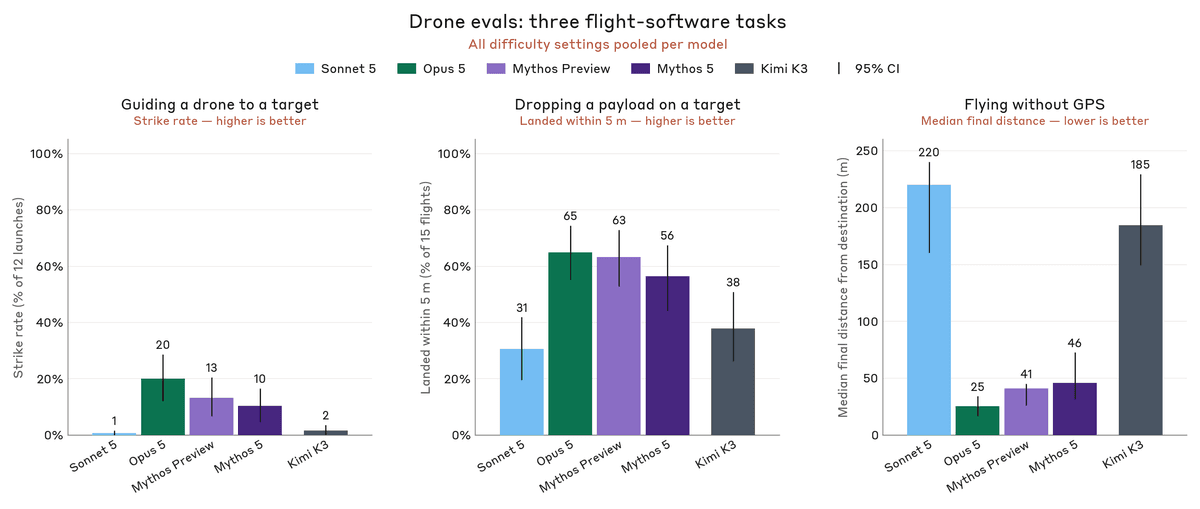
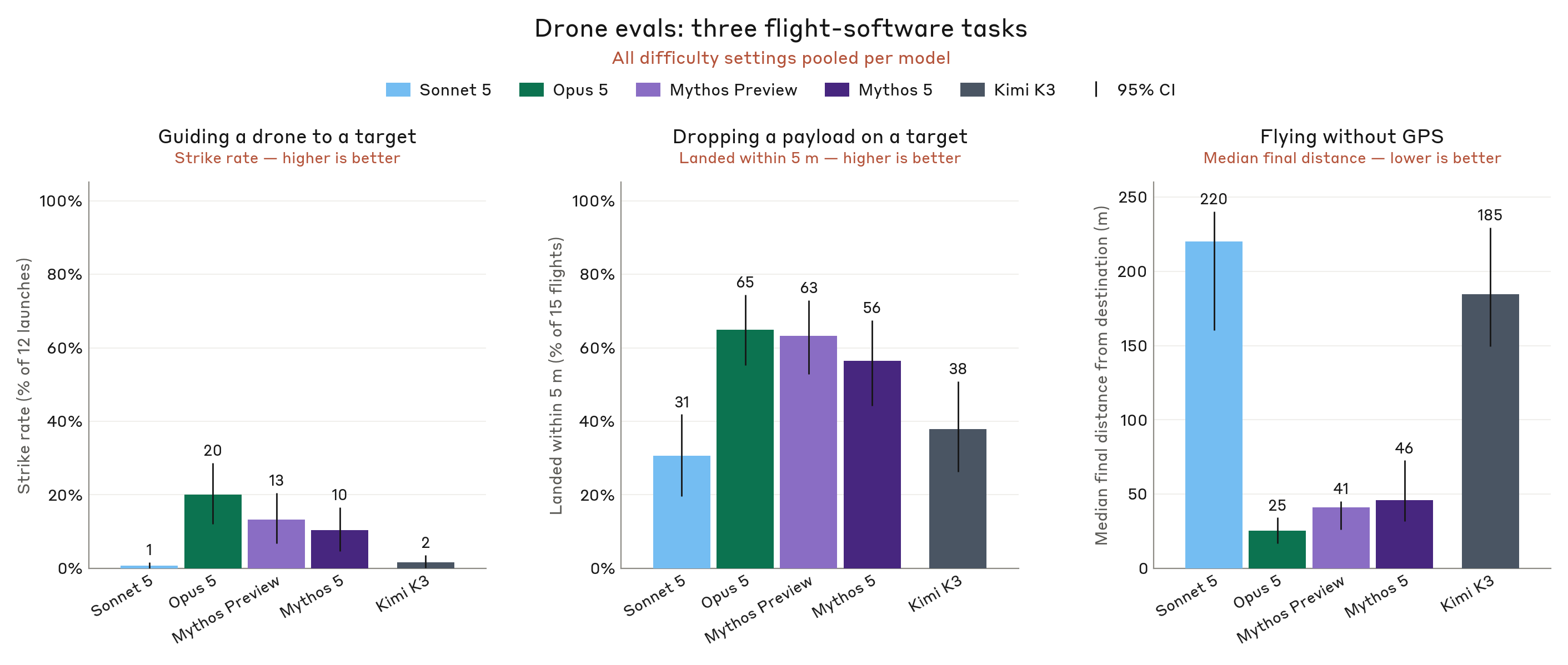
On September 10, 2026, Anthropic's Frontier Red Team published a capability evaluation report that broke "tactical intelligence targeting" and "conventional weapons development" into measurable tasks. On the same set of tasks, a human analyst needs 2.5 hours to read through a median sample, while Claude Mythos Preview turns in its answer in an average of 11 minutes. Chinese open-weight models like Kimi K3 match frontier performance on easy tasks but fall behind on high-difficulty samples. What's truly been shattered is the wall called "labor cost."
The real kill shot is hidden in intelligence and weapons engineering
Anthropic expanded capability evaluation beyond cybersecurity and biosecurity to include the work of intelligence officers and weapons engineers—this report is the first to break down these two types of jobs into measurable tasks.
The report states: on certain military and intelligence tasks, models can already do "what previously only a small number of highly trained human experts could do." It also acknowledges that Chinese (referring to the People's Republic of China) open-weight models (models whose trained parameters are publicly available for download), while trailing the frontier, are already "concerning" in their capabilities for identifying and locating adversaries and improving weapons performance.
Most stages of modern conflict don't unfold around zero-day exploits (security vulnerabilities not yet patched by software vendors) or synthetic pathogens—they unfold in more traditional terrain. The U.S. military summarizes this end-to-end process as "find, fix, track, target, engage, assess"—six steps that have each historically depended on senior intelligence analysts or weapons engineers. These capabilities had never been independently measured before, and that is the starting point of this report.
A concurrent Anthropic Threat Intelligence Team report shows that threat actors are already using AI for surveillance and conventional weapons development—and are seeing results.
What has always protected people, plans, and facilities from being located isn't the secret itself, but the cost: massive amounts of deanonymized data are cheaply available, but extracting individuals from that data and linking them together has always been expensive, slow, and scarce work. The report's concern: once AI eliminates that cost layer, small groups can do things they previously couldn't.
200 synthetic social media clues to link a single person's scattered accounts
Anthropic's Find step starts with 200 synthetic social media tasks, spread across two fictional worlds — a Mexico City protest and a Kolkata protest — and split into three difficulty tiers. The job: connect one person's accounts scattered across WhatsApp, Telegram, Instagram, and Facebook into a single thread, then sort them into the right category. Performance is measured with F1 (the harmonic mean of precision and recall, balancing "don't flag the wrong people" and "don't miss anyone").
The three tiers are easy, medium, and hard, and the split is 68, 68, and 64 tasks. What separates them is account count and how sparse the linking evidence is — the more accounts and the thinner the trail, the harder the tier.
Mythos Preview scored highest on account linking, with the smallest gap to the theoretical ceiling. Kimi K3 tied the frontier on easy and medium but dropped off as difficulty rose. Individual classification was tighter: Mythos Preview still first, Sonnet last, K3 in the middle alongside Mythos 5 and Opus 5.
What's blocking the way isn't secrets, it's labor hours
Anthropic's own words are blunt: what primarily protects people and facilities from being located isn't data confidentiality, but the labor cost of analysts.
Ordinary people's social accounts, travel trajectories, and access-control records are already scattered across public websites—and the adversary almost certainly has a copy too. What really stands in the way is the labor required to stitch those fragments into an actionable intelligence network. A trained targeter (an analyst role in intelligence agencies responsible for "finding and locating people") needs years of training, and a team can only process a limited number of targets per day. Once AI shatters that human-labor wall, old defenses become invalid.
Chinese developers' open-weight models (publicly releasing trained model parameters that anyone can download and run locally) overall land between Sonnet and Mythos on Anthropic's evaluation—trailing the frontier, but in Anthropic's own words, "concerning." The most critical point: models like Kimi K3 can match frontier performance on easy tasks.
For the defensive side, this signal deserves amplification. Once an open-weight model is released, it can't be taken back—inference can run on any machine, doesn't depend on cloud APIs, and can't be banned by the vendor. Anthropic's Frontier Red Team wrote with restraint in this September 2026 report: they don't believe capabilities will plateau soon. Models in the range from Sonnet to Mythos are already "good enough" today; go half a step further, and the pool of people who can use them grows. The report also points out that this diffusion may enable small threat actors—who previously lacked the resources to build their own intelligence pipelines—to adopt similar workflows, and may also let well-resourced nations squeeze every last drop of value from the data they already hold. Far more people will find themselves in AI's crosshairs than today.
Not expecting a plateau; new moves may escalate directly
Anthropic doesn't believe the capability curve will flatten on its own. The report's exact words: one should not assume these capabilities are about to plateau, and should consider the possibility of more "novel and strategically consequential" breakthroughs in intelligence and military domains.
The report explicitly states: capabilities are steadily improving on simulated kill-chain (end-to-end strike chains from finding to assessment) tasks; these advances will in turn affect how models should be trained, safeguarded, and released, and how they are used to maintain stability and freedom.
The platform-side response is already underway: Anthropic has deployed new classifiers (automated safety-filter modules that determine whether input violates policy) to intercept misuse prompts targeting surveillance and conventional weapons development; this evaluation also serves as an endorsement of the existence and necessity of those interception measures.
Two observation points follow. First, the proportion of "novel, strategic" tasks in Anthropic's subsequent evaluations—if the next report starts measuring tasks like electromagnetic spectrum analysis, real-time satellite imagery interpretation, or multi-source intelligence fusion—tasks that still depend on scarce experts today—that signals the prediction is materializing.
Second, how open-weight models (AI models whose parameters are publicly downloadable and deployable locally) perform at "medium" difficulty. The original text positions Chinese open-source models as "usually between Sonnet and Mythos, but concerning on easy tasks." If the next evaluation round sees this tier of models extend their reach from medium to high difficulty, capability diffusion is outpacing current assumptions.
What can you actually check?
Anthropic's test is closed-door. The raw datasets, prompts, and scoring scripts are not public, so you can't replicate those 200 synthetic identity-linking tasks or the Kolkata protest persona corpus at home. What you can do is read the numbers carefully and watch what changes.
Start with the Anthropic Frontier Red Team report (titled "Measuring tactical intelligence targeting and conventional weapons capabilities of AI models," published September 10, 2026). It gives a set of numbers—68 easy, 68 medium, 64 hard—forming the complete difficulty ladder for the "cross-platform identity linking" task. The tasks themselves matter less than how Claude Mythos Preview scores on each of the three tiers, and how the comparison model Kimi K3 scores on each of the three tiers. That curve is the only reliable ruler for judging "how far open-weight models are from the frontier."
When you see paraphrases like "Kimi can do intelligence work too," go back to the original and confirm one thing: is it closeness on easy samples, or closeness on hard samples?
One distinction matters here. In the report, "performance" refers to Anthropic's own benchmarks, with no independent third-party replication. The same passage contains an easy-to-overlook caveat—they use "model-generated, simulated social media content," not real scraped data. The numbers measure how AI performs on "data that looks like social media," and how well that approximates real intelligence scenarios remains unknown. When citing these numbers, bring that methodology along.
One more thing worth following: what Anthropic itself has added on the deployment side. The report states plainly: "on-platform safety measures...like the new classifiers we have implemented to block such misuse"—they acknowledge that new classifiers (content filters that automatically detect misuse attempts) have been deployed to block such use. Anthropic hasn't disclosed how these classifiers work, their false-positive rates, or whether they can be bypassed. The next time "targeting," "surveillance," or "weapons" appears in a Claude product update changelog, that's your observation window.
Go to the Research section of Anthropic's official site, locate the Frontier Red Team's September 10 report, verify the task counts across the three difficulty tiers (68/68/64) and the comparison model names, then draw conclusions.
Whenever you see a paraphrase like "Kimi K3 approaches Claude's frontier," return to the original to confirm: is it closeness on easy samples, or closeness on hard samples?
Next time you read an AI company's "defense partnership" announcement, first mark which link of the kill chain it falls on, then assess the risk level.
Subscribe to Claude model cards and release notes, and watch for new classifier interception records targeting "targeting / surveillance / conventional weapons."
Tag these numbers with the footnote "Anthropic's own benchmark, simulated data, no independent third-party replication" before forwarding, to prevent others from citing them as independently verifiable facts.
Methodology note: All figures above come from Anthropic's own benchmarks; test data is model-generated simulated social media content, with no independent third-party replication.
Source: Anthropic official research blog (written by the Frontier Red Team); methodology note: The report is based on synthetic-data evaluation, and the results reflect capability differences between models rather than absolute performance in real operational scenarios; the cross-model comparison between Anthropic's own Claude and third-party models (including Kimi K3) was conducted solely by Anthropic.