
On September 1, The Beijing News reported that on the evening of August 31, a NineSense unmanned delivery vehicle drove the wrong way and blocked a public bus during the after-school rush hour on Fangdong Street in Baqiao District, Xi'an. NineSense customer service responded the following day: the vehicle had been shut down for debugging, the issue was preliminarily attributed to a route configuration problem, and personnel had been dispatched to investigate. Just over a month earlier, the company had announced it had achieved scaled mass production of an L4-level mapless autonomous driving solution, claiming to be the world's first. The first publicly reported incident after mass production—and the blame is being placed on the route. A vehicle capable of driving the wrong way and blocking a bus likely has problems that go far beyond its route.
A Vehicle Branded L4 Drives the Wrong Way at Evening Rush Hour
On the evening of August 31, Fangdong Street in Baqiao District, Xi'an, was caught in the after-school rush hour. All vehicles were queued up in a line. A NineSense unmanned delivery vehicle switched on its turn signal, drove directly into the oncoming lane, and got stuck in place, unable to move.
A witness, Mr. Sun, filmed the entire incident. After The Beijing News picked up the video, it spread widely on September 1. NineSense customer service confirmed the following day that the vehicle in question had been shut down for debugging. The issue was preliminarily attributed to a route configuration problem, and personnel had been dispatched to investigate.
One month earlier, in July, NineSense Intelligence announced at the 2026 World Artificial Intelligence Conference that it had achieved scaled mass production of an L4-level (a high-level autonomous driving classification where the system performs all driving operations under defined conditions) mapless autonomous driving solution (an autonomous driving approach that relies on real-time onboard sensor perception instead of high-definition maps).
The Vehicle Was Executing a Mission—The Failure Was That the Route Wasn't Blocked
Customer service attributed the cause to "route configuration"—the delivery vehicle was running a pre-planned mission route from the backend that included a wrong-way segment, not an on-the-spot decision.
NineSense customer service pinned the blame on a "route configuration issue"—a statement that shifts responsibility from the vehicle to the cloud: the delivery vehicle didn't spontaneously decide to drive the wrong way when it saw oncoming traffic; it was dispatched with a pre-planned mission that included a wrong-way segment. In other words, the error occurred in the planning stage before dispatch, not in real-time 感知(perception (using cameras and radar to identify obstacles and lane markings)) or decision-making during driving. The incident shifts from "AI failing in the moment" to "the backend approved a non-compliant route."
A delivery vehicle's planning system typically pulls in road network data, traffic restrictions, and construction zones as constraints, and outputs an executable path. Wrong-way driving is a hard constraint—if triggered, the system should block it.
That it didn't this time—where's the problem?
Was "one-way street / oncoming lane" simply not written into the road network, or was the rule written in but overridden by something with higher priority (like a time-efficiency rerouting command)? It's all a black box right now; the sources don't say. Pinning a single wrong-way incident on "a misconfigured backend route" reveals more than just one bad data point—it exposes a planning chain that lacks fail-safe validation for high-severity violations like wrong-way driving.
Wrong-way driving almost inevitably leads to a head-on conflict with oncoming traffic—it's one of the most predictable high-consequence errors. If the planning system lets a wrong-way route through, is it also failing to block other equally high-risk violations?
The response stopped at three things: the vehicle has been shut down, the issue is preliminarily attributed to a route configuration problem 路线设置问题(the delivery vehicle follows a pre-planned backend mission route rather than making real-time path decisions), and personnel have been dispatched to investigate. How did this wrong-way route pass review? Does the planning stage have a wrong-way check? Had the same path been used before? There are still critical steps missing before we can answer "why did this route end up in the mission queue."
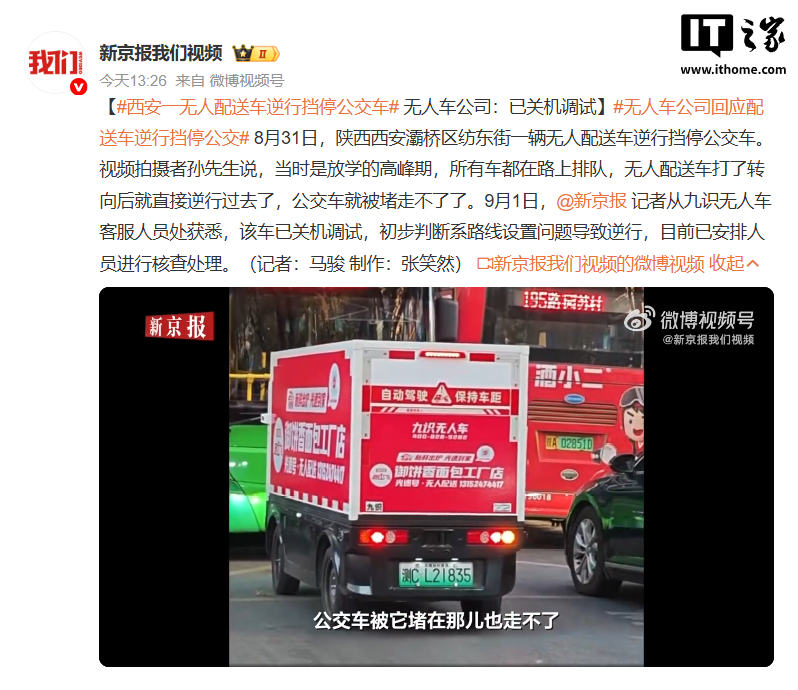
One Month After Mass Production, the First Public Incident Is Blamed on Something Their Own Solution Bypasses
NineSense customer service attributed the wrong-way bus blockage to a "route configuration problem"—yet "mapless" is their selling point.
At the July World Artificial Intelligence Conference, NineSense had just announced "scaled mass production of an L4-level mapless solution," claiming to be the world's first. Less than two months later, a NineSense delivery vehicle on Xi'an's Fangdong Street drove the wrong way during the after-school rush and blocked a bus. The videographer Mr. Sun was blunt: "All the cars were queued up in a line, the unmanned delivery vehicle turned on its indicator and just drove the wrong way, and the bus was stuck and couldn't move."
NineSense's customer service response: "The vehicle has been shut down for debugging; the issue is preliminarily attributed to a route configuration problem causing the wrong-way driving."
That word "route" is the problem. The company sells "mapless" 无图(not relying on high-definition maps; using real-time perception and algorithms to replace pre-built maps) as its core differentiator. Its first instinct is to blame the very element its own solution bypasses. For an L4 (high-level autonomous driving where the vehicle handles all driving operations within a defined scope) system, wrong-way is a hard constraint. The vehicle signalled, turned into oncoming traffic, and blocked a bus. At least one link in the perception–decision–execution chain failed to catch it. Treating "misconfigured route" as a starting point is fine—stopping there as an endpoint is not.
What is still unanswered:
Beyond customer service saying "personnel have been dispatched to investigate and resolve," the company has offered no further explanation. The two answers to the first question carry very different responsibility distributions. NineSense hasn't said which one applies.
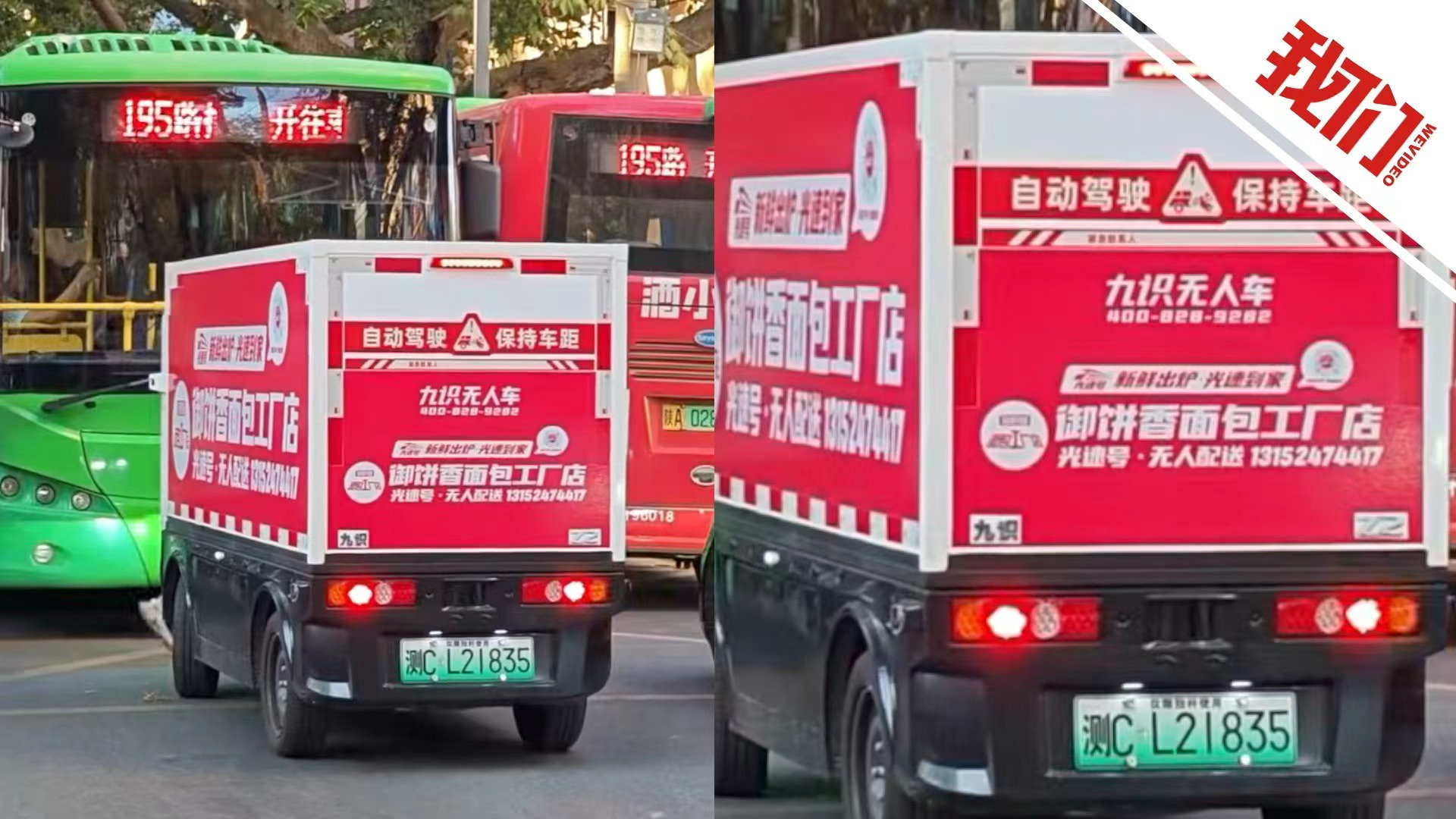
Blaming the "Route" Is Equivalent to Admitting an Upstream Process Failure
Behind those five words—"route configuration problem"—lies the real question that needs answering: how did this wrong-way route end up in the operations queue?
NineSense customer service's conclusion is just one sentence: the wrong-way driving was "caused by a route configuration problem." IT Home reported on September 1, citing The Beijing News, that the vehicle in question had been shut down for debugging and the company had dispatched personnel to investigate and resolve. The key lies in those two words—"route." Was this path with the wrong-way segment put into operation after manual planning and review, or was it auto-dispatched by the backend system?
Driving into the after-school rush hour, with the entire street queued up, means it showed up at the wrong place at the wrong time. Whether it's the system or a human, it should have been stopped before the vehicle ever set out.
This incident happened under the premise of L4 autonomous driving (high-level autonomous driving in defined scenarios, where the system handles most situations within its design scope) capability—the mission input itself must be compliant.
Putting a delivery vehicle that will drive the wrong way on the street isn't the vehicle "driving wrong"—it's the upstream process "letting it through wrong." If NineSense wants to preserve its banner of "the world's first L4-level mapless solution in mass production" (announced at this July's World Artificial Intelligence Conference, already at 30% penetration on new operational routes, per IT Home), what it owes next is a clear answer on route review and safety safeguards.
Xi'an isn't NineSense's only battleground. The report IT Home cited on September 1 also noted that this company, founded in 2021 and which unveiled its first unmanned logistics prototype in May 2022, has expanded its operations to multiple cities. Across the country, how many more routes are running that include wrong-way segments, narrow alleys, tidal-flow lanes, or school zones? There's no public figure—only the investigation results can tell us.
A few observable signals: if within days NineSense publishes how the route in question was generated (manual/system/hybrid) and discloses how many similar risk routes were identified and taken down, it shows the company is seriously patching its upstream process. If the public-facing message stays at the customer service level—"debugging in progress," "personnel dispatched to investigate"—and avoids the route generation mechanism, then "route problem" is just a fig leaf, and the mass production narrative will crack first in operational details. Whether the bus driver gets back the time he lost is a small matter; whether a city's morning and evening rush hours can accommodate hundreds of unmanned delivery vehicles—that's the real question to answer next.
What You Can Do Now: Watch One Time Window, Look for One Key Distinction
The sources don't provide a downloadable reproduction package, a public vehicle ID, or a self-check entry point for owners. The steps below are things ordinary readers can do today; everything else has to wait for NineSense to speak up.
The NineSense delivery vehicle that drove the wrong way and blocked a bus in Xi'an was involved in an incident on the evening of August 31; on September 1, customer service told The Beijing News: the vehicle has been shut down, and the issue is preliminarily attributed to a route configuration problem 初步判断系路线设置问题(first shifting the cause to the backend-planned path, without mentioning algorithms or hardware). This claim needs to be cross-validated by three things before it holds up—NineSense's own subsequent incident review, the local traffic police or transport authority's liability determination, and a second piece of original video uploaded by a third-party platform or witness.
The key distinction: a route configuration problem and an autonomous driving decision problem are not the same thing. A route configuration problem means a person misconfigured the path and the vehicle followed the wrong path; an autonomous driving decision problem means the vehicle itself chose to drive the wrong way within a legal path. Customer service has so far only acknowledged the former.
The videographer Mr. Sun described the sequence: turning on the indicator, driving the wrong way, blocking queued traffic. That's exactly what a vehicle with basic perception and path-execution capability would do. A purely execution-only vehicle wouldn't typically pick a wrong-way route on its own; but given the wrong path, it will follow it. So the question is manual versus auto: did a human misconfigure the path, or did the vehicle accept a path it should have rejected? Only the logs can answer that.
There's no public channel for ordinary users to self-check whether their own delivery vehicles carry the same risk. But readers can do one low-barrier thing—watch for two observable signals:
- Do unmanned delivery vehicles in the same operating area show similar turning or lane-crossing behavior on the same stretch of road recently? If it keeps recurring in the same area, the suspicion of a route configuration cause strengthens.
- Is it just this one vehicle, this one road? An isolated case leans more toward an individual configuration error.
This observation doesn't require any technical background—just tracking local news keywords.
Bookmark the two original reports from The Beijing News and IT Home, revisit them every 3–5 days, and watch for any incident review conclusions from NineSense or local traffic authorities.
Search Weibo, Douyin, and Xiaohongshu with keywords like "Xi'an Baqiao unmanned vehicle" and "Fangdong Street unmanned delivery" to check for a second original video or additional witness accounts.
Follow NineSense Intelligence's official WeChat account and website announcements; compare customer service's verbal "route configuration problem" with the formal text—has the company made any public statement on the path configuration process?
Watch for any statement from the Xi'an Baqiao District traffic police or transport department on this incident—this is the most authoritative signal for determining liability, far more weighty than the manufacturer's own account.
In news coverage, keep "route configuration problem" and "autonomous driving decision problem" clearly distinct—treat either phrase as a filter. If a report only mentions the former without explaining how the path was approved, take the conclusion with a grain of salt.
The real verification has to wait for NineSense to release the incident vehicle's operational logs or an independent third-party investigation report. Until then, every "personnel dispatched to investigate and resolve" is the same line of rhetoric. But here's the question that should keep you up at night: if one misconfigured route can send a delivery van the wrong way down a city street during rush hour, what happens when it's not one van—but hundreds, all running the same flawed route at once? Today is September 1; come back in 14 days and see whether the company actually clarified the problem, or just let the news cycle pass.
Source: IT Home (citing The Beijing News, reporter Ma Jun). Scope note: the customer service response is a preliminary judgment; the cause of the incident, the route review mechanism, and the vehicle's history have not been fully disclosed by NineSense. The "probing questions" in this article are reasonable doubts based on the customer service statement, not confirmed conclusions.