You enter your model keys into an AI development platform’s environment variables and prepare to launch an agent; in the same month, at least nine platforms—including Fireworks AI, Zeabur, Lightning AI, OpenCode, Railway, Warp, CommandCode, and Northflank—successively disclose security incidents. Wiz’s investigation shows that this is more than a string of credential leaks: attackers specifically seek model-access keys, then feed valid keys into a resale and bulk-consumption chain, turning stolen access into a product that can be monetized repeatedly.
Nine Disclosures Over 24 Days: Which Point to the Same Attack?
At least nine AI development platforms disclosed security incidents in October, spanning 24 days from the 6th to the 30th. Among them, Fireworks, OpenCode, and Warp reported signs of an “agent swarm” attack(an intrusion method in which multiple agents collaborate to advance an attack).
Fireworks AI spoke first on October 6, followed by Andromeda on the 9th, Zeabur on the 14th, and Lightning AI on the 15th.
How strong is the confirmed connection between the closely spaced disclosures? OpenCode and CommandCode explicitly attributed their incidents to “distillation” attempts(extracting a model’s capabilities to train another model), but neither confirmed that all nine incidents followed the same attack path.
| Disclosure Date | Platform | Disclosed Attack Indicators |
|---|---|---|
| October 6 | Fireworks AI | Reported signs of an “agent swarm” attack |
| October 9 | Andromeda | Described the incident as an industry-wide attack |
| October 14 | Zeabur | Disclosed a credential-access-related incident |
| October 15 | Lightning AI | Disclosed a credential-access-related incident |
| October 16 to 17 | OpenCode | Reported signs of an “agent swarm” and explicitly attributed the incident to distillation attempts |
| October 20 | Railway | Disclosed a platform security incident |
| October 23 | Warp | Reported signs of an “agent swarm” attack |
| October 28 | CommandCode | Explicitly attributed the incident to distillation attempts |
| October 30 | Northflank | Disclosed a platform security incident |
Despite the close timing, the public details are insufficient to prove that they belong to the same technical chain. The only confirmed commonalities are that three platforms reported signs of an “agent swarm” and two mentioned distillation attempts.
Different Entry Points, the Same AI Credentials Targeted
If the entry points differ, what do they have in common? The answer is simple: all were searching for environment variables that provide direct access to AI. There is currently no evidence that attackers used one vulnerability or one compromised dependency to breach every platform.
All public reports describe the same search method. Attackers specifically sought stored environment variables(configuration and keys read by programs at runtime), focusing on those that could access AI. The specific vulnerabilities varied, but the attackers’ targets did not.
[FIX] Still Chinese: environment variablesFireworks, Zeabur, and Lightning AI all identified credential access(obtaining and using login credentials) as the root cause of their respective incidents. The credentials were the direct targets, but public information does not show that the same vulnerability compromised all three platforms or that they shared the same external dependency.
Railway’s preliminary assessment was different: the initial entry point was its build infrastructure, where a privilege escalation allowed attackers with existing access to obtain higher-level permissions. Warp traced the root cause to a third-party vendor dependency; OpenCode attributed it to a “legacy system.” Because the failure points differed, they cannot be combined into a single intrusion path.
How Do Stolen Keys Enter the Tradable Compute Market?
The theft of a key is only the beginning. Whether it can be monetized depends on whether it is verified as “still working.”
Security company Wiz (a cybersecurity and cloud security company) observed two sets of corporate keys being abused downstream. The initial unauthorized activity for both sets began within 30 minutes after vendors reported credential access. This interval links the vendor intrusions to the subsequent key use, but establishes only a sequence of events, not that the same actor carried out both.
The initial validation was not large-scale consumption. The two sets of keys generated only 14 to 120 calls per day, a volume too small to constitute sustained compute consumption. The calls came from the same small Go (a programming language) client, with the two keys tested about one minute apart. This is characteristic of an automated task periodically confirming whether a key remains valid, not of normal use by a person.
Wiz was able to link key usage in the cases to public resale organizations, but could not determine how those organizations were connected to the initial intrusions or bulk abuse. What can be confirmed is that public resellers participated in the movement of the keys; what cannot be confirmed is whether they planned the intrusions from the outset. The evidence does not support the conclusion that the resale organizations were the attackers behind the scenes.
The infrastructure underpinning this chain also bears the marks of time. Infrastructure(the servers and network environment that host websites or services) associated with 23.106.46.239 can be traced back at least to 2025 and had hosted multiple LLM (large language model) resale websites. Key validation was not an isolated, spontaneous operation; it landed on resale infrastructure that had long existed and remained operational.
Why Are Validated Keys Then Consumed in Bulk?
Once validation succeeds, actual consumption relies on three things: rotating addresses, enumerating quotas, and concurrency across multiple hosts.
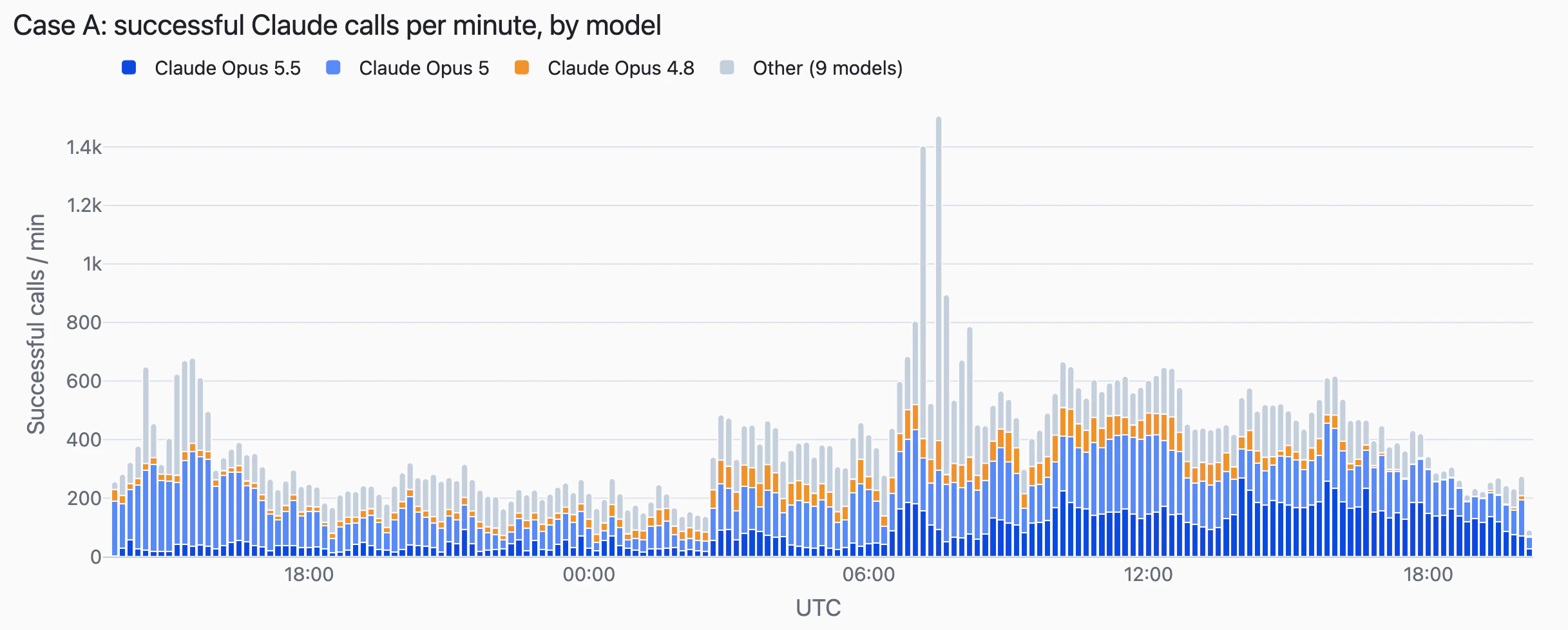
In Case A, probing began four days after the initial validation. The resale pool rotated proxy addresses and sent one call each to Amazon Nova, DeepSeek, gpt-oss, GLM, Kimi, Grok, GPT-6 Astra, and several Claude models, using a small number of requests to determine which models the key could access. This catalog probing also defined the range of potential call targets for subsequent activity.
Several hours later, a boto3 script(AWS’s Python development toolkit for cloud services) began enumerating AWS Bedrock and EC2 quotas. Another host then launched more than 1,000 calls in under a minute while mapping quotas and model availability across regions. Proxy rotation, scripted probing, and multi-host concurrency joined together to form the consumption process, turning a key from a one-time usable credential into an entry point for bulk compute calls.
In Case B, policy restrictions initially blocked consumption. The key could only use us.* cross-region configurations, while the resale pool initially requested global.* and therefore encountered numerous failures. The reseller then switched to region configurations that complied with policy, and the detection program identified working us.* model identifiers. The same-version boto3 script retested global.* and us.* while enumerating AWS Bedrock and EC2 quotas. After first failing, adjusting the configuration, and enumerating, the reseller determined the available range and then put the key into sustained use.
2.7 Million Calls May Have Cost More Than $100,000
After stealing the keys, the two corporate cases kept calling Bedrock, making about 2.7 million calls in total, of which approximately 1.9 million succeeded. Based on public list prices, the cost may have exceeded $100,000.
In Case A, approximately 800,000 Bedrock(Amazon’s managed cloud AI model service) calls were made in about 30 hours, with roughly 90% succeeding and only about 6% being throttled (requests blocked by the system because of speed or capacity limits).
In Case B, approximately 1.7 million calls were made in about 13 hours, with more than 1 million succeeding and nearly all the rest being throttled because of regional quotas. Throttled requests do not incur model-compute costs, but the successful portion has already been billed.
Actual bills will also depend on model type, input and output length, and billing rules, and no third-party retesting has yet been observed.
Why Can a Set of Keys Become a Sustainable Supply Business?
A stolen key is not a one-time password. It is more like access to a coding agent that multiple end users can invoke: the calling method can conceal bulk consumption, and if a call fails, a usable path can quickly be found.
These keys were used in a form resembling a coding agent serving multiple end users. Typical requests sent only a small number of uncached input tokens(the unit used to measure text processed by a model) but received hundreds of output tokens, a pattern consistent with prompt caching(fixed content that is repeatedly read is not charged for again). Individual requests did not resemble the bulk transfer of text, allowing resellers to generate ongoing charges without making the abnormality easy to spot from request volume alone.
A long-tail request also carried tens of thousands of uncached input tokens. Such a request cannot be explained by the same fixed workload and instead fits a scenario in which multiple end users share the keys: different needs are funneled into the same set of keys, so the call activity serves multiple customers and is mixed together under the same credentials.
Model calls also have built-in cross-model fallback capabilities. In Case A, the initial validation request for Claude Fable 5.1 failed, and the system fell back to Opus 5.5, which succeeded. Even if one model is unavailable, the key retains value. Automatic switching allows the same access to continue working and reduces the risk that bulk calls will be interrupted by a single point of failure.
Scripts make validation repeatable, turning a one-time theft into a sustained supply. Resellers do not need to operate manually request by request; the same process can repeatedly test keys, discover available models, and launch subsequent calls. Stolen credentials are thus packaged into a service that can be delivered over the long term.
Source: Wiz Research, “Black October” for AI Developer Platforms (October 30, 2026); the disclosures by the nine platforms, attack attribution, and call volumes and list-price costs for the two cases all come from the security vendor’s compilation and downstream observations. The specific incidents remain under analysis, and the reported costs should not be treated as the result of a completed independent review of every platform.