You open your browser, type in a familiar URL, and the page loads as usual. The machine in the middle that takes traffic for the site and forwards requests to the backend is very likely NGINX. Five research teams, including Wiz, independently found two memory-safety vulnerabilities in NGINX's HTTP/2 processing path, both rated 9.2 under CVSS 4.0. An attacker needs no account at all to execute code on the server. F5 released fixed versions on November 18, and until the upgrade is complete, temporarily disabling HTTP/2 can close the door first.
No account, no login, and you can execute arbitrary code on an NGINX machine
The Wiz research team characterized both vulnerabilities bluntly: unauthenticated remote code execution. In plain terms, an attacker needs no account and no login to the backend to execute arbitrary code on a machine running NGINX.
Both vulnerabilities are rated Critical, with a CVSS 4.0 score of 9.2. On a 10-point scale, that is the highest tier, meaning a low bar to exploit and a large impact. Wiz, along with Ikotas Labs, Metnir, Rapid7, and Xint, independently dug up the same two holes; several teams that never talked to each other hit the same spot, which shows this is not a fringe issue.
What can be done after a successful exploit? Wiz listed four things: execute code, steal sensitive data, tamper with the website, and disrupt service. These are not four options but a chain—first gain code execution, and the rest comes along for the ride. Whatever runs on the server, the attacker can read; whatever the site returns to users, the attacker can change.
The key is where the vulnerabilities sit. Wiz is clear that the flaws are in NGINX itself, not in your application code. Even if your website program is written cleanly, with no SQL injection and no privilege escalation, as long as this NGINX layer in front is compromised, the application behind it is still penetrated. Many people habitually put their security budget into auditing business code, and this layer gets bypassed.
The impact also spreads laterally. NGINX is often placed at the very front of the architecture, proxying multiple applications and APIs at once, and it is normal for one machine to host several services. Wiz's exact words are that a single affected deployment can put multiple services at risk simultaneously. What falls is not one site but an entire row.
What kind of server gets hit?
The only common precondition for both vulnerabilities is that the affected server has HTTP/2 enabled. But beyond "enabled," each has an additional condition that determines whether your machine is certain to be hit or only possibly hit.
HTTP/2(version 2 of the web transfer protocol, faster than the old version, enabled by default on most modern sites) is the hard threshold. NGINX deployments that don't enable it are out of reach of both vulnerabilities. If it is enabled, match yourself against the conditions below.
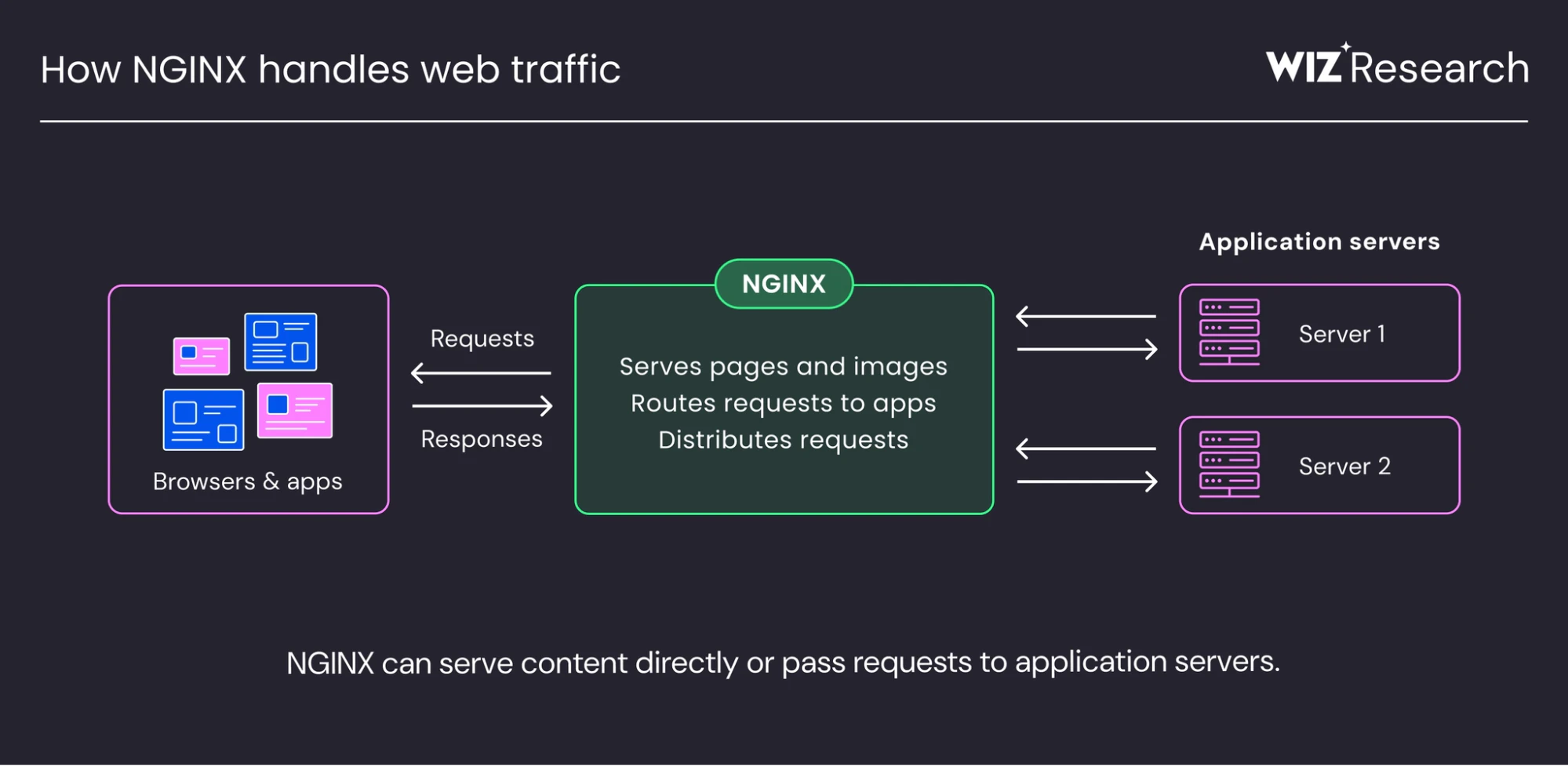
CVE-2026-123633 targets the reverse proxy(a server that stands in front of a website, receives requests for it, and forwards them to the backend) layer. The problem lies in the handling logic when the proxy's available connection slots are tight. Your NGINX must be forwarding traffic for a backend application and under connection pressure to hit this path. Pure static hosting deployments that don't forward are outside its range.
CVE-2026-123007 has broader coverage. It doesn't only hit reverse proxies; NGINX serving content directly to the outside is equally affected. Wiz's testing reproduced code execution over HTTPS on a 64-bit system, using an NGINX that only served ordinary static files, had no backend application, and had no third-party modules installed. The idea that "I don't have an app behind it, so I should be fine" does not hold here.
On versions, the impact of CVE-2026-123007 reaches back to NGINX 1.9.5 from 2015. A machine that hasn't been substantially changed since then and has kept HTTP/2 enabled has theoretically carried this problem all along. The age itself is a clue for investigation: the longer an entry point has gone without an upgrade, the higher it should be on your list.
Why were these two old vulnerabilities only found now?
These vulnerabilities were not newly written. The integer underflow in CVE-2026-123007 hid in the code for over a decade, and the use-after-free in CVE-2026-123633 existed for nearly six years. They sat there all along; nobody had just dug them up before.
The reason they went unfound is specific: both are memory-safety flaws. Integer underflow(a value subtracted below its minimum and wrapping around to a large number) and use-after-free(a program still reading and writing memory after it has been reclaimed)—the problem isn't in a single line of code but in the subtle interactions between memory operations and multiple code paths. Tracing such interactions by hand is so costly that most teams won't do it.
The Wiz research team switched tools. They used Wiz Atlas(Wiz's own AI code-scanning foundation) to scan out these two vulnerabilities, then used Gemini 4 Carbon and ChatGPT 5.6 Sol to validate the impact, confirming that an unauthenticated attacker can execute code on the server. Two stages: one to find, one to confirm the find was correct.
More noteworthy is the repetition. Multiple independent teams each dug up the same old vulnerabilities in PHP and NGINX, and Wiz's disclosure timeline also notes that F5 confirmed another research team had previously reported the same CVE-2026-123633. The same batch of old problems being hit simultaneously by different people shows the barrier isn't one team's luck but that the tools have moved down a level overall.
This cuts both ways for defenders. Vulnerabilities are found earlier and fixed earlier, making software harder; but faster discovery also shortens the window from public disclosure to exploitation. As for whether AI scanning can clean up this class of defect, there is no third-party retest data yet; Wiz has only published its own tool's results.
The patch was released on November 18—is your machine still in the gap?
Wiz reported the first vulnerability on October 21, and F5 released the security version on November 18—28 days apart. During those 28 days, attackers and you had the same code.
The timeline is clearer laid out. On October 21, Wiz reported CVE-2026-123633 to F5, attaching a confirmed working remote code execution and a remediation recommendation. F5 confirmed the same day that another research team had previously reported the same vulnerability.
On November 10, F5 gave Wiz the patch for CVE-2026-123633 for review, a routine pre-disclosure check. On November 16, Wiz reported the second vulnerability, CVE-2026-123007; the next day F5 confirmed it matched the planned November 18 security release. On November 18, the security release went out, and coordinated disclosure(the agreed process of publishing details after the vendor has fixed the issue) proceeded in parallel.
The official recommendation is to upgrade to "the latest version containing multiple fixes," not just apply the single CVE-2026-123633 patch. The reason is practical: the November 18 release collected fixes for both vulnerabilities at once, so patching only one leaves the other in production. Is everything fine after upgrading? The next section explains.
The third step is a stopgap, and its cost must be calculated clearly. Turning off HTTP/2 means multiplexing(running multiple requests in parallel over one connection) is gone, and browsers and gateways fall back to queuing per connection, which will change first-paint and API latency on high-concurrency sites. This trades performance for time; it is not a long-term solution.
One more thing to do right now: make a list. Which machines run affected versions, which actually have HTTP/2 enabled, and which are directly reachable from the public internet. Stack these three lists together, and that is the set you need to handle tonight. Attackers won't wait during the gap between patch release and production rollout.
The patch is out—is the door closed?
On the day the patch was released, production risk did not automatically drop to zero. Between getting the fix and actually having one fewer open door lie validation, coordination, and staged rollout.
Wiz puts it plainly: turning a released fix into production protection still requires substantial manual work, from validating the patch to coordinating rollout with service owners—none of it can be skipped. A patch is code; protection is a deployment state, and human action sits between the two.
Who to find first? Wiz's advice is to first identify deployments running affected versions and configurations, prioritizing those reachable by attackers. An NGINX that is only on the internal network and shielded by another gateway in front, versus an NGINX directly on the public internet with HTTP/2 enabled taking traffic—the order of handling should not be the same. Exposure determines order; the version number only determines whether to handle it at all.
During patch testing and rollout, apply mitigations first. Don't wait until the upgrade is complete to act; during the testing window the server is still running old code. If you can't upgrade, disable HTTP/2 first—this is the official temporary path and the only action that can immediately reduce exposure during this period.
One easy misjudgment: common memory-safety mitigations like ASLR do not stop these two vulnerabilities. ASLR(address space layout randomization, which changes memory addresses on every start to make exploitation harder) is a general defense at the operating system level, and many people assume it raises the difficulty of exploiting memory-corruption vulnerabilities. Wiz's disclosure explicitly states that exploitation of these two vulnerabilities does not rely on it as a backstop; don't treat default system configuration as a safety cushion.
Source: Wiz Research blog "Unauthenticated Remote Code Execution in NGINX: CVE-2026-123633 and CVE-2026-123007," November 18, 2026. Note on scope: vulnerability discovery and impact assessment come from joint research by Wiz with Ikotas Labs, Metnir, Rapid7, and Xint, plus Wiz's own testing; no third-party independent retest data was seen; fix status is based on F5's security release the same day.