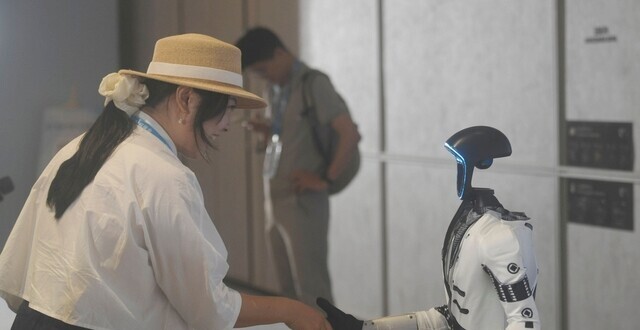
The first humanoid robot stock lands on the STAR Market with a 219x IPO valuation versus a 38x industry average — is this real performance or real premium?
150.80 yuan, 60 billion market cap, 219x P/E ratio
This pricing pushes Unitree into an awkward zone: revenue growth is fierce, but the P/E ratio is 5.7x the industry average.
On August 10, Unitree kicked off its subscription; on August 17, an announcement: STAR Market listing on August 19. The IPO price is locked at 150.80 yuan per share, corresponding to a market cap of roughly 60.993 billion yuan, with 40.4464 million shares publicly offered (10% of post-IPO total shares), raising approximately 6.099 billion yuan in total (net proceeds of 5.917 billion yuan). One winning lot requires a 75,400 yuan payment, with an online allotment rate of 0.0181% — over 9.78 million investors participated in this lottery.
The truly controversial number is the IPO P/E ratio(stock price ÷ earnings per share; the higher it is, the more years of profit you're paying for): 219.23x, compared to the industry average of 38.56x. The strategic placement list includes the National Social Security Fund, DeepSeek(a leading open-source large language model company), and China National Petroleum Corporation. High subscription heat and a P/E ratio far above peers — this is emotional pricing for the robotics track, not manufacturing-sector valuation logic.
The use of proceeds is another highlight. 2.022 billion yuan goes toward intelligent robot model R&D, nearly half of total funds raised; the rest flows into robot body R&D, new product development, and manufacturing base construction. R&D investment is this IPO's heaviest bet and the biggest source of imagination supporting the 219x P/E ratio — but whether that imagination can be realized depends on the scorecard from the first half of 2026.
Where 6 billion goes: nearly half bet on "models"
Total funds raised: 6.099 billion yuan, split into four buckets. Model R&D alone swallows 2.022 billion — this is Unitree's verdict on "what robots will compete on next."
The prospectus discloses four investment directions: intelligent robot model R&D, robot body R&D, new intelligent robot product development, and intelligent robot manufacturing base construction. The first and last correspond to "the brain" and "the production line"; the middle two to "the body" and "new products." All four receive allocations per the announcement.
Among the four, intelligent robot model R&D is expected to receive 2.022 billion yuan — a single line item claiming nearly half of total proceeds, clearly larger than the other three. It's Unitree's core bet: the company believes the next phase of competition in the robotics industry has shifted from "can you build a body that walks and jumps" to "how many tasks can a robot understand and how much can it do autonomously." The "model" here(the brain software that lets robots understand instructions and make decisions on their own) differs fundamentally from traditional control algorithms(operating rules with hard-coded action steps): the former learns capabilities from data, while the latter relies on engineers writing rules one by one.
By placing "model" first on the funding list and giving it nearly half the budget, Unitree is essentially using capital allocation to answer a question: where is the industry turning point? According to prospectus data cited by IT Home, Unitree posted 1.699 billion yuan in revenue and 278 million yuan in net profit in 2025, placing it among the few profitable high-performance general-purpose robotics companies globally. However, Q1 2026 saw year-over-year declines in adjusted net profit(real money earned after stripping out one-time gains), and the company forecasts H1 revenue of 1.052–1.128 billion yuan, a year-over-year increase of 35.62%–45.41% — a significant slowdown from the 332% growth seen from 2024 to 2025. Relying on existing quadruped and humanoid products to keep pushing revenue is becoming increasingly difficult at the margin.
The funding structure itself sends a signal: among the four buckets, models get the largest share, followed by the manufacturing base and body R&D — money tilts toward "software" rather than expanding production lines. The question the market must answer post-listing is whether this 2.022 billion yuan can become Unitree's moat in general-purpose robotics within two to three years.
Adjusted net profit is falling, yet the market gives a 219x P/E
Revenue grew 10x in three years; net profit went from an 11.14 million yuan loss to 278 million yuan — the numbers look great, but underneath lies another story: Q1 2026 adjusted net profit declined year-over-year, and the company's H1 guidance has dropped from triple-digit growth to 35%–45%.
The market's IPO P/E ratio is 219.23x versus an industry average of 38.56x — 5.7x the industry. One winning lot costs 75,400 yuan, with over 9.78 million participants and an allotment rate of 0.0181% — even lower than ChangXin Memory's. This pricing reflects not the past three years' growth curve, but imagination for the next two to three.
The imagination has anchor points. Unitree is one of the few profitable high-performance general-purpose robotics companies globally, with a ~16.4% net margin in 2025, Q1 revenue of 423 million yuan, and 68.49% YoY growth. The company is putting 2.022 billion of its 6.1 billion yuan raised into intelligent robot model R&D, nearly half — betting the next round on the embodied-intelligence brain rather than hardware iteration. The National Social Security Fund, DeepSeek, and CNPC appear on the strategic placement list, with DeepSeek alone investing roughly 141 million yuan. AI players putting real money into a robotics company — this crossover is itself a signal.
Risks are also on the books. The Q1 adjusted net profit decline is driven by increased R&D and sales expenses; R&D spending continues to ramp up, which will compress short-term margins. H1 2026 guidance of 35%–45% growth marks a clear deceleration from the 2024-to-2025 leap from 393 million to 1.699 billion yuan.
There's a lag between funded project kickoff and revenue generation — pouring 2 billion into model R&D doesn't translate into orders next quarter. The 60 billion yuan market cap implied by the IPO price has already prepaid for several years of growth. When the bell rings tomorrow, buyers aren't purchasing Unitree's 2025 report card — they're buying into the story of whether it can keep delivering triple-digit growth in 2027 and 2028.
Can the 1.05 billion threshold hold? The first suspense post-listing
Unitree has drawn its own line for the first half of this year: revenue of 1.052–1.128 billion yuan, year-over-year growth of 35.62%–45.41%. If it holds, the market will keep the 219x P/E story alive.
These figures are the company's own pre-disclosure estimates, not audited results. They show management is willing to publicly commit to a growth floor — more honest than vague talk of "rapid growth" for a freshly subscribing target.
The key constraint hides in the Q1 comparison. In Q1 2026, Unitree posted 423 million yuan in revenue with 68.49% YoY growth — a fast pace. But because R&D and sales expenses rose in parallel, adjusted net profit declined year-over-year. To exceed 1.05 billion yuan in H1, Q2 single-quarter revenue must land in the 630–700 million yuan range — another step up from Q1.
Looking at the three-year curve, Unitree's growth is far from linear. Revenue went from 159 million yuan in 2023 to 393 million in 2024, then jumped to 1.699 billion in 2025 — more than 10x in three years. The question is whether the high base of 2025 can be exceeded again in 2026, which determines whether the premium baked into the IPO price is genuinely expensive or cheap.
The online allotment rate of 0.0181%, fewer than 9.8 million participating accounts, and 75,400 yuan per winning lot — this number reflects retail sentiment, not fundamentals.
Two things to watch post-listing: first, the H1 earnings pre-disclosure announcement in late August or early September, checking whether revenue lands in the 1.052–1.128 billion yuan range and where within it; second, whether adjusted net profit recovers in tandem. If revenue rises while adjusted profit continues to fall, the 219x P/E anchor will be repriced.
Winners watch day one; non-winners watch delivery
Allotment results came out August 11; the August 12 payment deadline has passed. From tomorrow, only shareholders and those who did not win have moves to make.
Three hard numbers to watch when trading opens August 19. First, the opening price premium relative to the IPO price of 150.80 yuan — A-share new stocks typically face a 44% daily price limit, but STAR Market rules differ: no price limits for the first 5 trading days, then ±20% afterward. Day-one volatility may be more extreme than the main board. Second, trading volume: this issuance of 40.4464 million shares is 10% of post-IPO total shares, with an online allotment rate of just 0.0181% and 9.78 million participating accounts. Small float, high attention — the scarcity of shares directly determines turnover. Third, whether the post-listing market cap holds at 60 billion — the IPO price implies 60.993 billion yuan, and the 219.23x P/E ratio(IPO price ÷ earnings per share, measuring how many times earnings the purchase price represents) is 5.7x the industry's 38.56x. Any small earnings fluctuation will be amplified into market-cap swings.
For retail investors who did not win the lottery, the move now is simple: do not lever up or chase — grab a checklist and track Unitree's subsequent prospectus updates and 2026 H1 report. Company sources forecast H1 revenue of 1.052–1.128 billion yuan, up 35.62%–45.41% YoY, but Q1 2026 adjusted net profit already declined year-over-year due to increased R&D and sales expenses. Whether the revenue growth slowdown from triple digits in 2024 to the 35%–45% range is a growth-pace shift or a growth ceiling — the H1 report will deliver the first answer.
Record the opening price, intraday high and low, and closing price. Calculate the day-one turnover rate and closing market cap; compare against the 60 billion IPO market cap.
Check the first post-listing Dragon-Tiger list (top buyer/seller disclosure) to see if strategic placement holders like the National Social Security Fund or CNPC appear on the sell side.
Wait for the official 2026 H1 report and verify whether revenue falls within the forecast 1.052–1.128 billion yuan range.
Compare adjusted net profit: Q1 already declined YoY. If the R&D expense ratio (R&D ÷ revenue) in the H1 report continues climbing, the company has actively chosen the "burn cash for tech" path.
Track funded project progress: intelligent robot model R&D alone will spend 2.022 billion yuan, nearly half of total funds raised. Milestone updates for this project will surface in subsequent announcements.
This article is based on the IT Home original (2026-08-18). All vendor-published figures (benchmarks, reductions, etc.) are official disclosures and have not been independently re-verified by third parties unless otherwise noted.