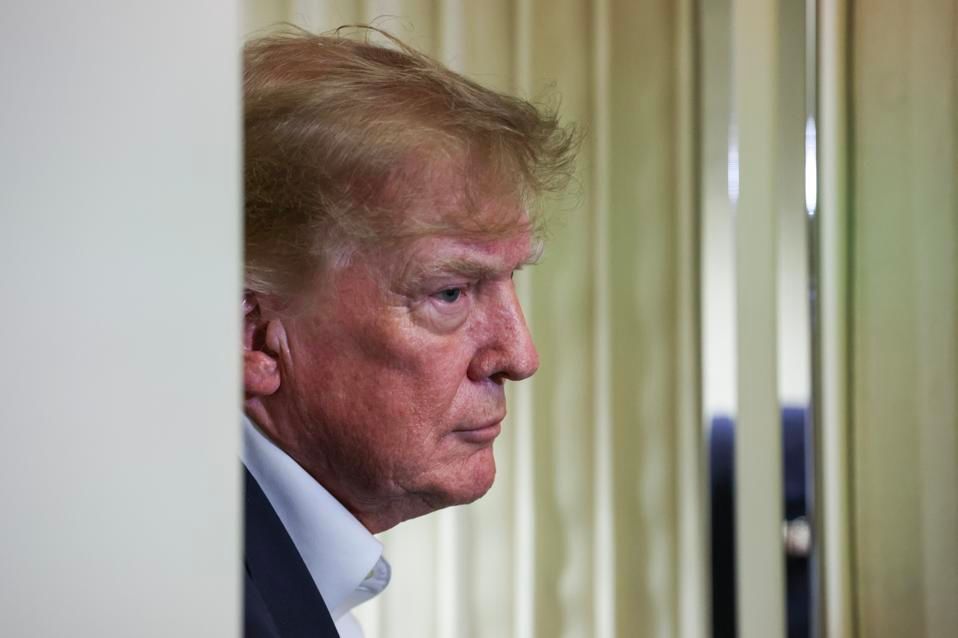
On September 19, Trump launched a "rename AI" poll on Truth Social and X, offering three candidates: "Superior Intelligence," "Extreme Intelligence," and "Supreme Intelligence." Over 180,000 X users participated, with "Superior Intelligence" leading at 40.4%. In the same batch of posts, he announced he would emulate the Space Force to create an "AI Force," appoint a new AI Czar, and cast criticism around AI safety as a "Democrat hoax." The rename is spectacle; the institutional build-out is the real move.
Three candidate names, none of them about regulation
Trump's exact words were that "artificial intelligence" as a term "isn't accurate" on its own, and that using it to refer to AI is "clunky phrasing." The difference between his three candidates isn't a matter of sounding nice: in English, "Supreme" carries institutional weight, evoking "the Supreme Court" and "supreme authority"; "Extreme" is an adverb of degree; "Superior" leans closer to an adjective of quality.
Musk replied under the post with: "It will be smart enough that we won't be able to understand it." — He didn't pick an option.
The "left-wing hoax" label, pinned on every critic
Trump's "hoax narrative" runs in two acts: first the data centers, then AI itself. The seat he wants filled is currently empty — David Sacks stepped down earlier this year from the AI and Crypto Czar role to become co-chair of the President's Council of Advisors on Science and Technology.
A few hours after posting, Trump doubled down: attempting to "weaken or even destroy artificial intelligence" is merely the latest in a long line of hoaxes cooked up by Democrats. In his telling, the hoax initially targeted major data centers; when people realized data centers bring wealth and prestige, that line of attack largely flopped, so critics pivoted to aim directly at artificial intelligence itself.
The counter-fact: both Republicans and Democrats have raised questions about large data centers(physical facilities that house servers and run AI compute workloads), and New York State recently became the first U.S. state to suspend permits for large data center construction.
With the narrative in place, the institutions follow. In the same batch of posts, Trump announced he would form an "AI Force," modeled on the Space Force he established during his first term. He also teased that he would soon appoint an "AI Czar," noting that the position was "open to highly intelligent individuals only." He did not describe the job's responsibilities.
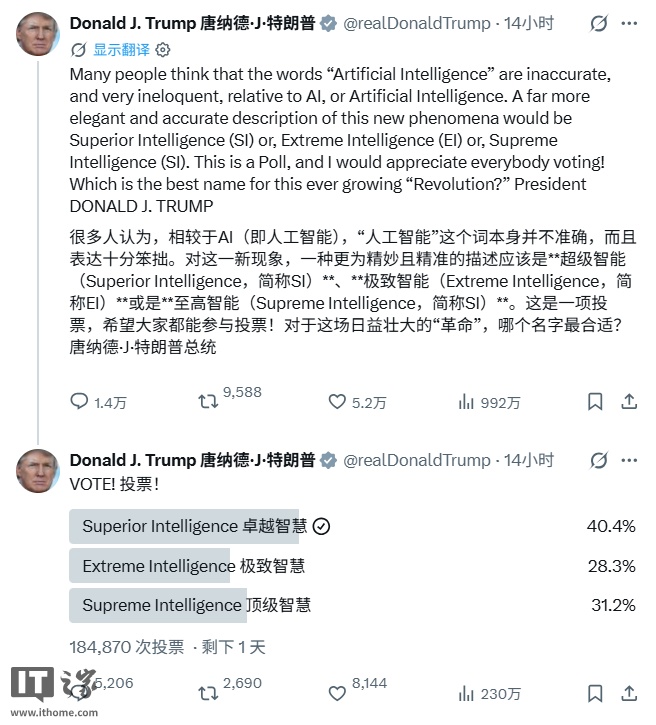
The vote isn't settled, but the new institutions are already rolling
The rename vote is just the appetizer; the institutional build-out is the main course: Trump doesn't want a new word — he wants a new bureaucracy.
While the vote is still running, the personnel moves are already underway. In a post later the same day, he announced he would form an "AI Force," copying the path he took in his first term to establish the U.S. Space Force.
Standing up as an independent service branch, paired with a dedicated civilian chief, with its own budget and headcount — those three pieces together mean AI is no longer a line of business under some existing department, but a force in its own right, with its own designation, its own ledger, and its own commander. Where the money comes from, who gives the orders, and who reports to whom — all of that now gets its own page.
Budget, headcount, commander — that's the whole checklist. A service branch doesn't ask another department for money, doesn't borrow another department's staff, and doesn't take orders from a deputy secretary. The AI Force would write its own line items.
The second position is even more counterintuitive: Trump teased that he would "soon" appoint an AI Czar, with the aside "highly intelligent individuals only" — and no job description. The desk had just been vacated, and he used it to anchor the "AI Force" rollout.
The absence of a job description is itself the tell: this isn't a regulatory role — it's a positioning role. Industry has already set the tone for the new Czar.
For industry, whether the rename succeeds is irrelevant; what matters is that Trump's "Force + Czar" combo elevates AI onto the same presidential marquee track as space and crypto — AI is no longer just another piece of ordinary industrial policy.
Huang's "hoax" verdict, and Anthropic's "destroy humanity" worry
Nvidia's CEO calls resistance to AI a "hoax." A departing Anthropic researcher says it could "destroy humanity." When those two voices collide, the true shape of this debate emerges: it's not just "should we hit the brakes" — it's whose version gets written into policy.
Hours after the rename-vote post, Jensen Huang took the stage at the All-In Summit (Sacks is one of the co-hosts). Trump called in; Huang picked up on stage. He backed Trump's verdict — the current pushback against AI is a "hoax."
Then he delivered a no-holds-barred commitment: "We will never allow" the AI industry's progress to slow down.
The colliding voice came from Anthropic. A researcher who recently left the company put it bluntly: executives at leading AI companies "genuinely believe that AI could wipe out all of humanity before this decade is out," and these companies are essentially gambling with everyone's lives.
Anthropic CEO Dario Amodei then put forward a proposal titled "managing the pace of development of frontier models (the most capable models)," with Sam Altman of OpenAI and Elon Musk of SpaceX both signaling support.
Two camps hold the opposite ends of "should we hit the brakes": on one side, "hoax theory + never slow down"; on the other, "existential risk + slow frontier model development." Between them stands a group of critics whose views don't fit either pole: the claim that "AI will destroy humanity" is, they say, a distraction from the real harms AI is already causing today.
Two open questions will decide how this plays out: the identity and authority of the AI Czar Trump teased, still undisclosed; and whether Amodei's pace-management proposal moves from advocacy to industry self-regulation — for now, Altman and Musk have offered only verbal support, with no concrete commitments.
Our read: as long as "never slow down" is picked up by actual policy while pace management stays parked in blog posts, the "hoax" narrative wins.
A few small things you can do without voting
What ordinary readers can do isn't vote — it's read the next scene correctly.
Grasp one distinction first: the three options in the vote — Superior, Extreme, Supreme Intelligence — are all flattering framings for AI; not one of them is about restriction or regulation. That is the substance of the "rename" move: using a shinier label to pre-filter the conversation about AI risk.
Then go to Truth Social or X and find the original posts. The rename poll and the follow-up "left-wing hoax" post were published separately; read either one alone and you go astray — the vote is real, and the attack on Democrats is real, and only together do they give you his full position. In the comments, Musk didn't pick from the three options — that itself is a statement: he isn't picking a label, he's picking a narrative.
Keep an eye on the "AI Force" and "AI Czar" storylines. Trump didn't say what this force actually does, nor what the Czar oversees, only that the position is "open to highly intelligent individuals only." The previous Czar has departed; the seat is empty. The next name announced, and that person's public résumé, will be worth more attention than the rename vote itself.
Go to X or Truth Social, find Trump's September 19 original posts, read the rename-vote post and the "left-wing hoax" post together — don't read just one.
Look at Musk's reply under the poll post — reproduce the original verbatim, don't interpret for him.
Add "AI Force" and "AI Czar" to your watch list; wait for an official White House announcement before drawing conclusions, and don't invent job responsibilities based on social media wording.
Track New York State's data center permitting freeze — it's currently the only AI-policy move that's actually been implemented at the state-government level rather than stuck in the discourse.
Source: IT Home (republished from TechCrunch; original posts on Truth Social @realDonaldTrump). Methodology note: vote figures are IT Home's real-time X stats as of publication; candidate vote shares may continue to shift. The "AI Force" and "AI Czar" exist only in Trump's posts and teasers so far; responsibilities, headcount, and budget have not been disclosed.