On August 3, Alibaba unveiled Qwen3.8-Max—the most powerful model in the Qwen family to date, with a total of 2.4 trillion parameters(a model's capacity — generally, bigger means smarter) and 95B activations. However, the real headline of this release is not the parameters, but two things: Qwen's first-ever open-sourcing of Max-level weights(the model's core files — get them and run it yourself) (available next week) and the official demonstration of a case where it "continuously programmed autonomously for 16 days."
Alibaba First Open-Sources Max-Level Weights
First, the basic information: Qwen3.8-Max has a total of 2.4 trillion parameters, 95B activation parameters, adopts a MoE sparse architecture(split into many parts; only the needed ones fire per task) (based on the Qwen 3.5 architecture extension), and has a context window(how much text it can hold at once) of 1 million tokens(the units AI bill by). It is the official version of Qwen3.8-Max-Preview, which was launched on July 19—same architecture, but with systematic post-training iterations.
Two key announcements: First, next week, weights will be open-sourced on Hugging Face and ModelScope, marking the first time Qwen has open-sourced Max-level weights, along with the dense model Qwen3.8-27B. Second, the API has officially launched and can be accessed through platforms such as Alibaba Cloud BaiLian, QwenCloud, and Qoder, compatible with OpenAI and Anthropic protocols, allowing seamless integration with development tools like Claude Code and Codex.
The positioning is clear: no longer simply competing on chat capabilities, but focusing on programming, office work, scientific research, and long-cycle tasks, fully targeting production-level AI agents(AI that plans tasks, calls tools, and keeps acting on its own). This is also the first Max-level model from Qwen that supports image, video, long document, and text full-modal input.
Pricing Globally Second, but Standard Benchmark Scores Not Yet Released
API pricing: input 2 USD/million tokens, output 6 USD/million tokens, implicit cache 0.25 USD/million tokens. The official stance is that it is "second only to Fable 5 (Claude) in overall capability," and several third-party blind tests also rank its total score as second globally.
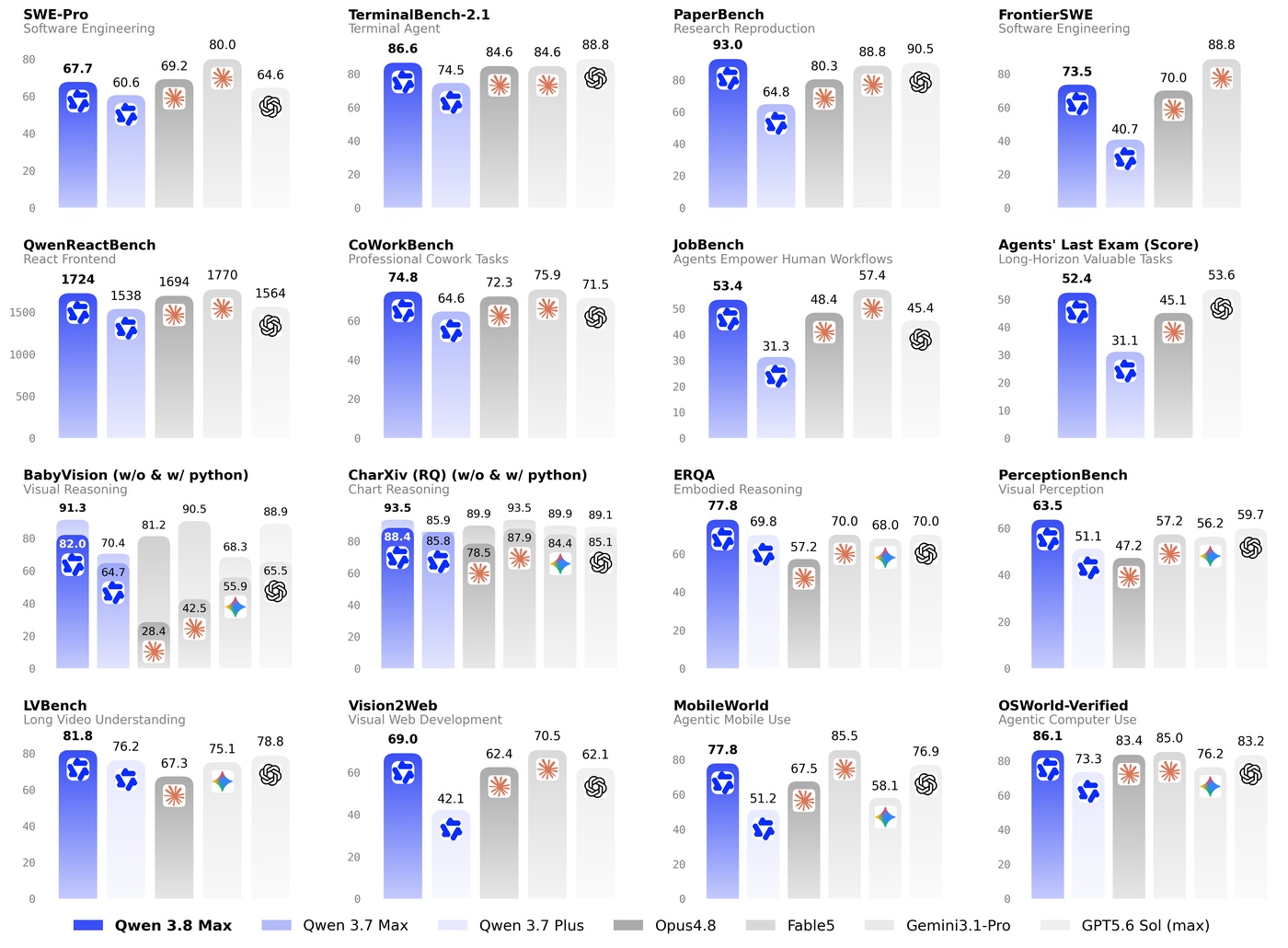
But stay alert: as of the release date, the official has not yet released standardized benchmark(the shared exam models are graded on) scores (SWE-bench Verified/Pro, LiveCodeBench, etc.). The third-party "second only to Claude" judgment is based on blind test subjective scoring, which is not equivalent to audited objective benchmarks. Consider this anchor point: Claude Fable 5's SWE-bench Verified is 95%—for Qwen3.8's official version to firmly establish itself in the second tier, it needs to reach over 70%. Before official scores are released, actual testing is more meaningful than the list's wording.
The "globally second" is currently based on official wording + third-party blind tests, not standardized benchmarking. ZhiDongXi’s actual tests also pointed out that in terms of SWE-bench Pro, TerminalBench 2.1 and other items, it still lags behind the latest closed-source models. Once the weights are open next week, external developers can further verify its true capabilities.
| Dimension | Qwen3.8-Max | Remarks |
|---|---|---|
| Total Parameters / Activations | 2.4T / 95B | MoE sparse architecture |
| Context | 1M tokens | Mixed attention mechanism (MHA + linear attention) |
| API Input Price | 2 USD/million tokens | Cache hit 0.25 USD |
| Overall Ranking | Globally 2nd (official + blind test wording) | Standard benchmark scores pending release |
| Weight Open-Source | Next week | HF + ModelScope, includes 27B dense version |
Data sources: Qwen official release + China Business Journal, ZhiDongXi, segmentfault cross-reporting.
The Key is Not 2.4T, but "Continuous Work for 16 Days"
The most important thing to look at in this release is not the parameter table, but the official demonstration of several long-range Agent cases. They are not testing "writing a function," but "whether it can manage a continuously changing engineering project."
The most astonishing one: starting from an empty folder, Qwen3.8-Max was tasked with creating a project called oh-my-cli, with no human intervention. The model itself organized requirements into issues, took on tasks, wrote code, ran tests, and if they didn't pass, it fixed them itself. As of July 30, it had run autonomously for about 16 days, leaving 265 commits, 127 PRs, and 151 issues in the repository.
Another research reproduction experiment is more like a stress test: giving the model a paper, it was asked to first reproduce and then improve it. It worked continuously for about 125 hours, wrote about 7600 lines of code, performed over 1100 operations, and ran 33 rounds of GPU training, first reproducing the six main conclusions of the paper, and then trying out 18 improvement ideas on its own. Additionally, there are cases such as a 24-hour competition that increased accuracy from 0.60 to 0.853, and about 500 rounds of interaction that optimized the number of gates in a chip netlist from 8298 to 678 (area reduced by 81%).
Boundary Reminder: These are official cases and official evaluations, not all real projects will be this smooth. The value of the cases lies in demonstrating the direction of "long-range autonomous execution," not in guaranteeing reproducibility.
Recipes are Free, but the Kitchen is the Real Barrier
Taking a broader view. The true significance of this open-source release and the counterintuitive consequence it brings are worth separate consideration.
Significance: Over the past six months, DeepSeek has leveraged the 284B V4-Flash to gain an edge with a smaller model, Kimi K3 (2.8T) has just been released with a promise to open-source, and now Qwen has directly unveiled a 2.4T model—and not just the API, but the weights are open-sourced, allowing all enterprises and developers to download, privatize deployment, and secondary modifications. Chinese open-source large models are collectively rushing towards the era of trillion-parameter models. The focus of competition has shifted from "chat capabilities" to "long-range Agents, toolchains, cost, and open-weight pace."
Counterintuitive Consequence: "Downloadable" and "Runnable" are two different things. The 2.4T weight file alone is at the TB level; to truly deploy reasoning, it requires a GPU cluster with high-bandwidth memory (HBM), not a single machine. Open-sourcing lowers the "download" barrier to zero, but raises the "deployment" barrier to the data center level—the demand for GPU/HBM is not reduced, but amplified.
Who Should Use Now, Who Should Wait for Weights
The API is already online, and the weights will be open next week. People with different needs will take different actions:
Want to test capabilities immediately: Use the API (input 2 USD/million tokens), integrate with Claude Code / Codex / Qoder, use the reasoning_effort parameter to adjust reasoning depth.
Want weights for fine-tuning(retraining it on your own materials so it fits you): Wait for the HF + ModelScope to open next week, synchronously there is a 27B dense version (suitable for teams with limited computing power(the computing resources needed to run models)).
Want to privatize deploy 2.4T: First calculate the hardware cost—need HBM GPU cluster, not a single server. If budget is insufficient, use the API or small-size version first.
Want to see true level: Wait for the official standard benchmark scores (SWE-bench, etc.) to be released, or wait for the weights to open and see external actual tests, don't just trust the blind test wording.
Alibaba's open-source release this time is not of a "larger model," but of evidence of a "worker who can work continuously." The 2.4T weights are free to download, but actually running them requires a data center-level GPU cluster—recipes are free, but the kitchen is the barrier. Those who want to use it first use the API, those who want the weights wait until next week, and those who want to privatize first calculate the hardware cost.
"Globally second" is based on official wording + third-party blind tests, standardized benchmark scores have not yet been released as of the release date; 16-day autonomous programming, etc., are official cases, not all real projects can be replicated. Market data such as market value changes are from ZhiDongXi reports.