
When developers call a model offered by multiple providers through OpenRouter, the page quickly selects the one with the lowest listed price; yet the request may take a long time to produce its first token, and after hitting a capacity limit, it may be routed elsewhere. The low price did not make the wait any cheaper. OpenRouter has therefore redesigned its routing: actual price, response speed, rate limits, failures, and answer quality are now considered together, and providers can no longer automatically receive traffic simply by undercutting on price.
The Problem with Automatically Routing to the Cheapest
On OpenRouter, a low price used to mean default traffic almost by definition, because the selection system considered only the listed price per input token.
About 77% of requests use models offered by multiple providers simultaneously. The same model can be executed by different providers, and the router's choice directly determines price, speed, and reliability. For most requests without a specified ranking or provider, the old router selected a provider almost entirely based on input token prices; the lower the quoted price, the greater the share of traffic a provider received.
This rule applied across a wide range of scenarios, but reduced “cheap” to a single input metric. OpenRouter's official summary of the old mechanism was blunt: cheap could win even when performance was poor. A provider only needed to quote a lower input token price to receive more traffic, and whether the service was actually faster or more reliable did not immediately become an advantage.
Failures were handled using the same price order. After a request failed, the system would try the next cheapest provider. This kept the request moving, but it could not erase the wait that had already occurred before the failure; obtaining an answer after rerouting did not mean the full cost of the attempt equaled only the final provider's listed price.
A more difficult issue was that provider rankings did not promptly reflect real-time performance fluctuations. A slowdown or decline in reliability would not immediately alter traffic distribution. A provider might have to deteriorate enough to be downgraded before its ranking changed; until then, its low price would sustain the traffic it received.
The old router therefore rewarded lower quotes rather than more cost-effective calls. Waiting and failure costs went uncounted, and improvements in speed earned no return.
What Exactly Does the Router Count for a Request?
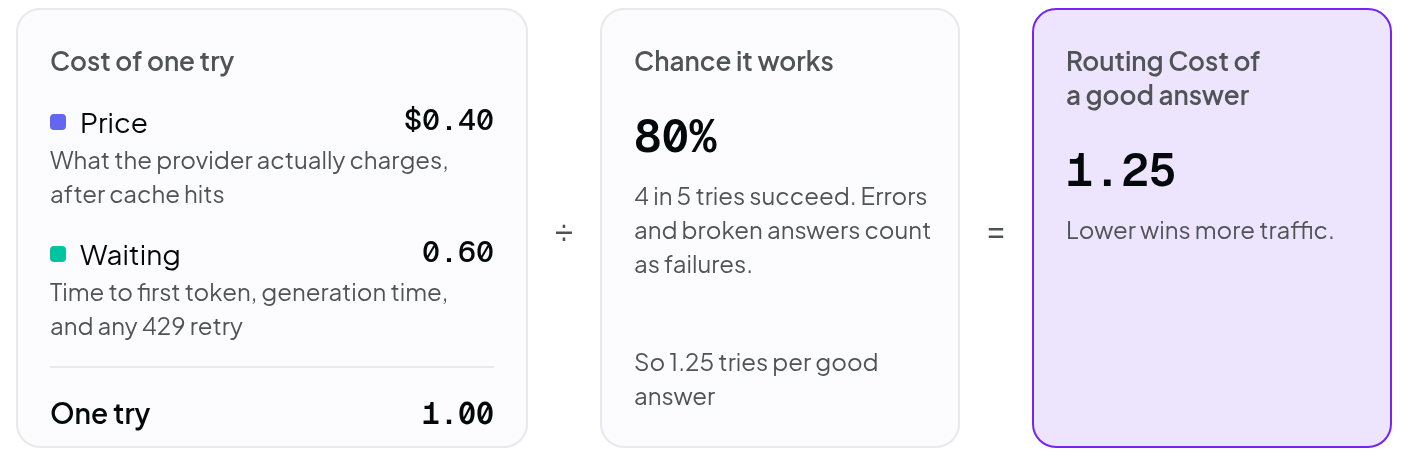
A cheap listed price can still lose. OpenRouter compares calls on Routing Cost(the all-in cost of an attempt): dollars actually paid, time spent waiting, and the cost of retrying failures.
That total is not the provider's unit price. It is built from three parts — the real charge for the tokens used, the wait for a response, and the retries a failed or unusable result forces.
The router starts by sizing the request. It reads recent traffic for the model to guess how many input and output tokens(the unit used to measure text processed by a model) the call will burn. Those guesses set two numbers: roughly what the call costs and roughly how long it takes.
Price enters as the effective price(the charge calculated from actual usage), not the sticker. OpenRouter calibrates it from recently observed traffic, folding in the provider's true cache hit rate(the share of requests that hit cached content) and the model's average mix of input and output tokens.
So a low listed price can hide a high effective one. Cut the input price but charge more for cached or output tokens, and Routing Cost carries the real bill.
Waiting counts too. The router estimates response wait times from recent traffic and adds that time to Routing Cost; the specific conversion depends on the rules applied to each model.
Retries keep stacking after a provider fails or returns something unusable. One attempt, then, is dollars plus time plus whatever the retries cost.

Every Extra Second Adds to the Bill
The lowest quote only answers “what is this call listed at?” The true cost must also account for how quickly the response arrives and how many retries are needed after a failure.
Speed enters the cost through end-to-end throughput(the number of tokens actually output per second). This measure considers not only how quickly the model continues producing tokens, but also the time spent waiting for the first token and the streaming time for the complete answer(returning generated content in successive segments). A long pause at the beginning can lower overall performance even if output speeds up afterward.
The wait for the first token is especially easy to overlook. Consecutive tool calls repeatedly wait for a new response to begin, so first-token latency is added separately to Routing Cost(the all-in cost calculated by the router). Of two providers with the same price, if one begins answering immediately while the other remains silent for a while, the latter has already incurred a greater time cost.
Failures also expose hidden costs. HTTP 429(a server rejecting a request because it lacks sufficient capacity) indicates that the provider has exhausted its capacity. The router includes that wait and the corresponding penalty in the cost instead of treating it as an ordinary failure and continuing.
Retry counts change what “cheap” means. If one in five attempts fails, it takes an average of 1.25 attempts to obtain a usable answer; even if failed attempts produce no complete answer, the waiting, failure, and additional call accumulate. A provider with a lower listed price but frequent rate limits may cost more to produce a usable result—provided rate limiting occurs often enough to trigger retries.
A Failure May Cost More Than a Success
A provider error directly loses the request, forcing it to be initiated again. If a successful call and an errored call carry the same listed price, their recorded costs may be similar even though their business outcomes are entirely different: the former completes the task, while the latter leaves a gap and attaches subsequent retries to the same job.
Penalties also directly alter traffic distribution. When one provider's error rate for a model is clearly higher than those of other providers, the router stops sending it requests until it recovers. No quoted price can win back traffic that has been suspended: a single error has already pushed the cost of that opportunity beyond the point of being worth another attempt.
Unusable answers are treated similarly. Current quality checks primarily examine whether tool calls have the correct format; a provider with malformed tool calls is downweighted and receives only a small amount of test traffic so that it can be validated again rather than continuing to handle normal requests. This test traffic consists of a small number of real requests used to recheck the provider, not a separate manual evaluation system.
The threshold covers more than tool calls. A provider whose benchmark accuracy falls significantly below the expected level is also downweighted and receives only a small amount of test traffic until the relevant flag is cleared.
“Low model price” does not mean “a cheap call”: the former is the provider's quote, while the latter must also include the costs left by failures, unusable results, and subsequent retries or rework.
Why Can a More Expensive Provider Still Receive Traffic?
OpenRouter's new router no longer selects solely on the lowest price. It distributes traffic among providers with comparable performance, allowing faster and more reliable services to continue receiving requests even when their Routing Cost is higher.
Caching can temporarily interrupt redistribution. OpenRouter's routing remains cache-aware (reusing intermediate results from previously processed content): as long as the cache is warm, the same session stays with its original provider, avoiding a switch over minor cost changes and the resulting loss of cache advantages. A higher overall score therefore does not mean every subsequent request will immediately move to a different endpoint.
The router continuously updates provider performance, monitoring each endpoint's actual price, latency, throughput, and error rate, then recalculating Routing Cost in real time. If one provider is significantly faster, or if waiting and failures impose a lower cost, it may win despite charging more; when several providers are close, traffic is divided among them rather than all being funneled to the cheapest one.
This distribution also preserves capacity headroom. When a provider slows down, throws errors, or sees throughput decline, traffic moves away from that endpoint until it recovers, without waiting for it to fall out of a fixed ranking. A temporarily congested service can also shed load promptly.
For cost-sensitive users or those with a clear preference, OpenRouter still offers both price-based sorting and fixed-provider options. Users can specify a ranking rule when they need the lowest available price, or pin an endpoint directly when they need every session to remain with a chosen provider. Default routing handles the overall tradeoff, while explicit settings return control to developers.
How Much Faster and More Expensive Is OpenRouter After the Redesign?
In OpenRouter's official experiments, the redesign delivered faster responses, higher throughput, and fewer capacity errors, while increasing actual call costs by 6.0%.
The time users spend waiting for the first token has decreased. Official tests show a 16.9% improvement in time to first token (TTFT), meaning the time from issuing a request until the first output segment appears. Consecutive tool calls repeatedly encounter this wait, so the impact extends beyond a single opening response.
The speed at which models produce complete answers has also improved. Throughput rose 16.3%, measured in end-to-end output tokens per second, including both the wait for the first token and the streaming time for the full output. The combinations selected by the new routing begin faster, and the entire output process is smoother.
Capacity errors fell by 67%, the most direct change in availability in the experiment. Requests encounter capacity limits when a provider's carrying capacity is exhausted; the new router includes these failures in the true cost of earning traffic, shifting traffic toward endpoints that can handle requests at that moment.
The bill shows a 6.0% increase in actual costs, which OpenRouter describes as a modest increase. A lower price is no longer sufficient by itself to win traffic: providers must also demonstrate shorter waits, higher throughput, and fewer errors.
These figures come from experiments conducted before providers optimized for the new algorithm and should not be treated as the upper bound after optimization is complete. No third-party retesting has been publicly disclosed, so the experimental methodology remains based on official results for now.
As more providers learn to optimize for the new algorithm, how will traffic allocation among price, speed, and reliability continue to change?
The source is OpenRouter's official “Announcements” post and its self-reported experimental results. The performance changes have not been independently retested, and the related figures represent only the official test methodology.