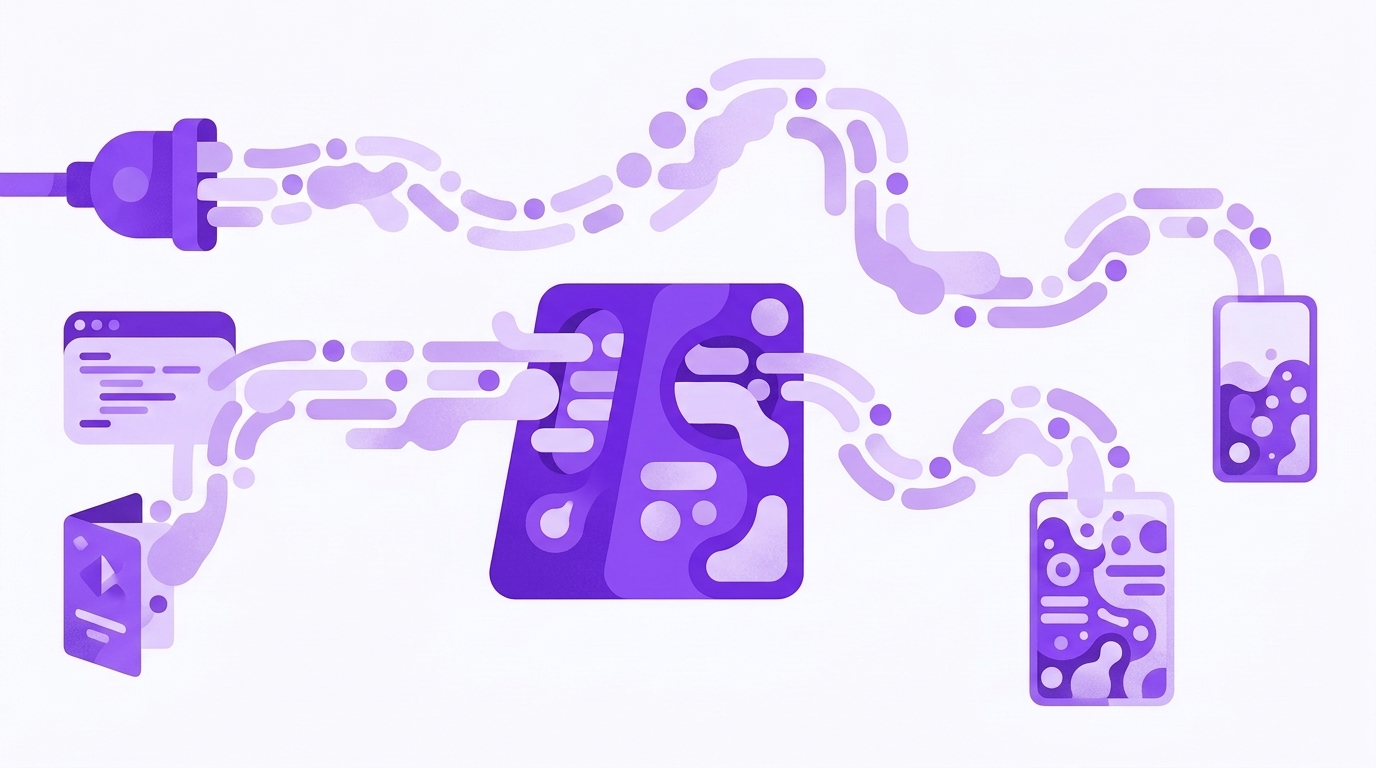
You ask an AI agent to look up the latest release and three bug issues in a GitHub repository. The answers may look identical, but the input-token bill can differ by dozens of times. OpenRouter tested MCP, CLI, and Skills on the same task: MCP, which loads 46 tools by default, consumed the most context; CLI consumed the least; Skills fell in between. What truly determines the cost is how much tool documentation the model reads at the start of each turn and how large the returned results are.
Before the model acts, MCP, CLI, and Skills have already supplied different information
Even before it starts searching GitHub, the model sees different content: MCP lays out the full tool catalog, CLI provides a single entry point, and Skills gives it a catalog that expands into manuals once the task matches.
MCP(Model Context Protocol, a protocol that enables models to call external tools)writes every tool offered by the MCP server into the request. Tool names tell the model what it can call, descriptions explain their purposes, and JSON schemas(specify the JSON format of tool parameters)indicate which fields to populate. All three are sent again with every request, forcing the model to reread the complete tool catalog on every turn.
Could the model instead receive only one entry point and look things up itself? That is the approach taken by command-line interface tools, or CLIs(program interfaces for executing commands in a terminal). When connecting to GitHub CLI, the model initially receives only a shell tool(a tool that lets the model run terminal commands) and a line stating that GitHub CLI is installed and authenticated. It does not need to memorize the full definition of every subcommand in advance; it only needs to know that the program is available and then construct the commands itself.
Can the entry point save even more? Skills does not even provide the full set of entry points upfront. Each Skill initially occupies a single line of description, like a catalog entry telling the model what capability is available; only when the task genuinely requires it is the complete SKILL.md(the full operating-instructions file for a Skill)loaded once. Instead of permanently inserting the instructions into every request, Skills lets the model first decide whether it needs to read them.
| Integration method | What the model receives before execution | What it receives during execution |
|---|---|---|
| MCP | The name, description, and JSON schema of every tool, sent with every request | The tool result returned by the server |
| CLI | A shell tool and a line stating that GitHub CLI is installed and authenticated | Command output |
| Skills | A one-line Skill description; the complete SKILL.md is loaded once when needed | Command output |
At first glance, MCP lays an entire tool manual on the table, CLI hands over a single terminal key, and Skills provides a catalog from which the matching manual is retrieved only when needed.
How many extra tokens does the same MCP toolset cost with different models?
The fixed MCP tool overhead described above varies across models and providers. The number of tools, the model, and the provider can all change this cost.
The default GitHub MCP toolset contains 46 tools. On Claude Haiku 5.5, each request adds 19,436 prompt tokens(the amount of prompt input the model receives each turn).
With the same set of 46 tools, GPT-6 Luna adds 8,903 tokens, while Gemini 3.8 Flash adds 8,525. The toolset does not change at all, yet the token count for the tool definitions differs by model, because each provider uses a different prompt format and counting method. The number of tools alone cannot be used to estimate the overhead.
The results also vary across providers on the same model route. For the same Gemini 3.8 Flash toolset, Google Vertex counts 8,525 tokens, while Google AI Studio counts 13,010. Recording only the model name is not enough; the provider route handling the actual request must also be fixed for testing purposes.
These figures follow OpenRouter's provider benchmarking methodology, and no third-party replication has been reported. Until the toolset and provider are fixed, no individual token count can serve as a budgeting basis.
For the same GitHub query, which method uses the fewest tokens?
When completing the same GitHub query on Claude Sonnet 5.5, the difference in input tokens is clear: CLI uses the fewest, Skill comes next, and MCP, limited to two tools, uses the most. Three figures show the scale of the gap.
OpenRouter's comparison test put the three integration methods through the same GitHub task. CLI used 1,421 input tokens in total, Skill used 3,315, and MCP, scoped to two tools, used 23,228. Here, “input tokens” refers to the prompt content read and billed by the model(context text received and billed by the model), not merely the sentence entered by the user.
| Integration method | Input tokens | Relative to CLI |
|---|---|---|
| CLI | 1,421 | Baseline |
| Skill | 3,315 | 1,894 more |
| MCP limited to two tools | 23,228 | 21,807 more |
How large is the gap? Skill used 2.3 times as many input tokens as CLI, while MCP limited to two tools used slightly more than 16 times as many. However, these results cover only this task on Sonnet 5.5 and cannot be treated as a fixed ratio for every GitHub query or other model.
Each combination was run three times, and the article presents the median, or middle value, of the three results. This is more representative of the task's typical input usage than a single run, but it is not the cumulative bill for the three runs.
Claude Haiku 5.5 counts prompts in the same way as Sonnet 5.5, so their input-token figures can be interpreted using the same methodology. Some Haiku 5.5 runs used more turns, and once the number of turns changes, the two models' bills can no longer be compared side by side.
A single tool result can outweigh an entire tool catalog
One release object returned by GitHub runs about 20,400 tokens. All 46 tool definitions in the default GitHub MCP toolset add up to 19,436. The result is bigger than the catalog.
On Claude Sonnet 5.5, that matters for the prompt token(units of input text the model reads while processing) bill. Start with one call, not a dozen: a single release result already costs more than every tool definition combined.
The overhead compounds across turns. The first turn carries the tool definitions. Once a tool returns a release object, that data sits in the context. Call another tool, and the next request still carries the earlier definitions and results.
So the total depends on how many calls you make and how big each result is — not just on how many tools are mounted.
Tool definitions are a fixed bill. Tool results are the bill that grows with the task.
Tool Search saves the entry cost, but not necessarily the final bill
Tool Search cuts the upfront definition cost, but the total bill can go either way.
Tool Search is OpenRouter's server tool (a tool hosted and run by the server). The 46 tools previously supplied to the model together are searched before the initial definitions are reduced to fewer than 600 tokens. The model no longer has to read the entire tool catalog when it starts.
But the test results cut both ways: on Sonnet 5.5, using Tool Search cut the total task cost in half; on Haiku 5.5, it increased the cost instead. The same optimization did not move both models' results in the same direction.
Initial cost is not the same as the final bill. Once the task begins, the model still has to find the appropriate tool, make the call, and receive the result; Tool Search saves only the entry stage. It shortens the tool-definition phase but does not automatically rewrite the subsequent execution process.
These figures come from OpenRouter's own test, and the article provides no third-party replication. They show how the tool performed with this set of models and tasks, but they cannot be treated as a fixed ratio for every workflow.
Returning to this GitHub query: the same answer can be obtained through MCP, CLI, or Skills, but the context bill differs. When the toolset is not fixed and the model has not been selected, loading the full default GitHub MCP toolset is the least predictable integration method in terms of cost.
Source: OpenRouter's official blog post, “MCP vs CLI vs Skills: What Each Costs in Context”; the methodology uses the median of three runs under OpenRouter's selected GitHub query, tool configuration, and model environment. Input tokens and costs come from its tests, with no third-party replication provided.