OpenAI Reveals ChatGPT User Demographics: Increase in Users Over 35
ChatGPT User Base Reaches 1 Billion, Significant Rise in Workplace Usage
OpenAI recently released a report disclosing the changing trends in ChatGPT's global user demographics, including total user count, usage scenarios, and age composition.
According to OpenAI's blog post on August 6th, ChatGPT's global user base has surpassed the 1 billion mark. This milestone signifies ChatGPT's transformation from a mere Q&A tool to a more versatile task execution tool. In workplace settings, users employ ChatGPT more frequently compared to non-work scenarios. Data shows that the likelihood of using ChatGPT for tasks like writing, coding, editing, and analysis in work settings is more than double that of non-work settings. In contrast, usage in non-work scenarios remains primarily focused on "questioning" or seeking information and explanations.
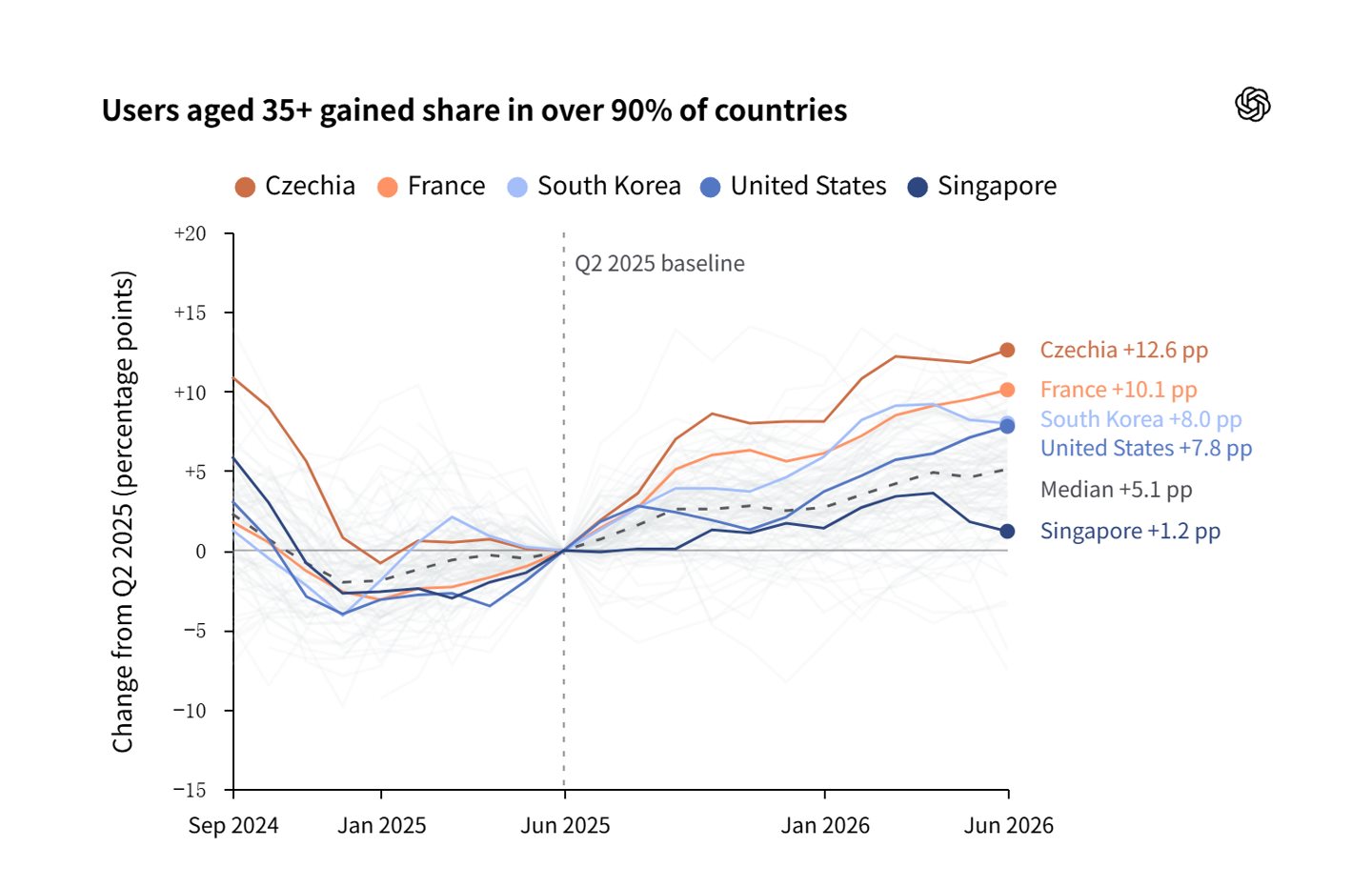
In terms of functionality expansion, the launch of ChatGPT Images 2.0 has spurred growth in multimedia applications. Since its release in April 2026, the global proportion of multimedia-related messages has risen to 7.8%. Despite multimedia usage showing the fastest growth, it still lags behind leading application scenarios such as practical guidance, writing, and information search. In terms of age composition, there has been a significant increase in usage among users aged 35 and above. Compared to 12 months ago, the share of messages sent by these users has increased by 5 percentage points, with countries like France and the Czech Republic seeing increases of over 10 percentage points.
From Q&A to Task Execution: The Evolution of ChatGPT's Capabilities
ChatGPT's usage is evolving from a simple Q&A tool to a more complex task execution tool. What are the technical mechanisms behind this shift? How does it differ fundamentally from previous language models?
ChatGPT's core mechanism lies in its use of transformer architecture(a specialized neural network architecture) capable of handling long-range contextual dependencies. Unlike traditional RNN(Recurrent Neural Networks), transformers utilize self-attention mechanism(a method of calculating weights) that allows them to simultaneously focus on all positions in the input sequence, thereby understanding context more effectively. This mechanism enables ChatGPT to better handle complex tasks such as writing, coding, and analysis.
Another key feature of ChatGPT compared to earlier dialogue systems is its powerful fine-tuning(optimization through specific datasets) capability. In training ChatGPT, OpenAI used vast amounts of text data from the internet, covering a wide range of topics and styles. This approach allows ChatGPT to generate more natural and diverse text. Additionally, OpenAI employs human feedback reinforcement learning(a training method that incorporates human feedback) to continuously improve the quality of the model's output, better meeting user needs.
In terms of multimedia processing, the release of ChatGPT Images 2.0 marks a further enhancement of its capabilities. This version introduces more advanced multimodal processing(ability to process text and images simultaneously), enabling ChatGPT to understand and generate image-related descriptions and content. This improvement broadens ChatGPT's application in multimedia scenarios, such as image recognition and image description generation.
The evolution of ChatGPT's mechanisms has transformed it from a mere Q&A tool into a more powerful task execution tool. This shift is evident not only in the improvements to its technical architecture but also in the continuous expansion of its application scenarios. As ChatGPT's capabilities continue to improve, its influence across various fields will further strengthen.
Users Over 35: The New Mainstay of ChatGPT
OpenAI's latest data indicates a significant change in ChatGPT's user base, with a rapid increase in usage among users aged 35 and above, making them an important force that cannot be ignored on the platform.
Compared to 12 months ago, the share of messages sent by users aged 35 and above has increased by 5 percentage points. This change may seem small, but given ChatGPT's large user base, it equates to tens of millions of new mature users.
There may be several reasons behind this phenomenon. Firstly, the ChatGPT(an AI dialogue model) has been continuously enriched in functionality, expanding from initial text generation to areas such as multimedia processing and programming assistance, attracting more mature users who need to handle complex tasks. Secondly, as ChatGPT becomes more widely used in work settings, professionals over 35 may be more inclined to use AI tools to improve work efficiency. Data shows that users are more than twice as likely to use ChatGPT for tasks in work settings compared to non-work settings, indicating that ChatGPT is transforming from a "Q&A tool" to a "task tool."
Additionally, the growth of the mature user group may also be related to the increased popularity and acceptance of AI technology. As AI technology continues to advance, more users are beginning to recognize the value of AI tools and integrate them into their daily lives.
Significant Growth in France and the Czech Republic
OpenAI data shows that ChatGPT's user demographics in Europe are undergoing significant changes, particularly in France and the Czech Republic, where usage among users aged 35 and above has increased substantially.
In France and the Czech Republic, the proportion of messages sent by users aged 35 and above has increased by more than 10 percentage points over the past year. This growth trend is not limited to these two countries but is also evident in other parts of Europe. In nearly 75% of European countries, the increase in the proportion of messages sent by users aged 35 and above is higher than the average.
This trend indicates that ChatGPT is expanding from its early young user base to a wider demographic. As its features continue to improve and users become more familiar with AI tools, more middle-aged users are starting to use ChatGPT in work settings. OpenAI's report shows that users are more than twice as likely to use ChatGPT for tasks in work settings compared to non-work settings, indicating that ChatGPT is becoming an important tool for professionals.
Furthermore, ChatGPT's multimedia capabilities are also growing rapidly. Since the release of ChatGPT Images 2.0 in April 2026, the global proportion of multimedia-related messages has risen to 7.8%. Although multimedia usage still lags behind leading scenarios such as practical guidance, writing, and information search, its growth momentum is strong, indicating that user demand for the diversification of AI tools is increasing.
In the future, as AI technology continues to develop and user habits evolve, ChatGPT's user base and usage scenarios may continue to expand. OpenAI needs to closely monitor these trends to ensure its products can meet the changing needs of users.
How to Personally Experience ChatGPT's New Changes
OpenAI's report showcases the changing trends in ChatGPT's global usage. As users, we can experience these changes firsthand through some simple operations and verify the trends mentioned in the report.
First, you can try using ChatGPT in work settings to complete some practical tasks. According to OpenAI's data, users are more than twice as likely to use ChatGPT for tasks in work settings compared to non-work settings. You can start with the following aspects:
Use ChatGPT to write a work report or meeting minutes, observing the accuracy and practicality of the generated content.
Try using ChatGPT to write a piece of code to solve a technical problem you are currently dealing with.
Give ChatGPT a lengthy document for summarization and refinement, to see if it can capture the key points.
Utilize ChatGPT to analyze a set of data, generating charts or reports, and evaluate its analytical capabilities.
Second, you can explore ChatGPT's multimedia applications. Since the release of ChatGPT Images 2.0 in April 2026, the proportion of multimedia-related messages has risen to 7.8%. You can try the following operations:
Upload a picture and let ChatGPT describe the content of the picture or generate related text descriptions.
Let ChatGPT generate a picture based on a text description, testing its image generation capabilities.
Try using ChatGPT to create a piece of music or audio, evaluating its performance in audio generation.
Finally, pay attention to the changing trends of age groups. According to the report, the share of messages sent by users aged 35 and above has increased by 5 percentage points over the past year. You can verify this trend by observing the usage habits of yourself and those around you. For example, you can:
Ask friends and relatives over 35 if they use ChatGPT, and understand their usage scenarios and frequency.
Initiate a survey on ChatGPT usage habits on social media, focusing on feedback from different age groups.
Record the number of times you or your friends use ChatGPT in a month and the purpose of use, comparing the usage patterns of different age groups.
Through these operations, you can not only experience ChatGPT's new changes firsthand but also gain a deeper understanding of its usage trends on a global scale.
This article is based on the original article from IT Home (2026/8/7). The numbers released by the manufacturer (benchmark scores, decreases, etc.) are official figures and have not been independently verified by third parties unless otherwise stated.