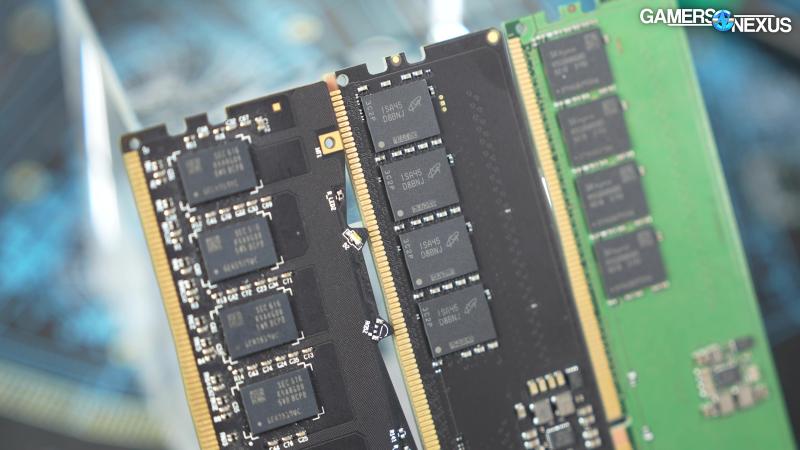
Micron, Samsung, and SK Hynix have locked 50–70% of their capacity into 3–5 year long-term agreements (LTAs), selling to 5–16 top-tier clients. Over the past year, 32GB DDR5 kits have surged 363%, while high-end DDR5-6000 64GB kits have jumped roughly 483%. GamersNexus's verdict: memory makers have finally found a way to break the boom-bust cycle, and that's bad news for consumers. The era of cheap memory may be over.
Prices doubled or tripled in a year; the worst nearly five times over
From last September to now, average memory and SSD prices have doubled or tripled depending on category. The two tiers mentioned in the lead are the most expensive in this round.
GamersNexus has been tracking sample average prices since last September: 2TB NVMe SSDs up 137%, 2TB SATA SSDs up 183%, 32GB DDR4 kits up 294%, and 32GB DDR5 kits up 363%.
Neither the two main memory generations—DDR4 and DDR5(DDR refers to memory generations; DDR5 is the current mainstream, faster and pricier than DDR4)—nor the two SSD interfaces—NVMe and SATA(SSDs are solid-state drives that store files and the OS; NVMe runs over PCIe for higher speed, while SATA is the previous-generation interface)—escaped unscathed.
High-end models are even more extreme: the average price of a DDR5-6000 64GB kit jumped from $240 to $1,300–$1,400, a rise of roughly 483%. A 128GB DDR5-6400 G.Skill ECC Registered module(error-correcting enterprise-grade memory, originally designed for servers and workstations) that GamersNexus bought for $1,060 in 2024 is now out of stock, with secondary-market listings as high as $6,800; the same series' 512GB kit climbed from $4,200 to $23,811. Over the same period, a 4TB Samsung 990 Pro went from $390 to $1,100, a 254% increase. The consumer shortage has already spilled over into the workstation and content-creator segments.
Capacity no longer goes to the highest bidder; the first question is: how long did you sign for?
Micron, Samsung, and SK Hynix have dismantled the memory pricing cycle with a single sheet of long-term contracts. The cycle only worked because capacity wasn't locked away in advance—how much wafer each fab produced, who it was allocated to, and at what price all followed the spot market. Oversupply meant price drops; undersupply meant spikes, on a three-year rhythm. That rhythm has now been broken by the three numbers in the card above.
What really changed is the allocation rule. In its analyst call materials, Micron said it outright: the company is allocating capacity "based on the depth of the partnership rather than the price offered." Who can pay doesn't matter—what matters is who signed early and signed long. The same materials contain an even harder line: on the DRAM side, "supply to customers outside the top 10 will be restricted."
Where does the consumer market get pushed? Capacity outside LTAs is already scarce, so the retail side (memory modules, standalone SSDs, finished consumer electronics) can only get the remaining 30–40% on the spot market—and when AI demand peaks, it gets pushed to the back of the line. Samsung and SK Hynix's capacity figures point in the same direction, though individual contract counts haven't been disclosed.
The contract length is the real issue. Three to five years means this upcycle won't follow the old script—the expanded wafer output was written into LTAs before construction even began. GamersNexus's verdict: "memory makers have finally found a way to break the cycle, and that's not good news for consumers." Capacity used to be the spot market's buffer; now the spot market is the LTAs' overflow valve.
Amazon is telling you not to buy hardware
A cloud seller publicly says local hardware is getting too expensive—you should move to the cloud. The winners of LTAs aren't just the memory makers, but also the very hyperscalers who most want to push you onto the cloud.
Rising consumer prices should be driving customers away from the cloud—everyone would rather buy their own machines than rent compute. Reality flipped the other way. GamersNexus's September 2026 report spelled it out: Amazon publicly stated that more users will consider moving to the cloud because of rising local hardware costs.
Those words carry different weight coming from a cloud vendor. Amazon isn't a bystander—it's a member of the buyer cohort that's siphoning consumer capacity away.
Here's how the mechanism works. 50–70% of Micron, Samsung, and SK Hynix's capacity is locked into 3–5 year contracts, sold to 5–16 top-tier clients—the vast majority of them hyperscale cloud providers(cloud service operators that build their own mega-data centers, such as AWS, Azure, and Google Cloud). When consumer demand fluctuates or retail channels run dry, memory makers have no free capacity to redirect. JP Morgan further points out that while LTAs help hyperscalers hold down procurement costs, they leave memory makers almost unable to respond to consumer demand. Supply is locked, and prices stay locked at the high end.
Small businesses and independent developers are the first to get squeezed. Local server upgrades are unaffordable; a 128GB DDR5-6400 ECC Registered module is simply unavailable through mainstream channels, and the only option is third-party sellers at $6,800. Building a high-end workstation now costs more than renting cloud capacity—which is exactly the story cloud vendors want to sell: stop buying hardware, hand your workloads over to us.
The decade-old common sense that "fixing a computer is cheaper than renting the cloud" is reversing. Amazon's public stance and JP Morgan's analysis point to the same conclusion: when a cloud vendor publicly tells you not to buy hardware, it's not serving customers—it's harvesting a market that the LTAs themselves created.
The memory price fire is reaching MRI machines
Average smartphone prices jumped 27.6% in a year to $581—shipments are falling, prices are rising.
IDC gives two numbers: global smartphone shipments in 2026 will drop 16.7%, while the average price climbs to $581, up 27.6% year-over-year. Volumes down, prices up—memory costs are passed straight to consumers.
Apple's price-hike list includes the MacBook Neo, MacBook Air, MacBook Pro, Mac Studio, the entire iPad lineup, HomePod, Apple TV, and Vision Pro.
Tim Cook said it bluntly at what was his final earnings call as CEO: "We really don't want to raise prices, but this is a once-in-a-century memory flood—memory prices are going up exponentially."
Game consoles are adjusting too. Xbox raised its 512GB model by $100 and its 1TB model by $150 starting August 1, and discontinued the 2TB model outright. The official announcement contained an even harsher line: storage and memory prices are expected to double again before fall 2027.
The Nintendo Switch 2 has risen above MSRP, and the Sony PS5 has had two price hikes within a year. Amazon has raised prices across the Echo Dot, Kindle, Fire TV Stick, and eero router lines.
The CSO of TechInsights offered an even more pointed take: iPhone price hikes are just the beginning—even MRI machines may face production delays. That claim has a real-world basis: MRI and other medical imaging devices rely on high-capacity, high-speed storage and memory chips to cache scan data, and manufacturing capacity priority has already been locked up by data center LTAs (multi-year supply contracts).
Watch two names and you're covered
The only variable for the consumer market is whether two new Chinese fabs can pull global average prices down. Watching them is an earlier signal than watching the big three's earnings reports.
First, what's confirmed now: Yangtze Memory Technologies (YMTC) has already broken into the global top three for NAND shipments, overtaking Kioxia, Micron, and Western Digital; ChangXin Memory Technologies (CXMT), per Counterpoint data, has captured 10% of global DRAM revenue. NAND is the chip that stores data inside SSDs, DRAM is the chip inside memory modules—both Chinese makers are climbing both lines simultaneously.
But the source is blunt about this: both companies are being blocked from the U.S. by the American government, despite selling consumer-grade storage. In other words, Chinese fabs can expand capacity and pull global average prices down, but they may not be able to sell directly to U.S. consumers. The U.S. market is still controlled by Micron, Samsung, and SK Hynix—and the LTAs are theirs too. The root cause of consumers not getting cheap memory hasn't moved.
So "what can be done now" needs to be split into two layers. The first is observation: watch Counterpoint's next-quarter global DRAM revenue rankings to see if CXMT's share keeps climbing or pulls back; at the same time, watch the U.S. Commerce Department's Entity List (a blacklist restricting companies from doing business with American firms) for any new entries or exemptions for YMTC and CXMT—that directly decides whether Chinese capacity can flow into the U.S. consumer market. The second layer is waiting: wait for Micron's late-September earnings call to disclose the number and term of newly signed LTAs. If new contracts this quarter continue at the "3–5 years, 50–70% capacity lock" pace, the low-price era's absence will be confirmed once more; if a top-tier client drops out mid-contract or pivots to in-house DRAM, the consumer side might finally get a breather.
Amazon publicly urging users to the cloud, and JP Morgan saying LTAs have left memory makers unable to respond to consumer demand—taken together, these two signals mean the pace of cloud vendors' in-house memory development will determine how long consumers have to wait. Every bit of DRAM capacity Google, AWS, and Azure develop in-house is one fewer LTA client for the big three, and that freed-up capacity will, at some point, flow back to retail.
One final, more pragmatic point: don't gamble on memory prices falling and stockpile now. The past year's SSD and memory price jumps are fact, not forecast.
Check the next Counterpoint quarterly report to confirm whether CXMT's share of global DRAM revenue remains above 10%.
Review U.S. Commerce Department Entity List announcements and watch for any new provisions or consumer-product exemptions for YMTC and CXMT.
Wait for Micron's late-September earnings call and note the number of new LTA clients, contract terms, and locked capacity ratios.
Track in-house memory chip progress at Google, AWS, and Azure—each additional die means one less squeeze on the consumer side from LTAs.
Bookmark your current memory and SSD models on a price-comparison site like PCPartPicker, note today's price, and recheck in 90 days to confirm the trend.
Source: GamersNexus original report "Memory Companies Have Destroyed the Consumer Market" (2026-09-29). Data scope is based on the site's average price sampling of in-stock e-commerce models and vendor earnings disclosures.