
A Chinese AI model has become so popular this month that it was "forced to stop selling new memberships." Just days after Moonshot AI's open-source model Kimi K3 was launched, the company admitted in a late-night post on Sunday: Over the past 48 hours, demand has approached the upper limit of our current computing power(the computing resources needed to run the model), forcing us to pause new subscriptions and prioritize existing users, with plans to gradually reopen access.

First, let's talk about what makes it strong: a genuinely formidable "world's largest open-source model"
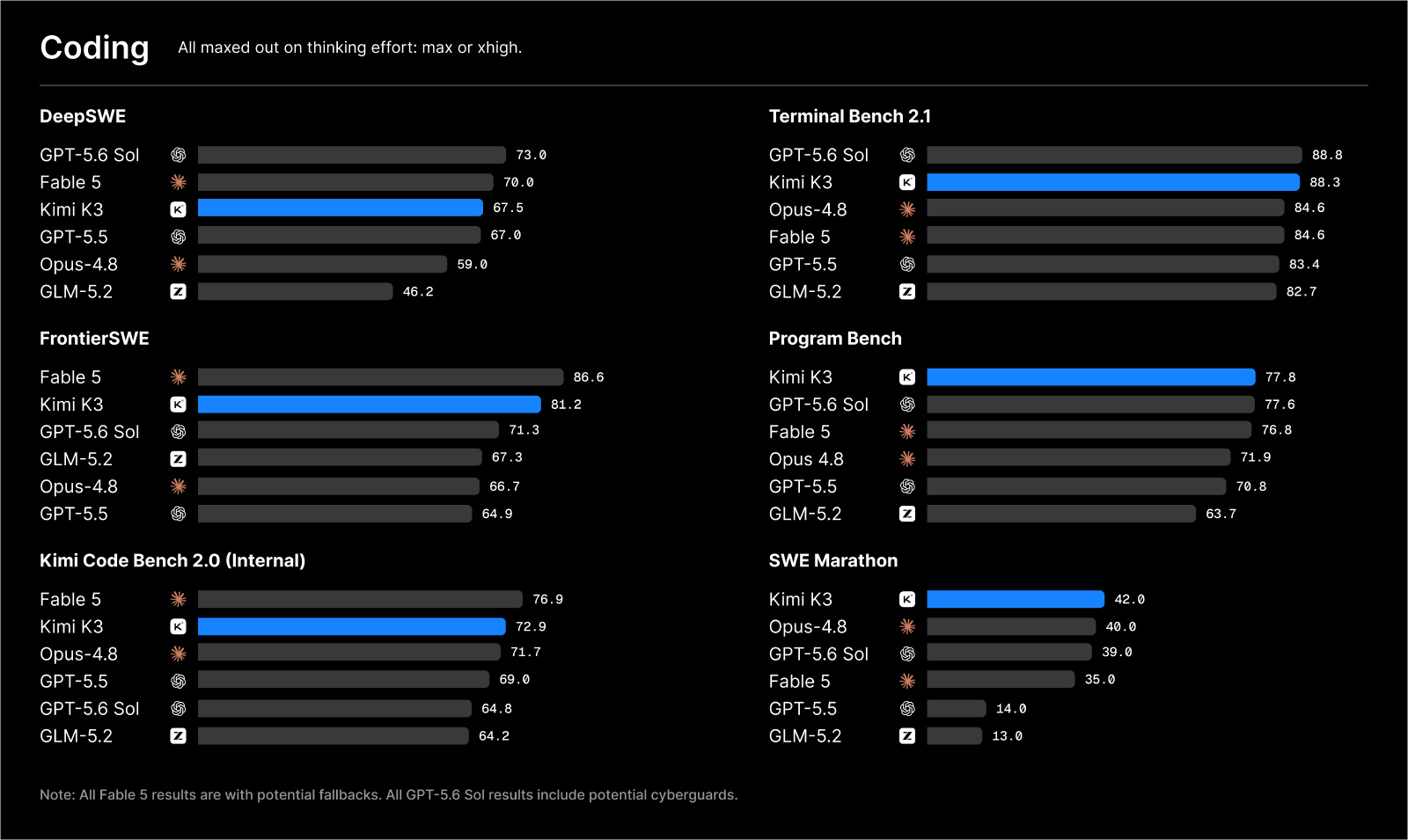
Kimi K3 didn't become popular due to marketing. Its parameter count(a number that measures the size of the model, usually the larger the number, the higher the potential capability) has reached 2.8 trillion, making it the largest open-source model(model weights are made public, allowing anyone to download and develop on top of it) currently in the world.
After its public release, it topped the "front-end coding capability" leaderboard on the AI model evaluation platform Arena, outperforming many more well-known closed-source models. Because it is open-source, affordable, and powerful, it quickly gained fans both domestically and internationally after its launch, and demand in the first 48 hours pushed its computing power to the limit.
The sales halt exposes not a model weakness, but a chip shortage
The real point of interest is the reason for the sales halt. Omdia chief analyst Su Lianjie believes that the release of a new model naturally triggers massive interest and puts pressure on existing computing infrastructure, and this time it "indicates that Moonshot does not have enough chips to support the current peak in demand."
He adds that a more likely reason is that Moonshot did not anticipate K3 would be this popular, and that K3's demand for computing power is "very high," making the allocation of computing resources both tight and expensive. In other words, what is holding back China's top models is not intelligence, but the availability of enough top-tier chips.
This is not just Kimi's story. On the same weekend, Alibaba previewed the 2.4 trillion parameter Qwen3.8 Max, claiming it is one of the strongest models in the world; last month, startup ZhiPu (Z.ai) launched GLM-5.2; and DeepSeek has its latest V4. Most of China's cutting-edge models follow an open-source, low-cost route and are collectively capturing global attention.
Why a "too popular" Chinese model makes US tech stocks tremble
The release of K3 has put pressure on the stock prices of US tech giants. The logic of market concerns is straightforward: if China can continuously produce cheaper, yet powerful open-source models, the pricing power and demand that US AI companies pride themselves on could be eroded.
Even though US-led restrictions have already blocked China from obtaining some of the most advanced chips. This creates a curious situation: on one hand, the best chips cannot be bought; on the other hand, the model is so good that it exceeds the available computing power. The sales halt is precisely the most direct evidence of this pent-up demand.
With the combination of open-source, low-cost, and powerful features, K3 gained fans both domestically and internationally upon its launch, and the entrance was jammed within 48 hours—this is the most direct trigger for the "sales halt."
K3 has an extremely high demand for computing power, but top AI chips are subject to export restrictions, making it impossible to expand capacity by adding chips in the short term, hence the need to close new customer access.
China's continuous production of cheap and powerful open-source models threatens the pricing power of US AI companies, and the US stock market is also under pressure—this is why it is receiving special attention.
So, as an ordinary reader, how should we view this matter?
Don't be swayed by the two extreme views of "Chinese model topping the charts" or "it's just because they can't buy it." Here are four judgments you can use immediately:
Want to try it out: New subscriptions are temporarily closed, keep an eye on Moonshot's official "batch reopening" announcement, don't trust third-party proxy subscriptions.
It's open-source: Teams with sufficient computing power can directly download the weights and deploy it on their own, without waiting for its subscription slots.
Don't take "number one" as all-powerful: K3 took the lead in front-end coding, but that doesn't mean it's the strongest in every task.
Evaluate in two columns: When judging a model, separate the "how strong is its ability" from "can you really get the computing power."
Kimi K3's popularity to the point of sales halt is not a marketing gimmick, but a manifestation of hard constraints. It used the trio of open-source, low-cost, and powerful features to halt its own computing power, and also softened the US stock market; but this halt also shows that the current ceiling for China's cutting-edge models is not in how smart the model is, but in how much top-tier computing power it can access—remember to separate "ability" and "availability" when reading such news.
This article is based on primary sources and cross-checked reporting. Vendor-published figures are the vendors' own and have not been independently verified unless noted.