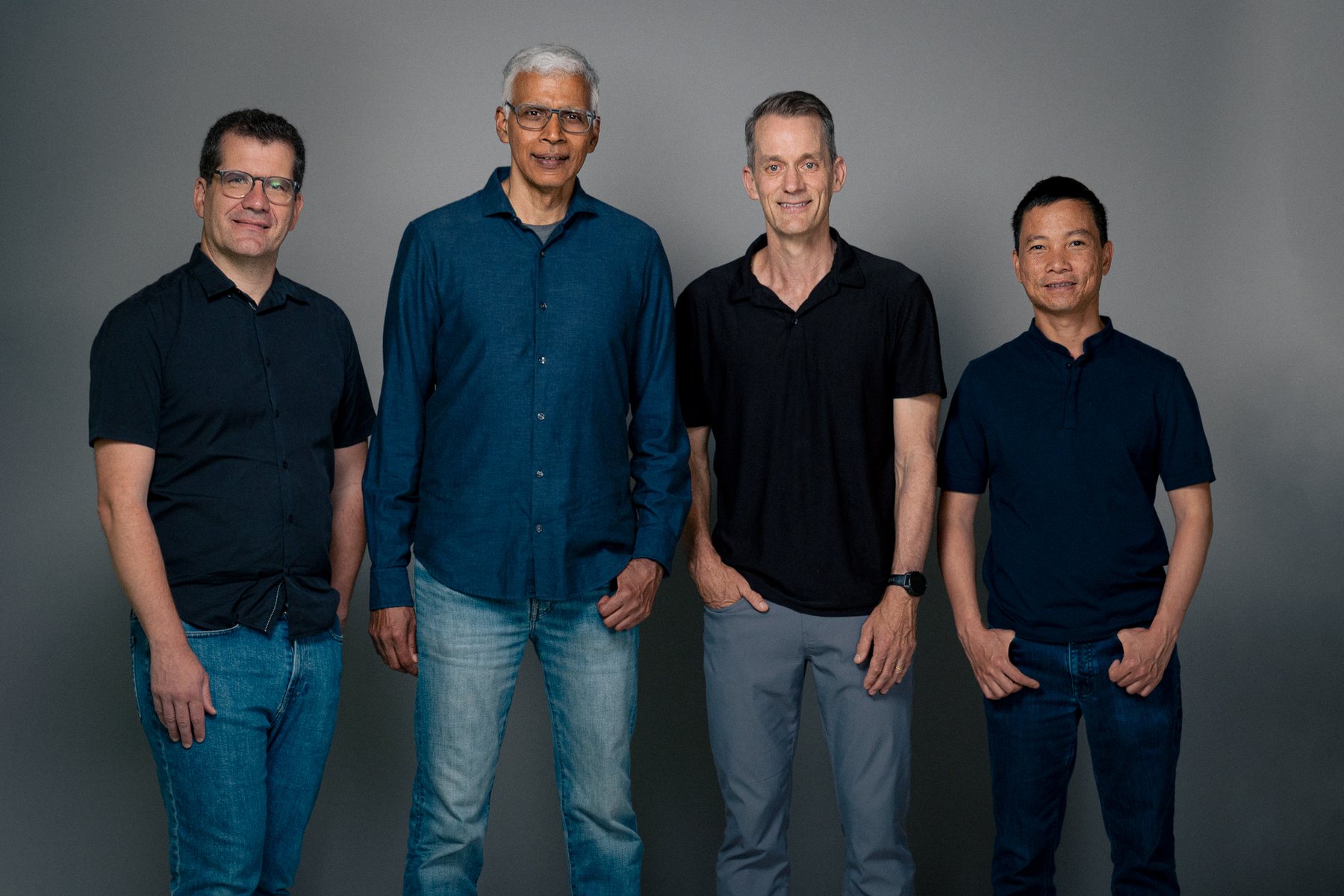
On the morning of August 6th, Google's Chief Scientist Jeff Dean announced his departure on X, ending his 27-year tenure at the company—he joined as employee number 30 in 1999 and witnessed its growth from 25 people to 190,000. Even more significant was the departure of his companions: Sanjay Ghemawat, a founding father of distributed systems, Oriol Vinyals, the technical lead for Gemini(Google's flagship large language model, competing with the GPT series), and Quoc Le, co-founder of Google Brain(Google's deep learning research team, established in 2011). The four have founded a new company called Discovery Loop. On the same day, DeepMind CEO Demis Hassabis announced his resignation.
Three Announcements, One Day
This is not an isolated departure announcement, but rather a triple change in Google's AI leadership in a single day.
First, Jeff Dean's farewell. In his farewell letter, he wrote that he witnessed Google's growth from a 25-person team to 190,000 employees, with 13 products now having over a billion users each. His last working day is August 7th.
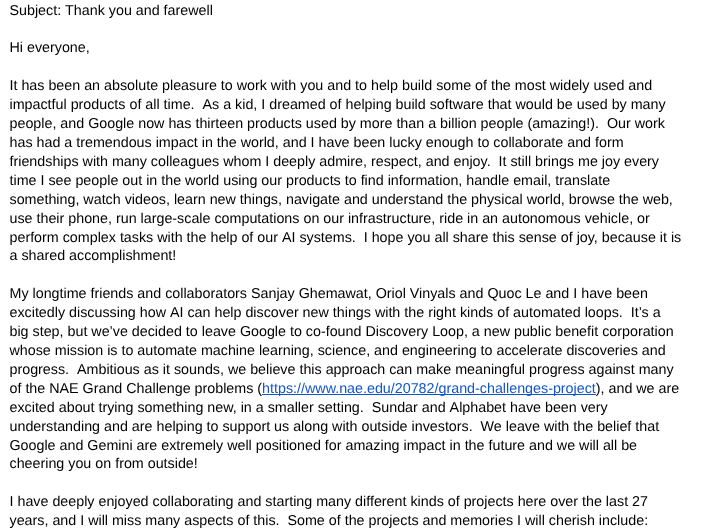
Second, Discovery Loop's official launch. Dean will serve as CEO, co-founding the company with Ghemawat, Vinyals, and Quoc Le—collectively, their time at Google spans over 80 years.
Third, DeepMind's leadership change. Hassabis steps down as CEO, becoming Chairman and Alphabet's new Chief Scientist, focusing on long-term strategy; his deputy, Koray Kavukcuoglu, takes over as CEO, reporting directly to CEO Sundar Pichai.
Departing Not Just as Executives, but as Pillars of Google's AI Foundation
To understand the magnitude of this upheaval, one must first recognize where these four individuals stand in Google's structure.
Jeff Dean — Overall Coordination. Co-designed MapReduce(a framework for parallel processing of large datasets), BigTable, Spanner, laying the groundwork for the big data era; in 2011, co-founded Google Brain (the team that "recognized cats from YouTube videos"); led the merger of Brain with DeepMind, co-leading Gemini.
Sanjay Ghemawat — System Architecture. One of Google's two highest technical ranks, partnered with Dean for over two decades; the backbone of today's mainstream cloud computing and big data systems can be traced back to his work.
Oriol Vinyals — Large Models. DeepMind Research Vice President, Gemini Technical Lead, previously led landmark projects such as AlphaStar.
Quoc Le — Automated Machine Learning. Co-founder of Google Brain, a pioneer in the field of AutoML (making machines design models automatically).
The four cover large models, automated machine learning, system architecture, and overall technical coordination—almost the entire load-bearing wall of Google's AI edifice. This is why the market reacted with a 4% stock price drop.
Google Loses Talent but Becomes an Investor
The most unusual aspect of this departure is its amicable ending.
According to Wired, Pichai made several attempts to retain them, but the four found the freedom of a startup more appealing. Vinyals put it bluntly: "In a large company, to make fundamental changes, one must always overcome a lot of inertia."
But Google did not burn bridges: Alphabet became a founding investor in Discovery Loop and signed a one-year cloud resource supply agreement, continuing to provide cloud resources. In other words, while Google suffers the stock price impact of talent loss, it also spends money to bet on the very talent it lost—if the path of "AI automated science" proves successful, Google wants to be at the table. Beyond Google, the seed round was co-led by Radical Ventures and Khosla Ventures, with Kleiner Perkins, Lightspeed, and Doerr Capital participating.
For Google, it is better for these individuals to go to a company they have invested in than to a competitor. This is a farewell with a hedge.
Discovery Loop's Mission: Letting AI Do Science Itself
The new company has chosen not to create another large model, but to bet on a more radical path.
Discovery Loop is registered as a benefit corporation(a company form that balances commercial profit with public mission), aiming to use large-scale computing power to automate experimental processes in science and engineering: simultaneously initiating and iterating on thousands of experiments, partially or completely replacing human experimental cycles. Initially focusing on automating machine learning research itself, with future expansion into drug development, hardware design, and clean energy. The founding team's joint statement is straightforward: "The next great frontier for AI will go beyond answering questions and begin making discoveries."
Translated into industry language: they aim to create a recursive self-improving(AI continuously improving its own capabilities, getting stronger over time) research engine—allowing AI to improve the way AI research is conducted itself. This is both one of the most imaginative directions at present and one of the most controversial in terms of safety.
Just Watch Three Things Next
The aftershocks of this earthquake will last a long time, but ordinary people only need to watch for three signals.
Discovery Loop's first achievement. "AI automated research" is still a vision; when the first tangible result appears and whether it can truly replicate scientific discoveries will be the only test of its validity.
DeepMind's transition. After Koray Kavukcuoglu takes over, will the iteration pace of Gemini change; how much actual influence will Hassabis retain as Chairman and Chief Scientist.
Whether Google's brain drain continues. The four did not just take themselves. If more core researchers follow in their footsteps, this event will change from an "isolated case" to a "trend."
The real focus of this earthquake is not who left Google, but that the "cornerstone layer" of Google AI has begun to spill over. The designers of MapReduce, the founders of Brain, and the co-leaders of Gemini all departed on the same day to work on "AI doing science itself"; Google was poached, yet it paid to become a founding investor. Twenty-seven years of service in exchange for a new bet—next year, watch whether Discovery Loop can turn "beginning to make discoveries" from a slogan into published papers.
The core facts of this article come from Jeff Dean and Demis Hassabis's official announcement tweets (2026-08-06), and have been cross-checked with multiple media outlets including TechWeb, Guandianwang, and Sohu Technology. The stock price drop and market cap loss figures are based on media reports, with slight variations across sources; the details of Pichai's retention efforts are paraphrased from The Wired; the seed round funding structure is based on Wall Street Insight/PANews reporting.