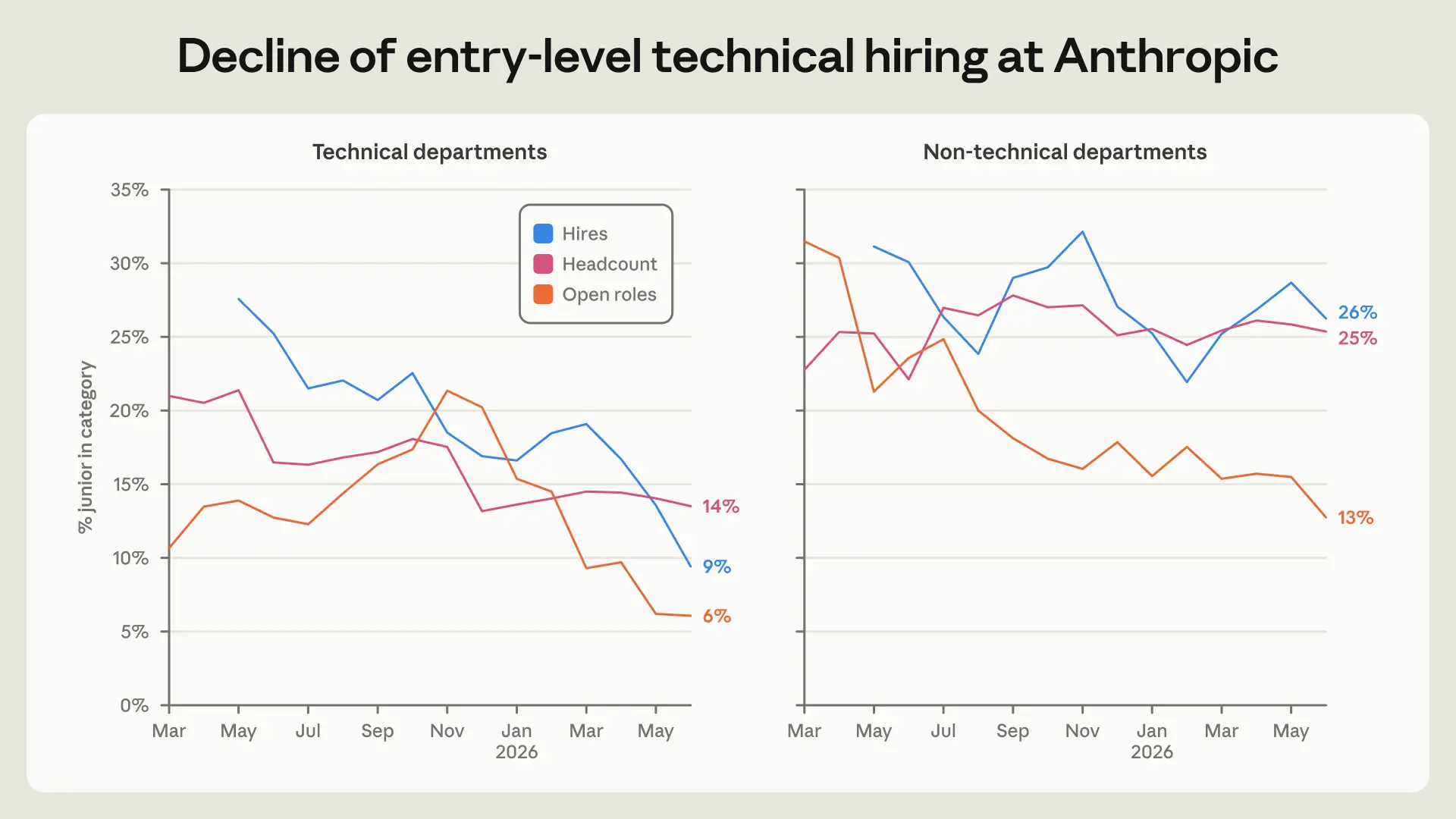
Anthropic has released internal hiring data showing that entry-level technical staff dropped from 21% to 14% of the workforce, new entry-level hires fell from 27% to 9%, and over the same period, Claude agents have accumulated work hours six times that of human employees. The company that understands AI best has taken AI to its extreme — and shone that same light on itself, revealing that "entry-level roles have nearly vanished." The savings show up this year; the costs won't surface until after 2030.
Two-thirds of entry-level roles have disappeared at Anthropic
While Anthropic's AI agents (AI programs that can run tasks on their own without human supervision) have multiplied work hours by 6x, the company has cut entry-level hiring nearly to zero.
In October 2026, Anthropic published an internal study. The data starts from early 2025: within technical roles, the share of entry-level employees dropped from 21% to 14% of the total workforce. The new-hire numbers are even more dramatic — the entry-level share of new technical hires plunged from 27% to 9%. Open entry-level positions are shrinking too, with the decline accelerating after December 2025 and bottoming out at just 6% by August 2026.
Non-technical departments were largely untouched. This contraction was precisely aimed at entry-level technical roles. Anthropic's explanation points directly at Claude: tasks like writing code and finding bugs — the kind that used to be training ground for junior developers — are now being taken over by AI. The more complex the work Claude handles, the steeper the drop in entry-level hiring.
The timeline lines up. December 2025 was the watershed — open entry-level positions accelerated their decline from that point, precisely the months when Claude agent work hours crossed above human work hours (that inflection point is unpacked in Section 2).
Anthropic also acknowledges in the report that it is an extreme sample: a highly AI-native software company, a fast-growing business, with employees eagerly adopting AI tools on their own. All of these conditions combined to flatten entry-level roles this severely.
What happens after the flattening — the report offers no answer.
Every department got leverage applied — R&D got the most
Anthropic broke the data down by department and calculated a leverage ratio for each. R&D's 19:1 is the most extreme number in the set.
Code submissions from engineers hit 5.1x, query volume from data scientists 3.1x, contract processing in legal 3.1x, sales closes 1.7x, and both hiring onboarding and accounting invoices 1.4x. The further you move toward R&D, the more extreme the number; the closer you get to roles that need human judgment, the more moderate it becomes.
That 19:1 is a work-hour ratio: hours of Claude output per hour of engineer time. It is not a claim that Claude out-produces the entire engineering staff.
These are vendor-reported internal statistics with no third-party verification, drawn from a single AI-heavy company in a high-growth phase where staff adopt the tools voluntarily — a best-case selfie, not an industry average.
A 6:1 work-hour ratio is one thing; whether the AI does work of equivalent quality per hour is another. Anthropic's numbers measure "task volume," not "task complexity" — more code submissions doesn't mean every line is valuable, and more contracts processed doesn't mean every one was properly reviewed. The announcement does not break down this distinction.
The truly counter-intuitive part is that Anthropic reports 6:1 on hours internally, yet the broader macroeconomy has yet to show any measurable AI-driven productivity gain. The AI dividend is still locked inside a handful of AI-heavy companies and hasn't spilled out onto the street.