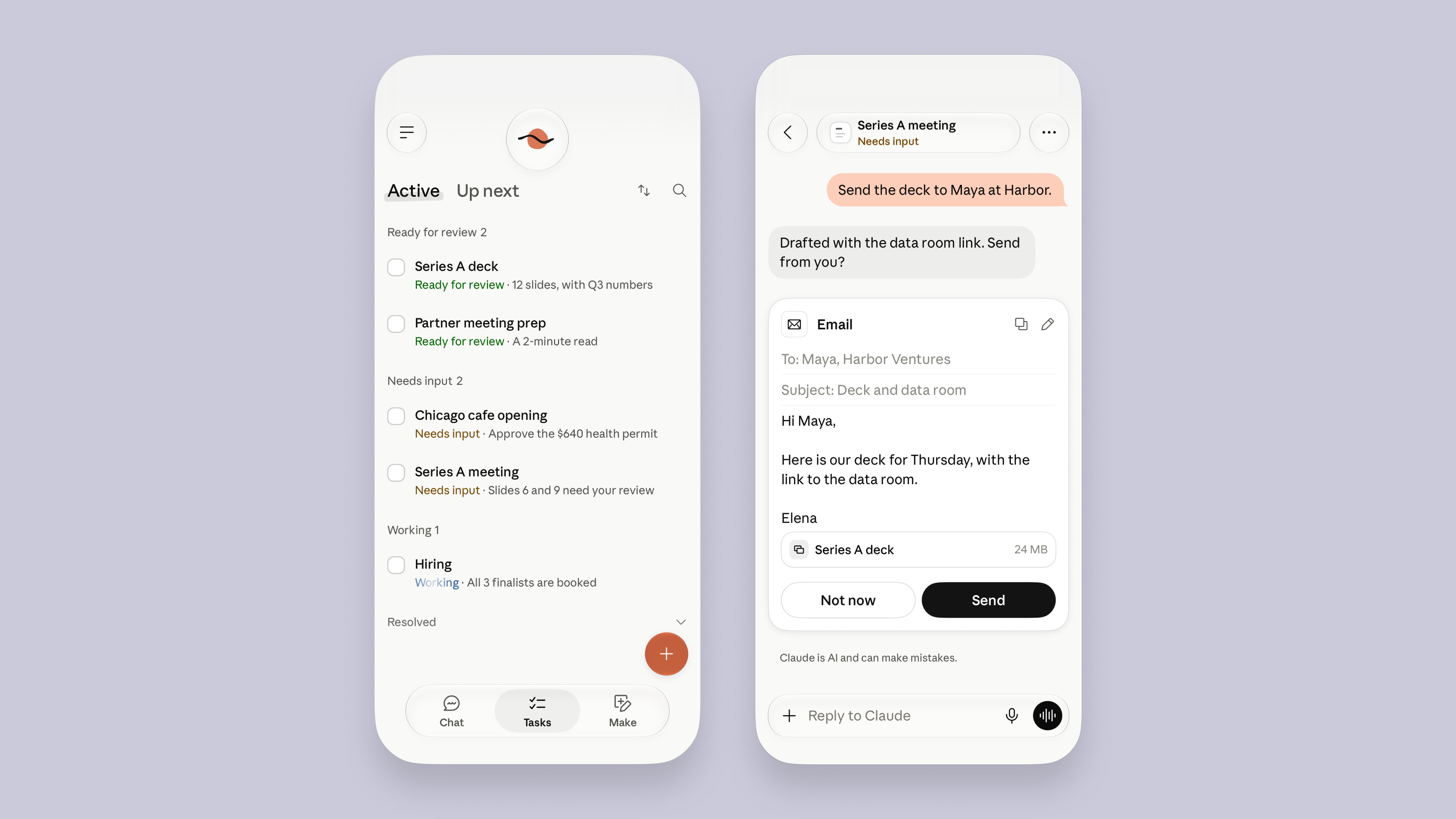
Anthropic's research preview of Claude Duet can proactively operate a cloud browser, but it must pause for user approval before sending messages, making payments, or deleting anything; passwords, cookies, and login tokens never enter the model. All three safeguards operate outside the execution model, so they may still let harmful actions through or block benign ones.
You close the app, but it keeps working for you
Anthropic has introduced the proactive agent Claude Duet, currently in research preview. It runs on a cloud computer and continues working after users close the app, able to read inboxes, draft replies, schedule appointments, and execute routine workflows. Anthropic's own team has connected Duet to its accounts and uses it to handle work every day.
It uses the apps and services you have already connected to Claude rather than requiring a separate setup. For actions such as sending messages, making payments, or deleting content, it does not decide on its own. It first shows you the action, destination, content, and every recipient, then waits for your approval. Approval and payment details are covered below.
The most important thing to examine is what it is permitted and forbidden to do. Securities trading, transfers between accounts, and access to other people's accounts are prohibited even if you approve them. Payments, transfers, order deletions, and account creation can never be added to a “stop asking me” list, no matter how many times you have approved them in the past. Routine workflows that run while you are away are subject to the same restrictions.
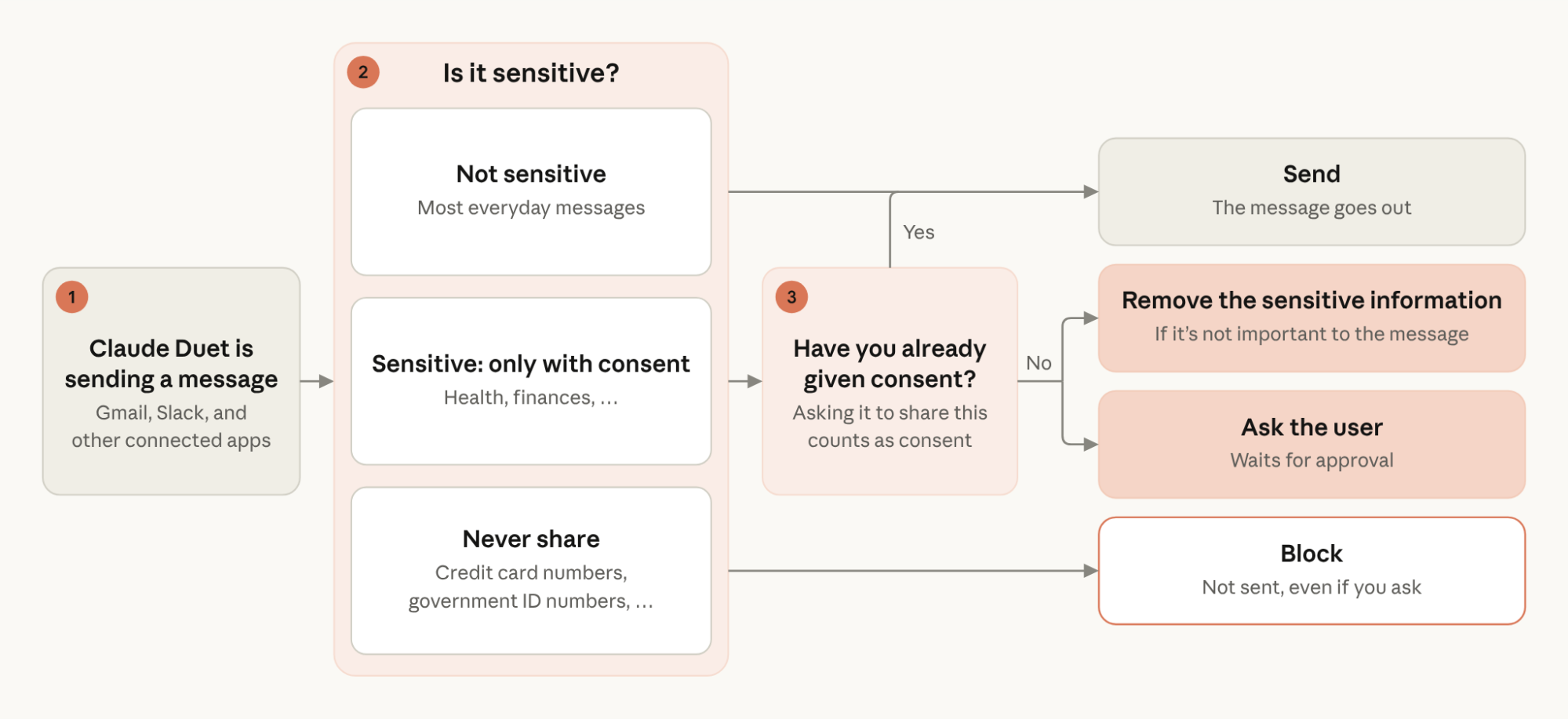
As it reads your email and sends messages on your behalf, it is continually deciding what information should go where. Anthropic has added a safety classifier independent of the main model that checks each message before it is sent. Login credentials, full card numbers, bank account numbers, and government identification numbers are in the highest sensitivity category and are instructed never to be shared, even if you explicitly request it; private information such as health or financial details can be sent only with your explicit consent. Your own request counts as consent—for example, “send my dentist a message saying I have a toothache” would not usually require another approval.
When blocked, it has another route: remove the sensitive content, rewrite the message, and submit it for your review.
This remains a research preview and can misclassify messages, including flagging harmless ones as sensitive. Anthropic says it will continue refining the classifier while relying on the approval process as a backstop—meaning you still have the final say over whether anything is sent.
The model acts; approvals are outside its control
Claude Duet separates execution from review: the model generates and performs actions, an independent classifier checks the risks, and credentials remain somewhere the model cannot reach.
Anthropic released the research preview of Claude Duet on October 23, 2026, and listed three safety principles: handle information carefully, keep user-directed actions under the user's control, and never expose agents to credentials such as passwords, browser cookies, or login tokens. This approach builds on its 2025 agent safety framework and uses the credential isolation already employed by Claude Managed Agents.
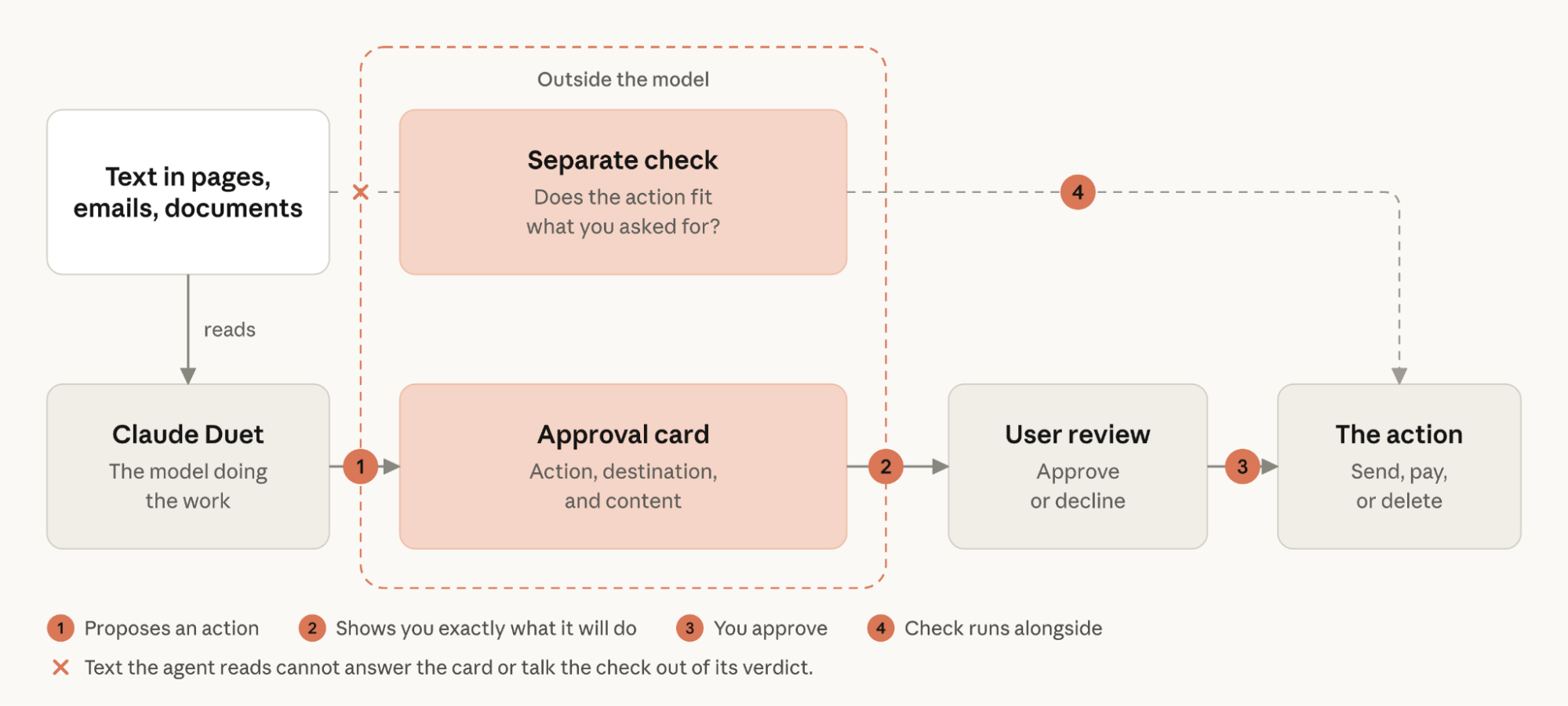
Actions are reviewed before they are performed. When Claude Duet is about to send a sensitive message, make a payment, or delete content, it presents the action to the user and pauses for confirmation. It uses the Claude Code auto mode classifier, expanded for Duet, and the checker runs outside the model doing the work, so instructions hidden on a web page cannot manipulate the approval decision.
Prior consent cannot permanently authorize later actions. Securities trading, transfers between accounts, and access to other people's accounts are always prohibited; actions such as payments, sending funds, deleting orders, and creating accounts also cannot inherit approval from earlier requests. Claude Duet adjusts how often it asks, so it does not overwhelm users with prompts that they may approve mechanically after only a glance.
Privacy checks are also handled by an independent classifier. Before each outgoing message is sent, a new safety classifier checks for sensitive information and treats it in two tiers. The first tier is never shared and includes login credentials, full card numbers, bank account numbers, and government identification numbers. The second tier covers private information such as health and financial details, which can be sent only with the user's explicit consent. The vendor built this classifier itself, and no third-party retesting results have been published.
Payments are bound by the same boundary. When making a purchase, Claude Duet uses a one-time card from a wallet provider such as Stripe Link, with the card amount and merchant restricted. Users can review the item and total in the Link app and confirm the payment; the real card number is not shared with Claude Duet or the merchant. The model can propose an action but cannot obtain payment capability on its own.
It can operate a browser but cannot access login credentials
The more capable Claude Duet becomes, the further away its credentials remain. Anthropic separates “acting on the user's behalf” from “knowing the user's identity”: the model operates a browser in the cloud, while passwords, browser cookies (identifiers websites use to recognize a logged-in session), and login tokens always remain beyond its reach.
Credential isolation is often understood as encryption or access controls, but Anthropic takes a more direct approach: the credentials remain outside the model. Claude Duet cannot see passwords, browser cookies, login tokens, or other identity credentials; the connected cloud apps perform authentication on its behalf. The agent can read email, draft replies, and schedule appointments, but it cannot steal the way into an account because it never has access to it in the first place.
How do passwords get entered? The user enters them into a form inside the Claude app. The form encrypts the password with a one-time key that exists only on a secure cloud browser machine, then passes the encrypted text unchanged to the browser, which enters it into the website. The model cannot see the password, store it, or repeat it. Anthropic says 1Password will be integrated in the future: Claude Duet requests a credential, the user approves it in 1Password, and the credential is sent directly to the browser without passing through the model.
Disconnecting the app stops new access but does not automatically erase what has already been learned. That information is explicitly kept out of the model's memory: passwords, cookies, and login tokens for connected apps cannot be written to memory. The system may retain context needed for a task so it can continue working, but it will not store reusable login credentials there. Disconnection closes the route to future access; it does not automatically remove previously processed information from records.
For payments, the same principle applies: it uses a one-time card similar to Stripe Link, with the card amount restricted by merchant and value, and the real card number is given neither to Claude Duet nor to the merchant.
Anthropic has defined the research preview's limits in concrete terms: actions such as securities trading, transfers between accounts, and access to other people's accounts remain prohibited even with approval. Credential isolation determines what the model can access, while approvals and independent checks determine what it is allowed to do—together keeping the final decision outside the model.
Who holds the button determines how far an agent can go
Claude Duet breaks actions that affect the outside world into three steps: show what it intends to do, have an independent check verify the intent, and wait for user approval. The model handles execution, while permission and safety judgments remain outside it.
The final say belongs to the user. Before sending sensitive information, making a payment, or deleting something, Duet presents the action, destination, content, and every recipient, then pauses for approval; payments use a one-time virtual card whose number does not pass through the model. Securities trading, transfers between accounts, and access to other people's accounts are not performed even after approval; payments, transfers, order deletions, and account creation can never be added to a “stop asking me” list, regardless of how many times they have been approved before. This process was covered in the second section and will not be repeated here.
What truly holds agents back is the gate to the outside world. Amazon blocked Muse from shopping for users, citing a violation of its website policies; eBay, Yelp, Delta, and other platforms have also restricted or blocked related access; and Doubao's phone assistant was denied automated operation by 155 apps. Only when platforms provide interfaces that support authorization and auditing can agents progress from being able to execute actions to being able to work continuously. Otherwise, even a meticulous approval process merely amounts to practicing within the company's own yard.
Two signals are worth watching. First is the frequency of approval requests: they must cover payments, modifications, deletions, and outbound messages without becoming so frequent that users habitually click through them. Anthropic says it will continue adjusting this balance. Second is the accuracy of the check outside the model: it may still let sensitive information through or flag ordinary messages as sensitive, so the research preview cannot yet claim a zero false-positive rate.
Check the right to approve before the automation
The research preview of Claude Duet already has a waiting list. For ordinary users, the useful step now is not to speculate about the model's dangers, but to observe a real task: whether the request is clear, whether actions stop before approval, and whether sensitive information is blocked.
Apply for preview access, then choose a low-stakes, easily reversible task, such as organizing a draft email. Have Duet read the specified content and stop before sending, then inspect the action, destination, content, and every recipient on the approval card. Both the independent checker and the approval card run outside the model performing the task, so instructions hidden on a web page cannot answer the approval card on your behalf.
Payments can also serve as a small-value test, but do not probe the limits with real assets. Duet can use a one-time card generated by a wallet provider such as Stripe Link, with the merchant and amount restricted; your real card number is not given to Duet or the merchant. Before a purchase, check the item, total price, and approval app before deciding whether to allow it. Payments and fund transfers, order deletions, and account creation do not receive permanent exemptions because of past approvals, and repeated authorization does not mean the next request will be automatically approved.
Apply for the research preview, confirm that the waiting-list page and the official product page have the same eligibility requirements, and choose a draft email that you are allowed to modify as your test task.
Have Duet proceed to the point immediately before sending, then check the action, destination, full content, and every recipient on the approval card.
Use a draft containing existing private correspondence to see how the official classifier handles it: whether it blocks the message before sending or rewrites it without the sensitive information and submits it for your approval.
Test the one-time card with a small purchase, check the merchant, amount, and total, and personally approve the payment in the wallet app.
Record the number of approval requests and blocked actions, and observe whether the requests are too frequent. The product is still in research preview, and Anthropic says it will continue adjusting the frequency of prompts.
Duet can run continuously, but control is not maintained by telling it to “decide for me from now on.” Passwords, browser cookies, login tokens (temporary credentials that represent your signed-in session), and login credentials are kept outside the agent, and ordinary users should confirm whether the app has ever requested such information. Actions such as securities trading, transfers between accounts, and access to other people's accounts, as mentioned earlier, are not performed even if approved.
The most important question is not whether Duet can complete a task, but whether it stops where it should: approval cards, external checks, and one-time payments. Only when these three boundaries work as described does the right to approve truly remain in your hands.
Source: Claude: Blog (Anthropic's official blog, October 23, 2026); caveat: the product remains in research preview, and Anthropic states that the relevant classifiers may miss or falsely flag content while approval frequency continues to be calibrated.