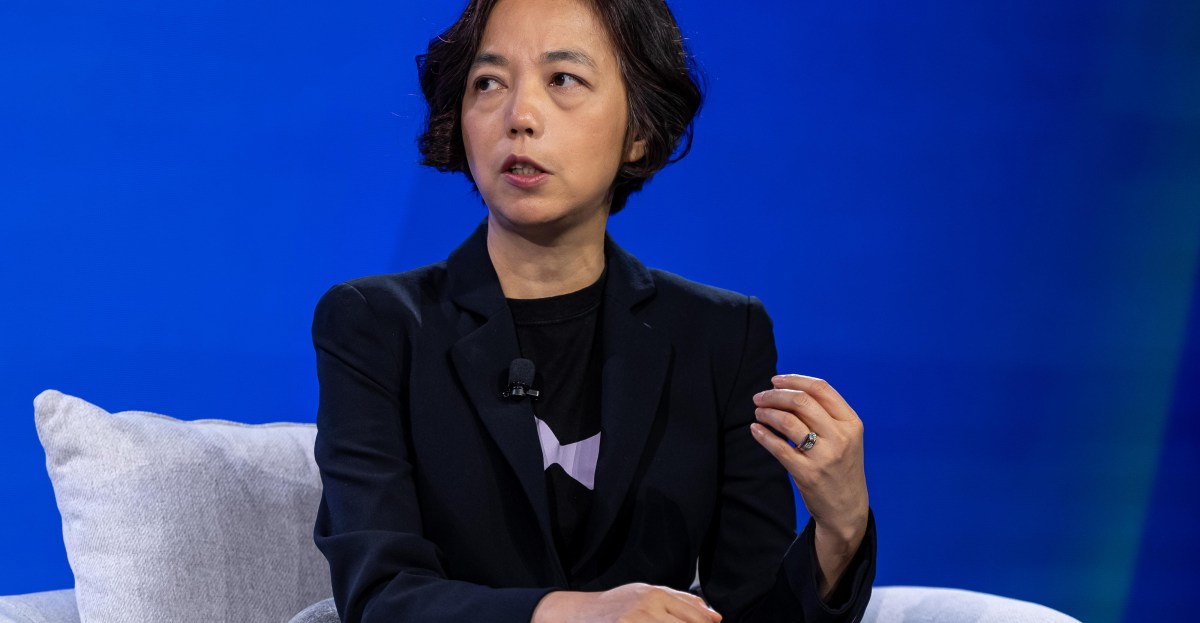
AMD has folded World Labs — co-founded by Fei-Fei Li — into its empire in an all-stock deal worth roughly $8.2 billion. Li will step in as Executive Vice President and Chief Scientist, reporting directly to Lisa Su. World Labs was only founded in 2024, and its first commercial product, Marble, launched in 2025, selling 3D world generation. What AMD is paying for isn't a product premium — it's the Li team's judgment about how much compute next-generation models will consume. That judgment will end up written into chip design specs.
$8.2 billion lands on the AI chip battlefield in just two days
AMD has scooped up an AI research company founded only in 2024, absorbing it into itself in an $8.2 billion all-stock deal.
On September 28, 2026, AMD announced the acquisition of World Labs for roughly $8.2 billion in an all-stock transaction, expected to close by year-end. Fei-Fei Li will become Executive Vice President and Chief Scientist, reporting to CEO Lisa Su.
Su put the rationale plainly: building the compute platform for next-generation AI demands a deep understanding of how models are evolving, and Fei-Fei Li and the World Labs team bring top-tier research leadership and model expertise. Li herself framed the merger as an effort to "bring technological breakthroughs out of the lab" — to "scale up investment, broaden reach, and get closer to the hardware."
The deal looks even more striking on the larger board. Earlier this month, Nvidia announced its own acquisition of Hugging Face for nearly $13 billion. Together, the two AI chipmakers have poured over $20 billion into model companies in less than a month. The race to define what kinds of models chips should be designed for has already begun.
So what exactly is $8.2 billion buying? World Labs was only founded in 2024, and its first commercial product, Marble, went live in 2025. Fei-Fei Li is a Stanford computer science professor, regarded as a pioneer in AI for leading the construction of ImageNet(an image database that drove breakthroughs in modern AI vision capabilities), with research focused on computer vision and "physics-grounded general intelligence." AMD isn't buying a product — it's buying the Li team's judgment about where models are headed.
AMD isn't betting on Marble — it's betting on the power to define the next generation of chips
What $8.2 billion buys is the Li team's judgment about how much compute future models will need — and that judgment will be written into next-generation chip design specs.
First, what AMD is actually buying. In 2024, Fei-Fei Li co-founded World Labs, focused on getting deep learning models to understand physical reality. In 2025, the company launched its first commercial product, Marble: input a prompt, get out an interactive 3D world. The product can generate revenue — but that's not what AMD is paying a premium for.
Here's the question: what makes a startup that makes a 3D generation tool worth $8.2 billion? Su spelled it out in the announcement: "Building the compute platform for next-generation AI requires a deep understanding of how models are evolving." AMD isn't in a hurry to sell Marble to more users. What it wants is for the Li team to tell AMD what kind of compute, memory, and interconnect the next generation of models will demand.
Buying a product company buys today's revenue. Buying a research team buys tomorrow's design spec. Li will serve as AMD's Executive Vice President and Chief Scientist, reporting directly to Su, while the World Labs team continues to focus on advancing AI model research. People are being placed into the decision-making chain — not stuffed into a product line.
This all-stock deal is expected to close by year-end. The real question is whether that judgment can be turned into specifications before the chips tape out. If yes, $8.2 billion buys a seat at the table. If not, it's an expensive talent acquisition.