You hand internal company data to an AI platform recommended by your boss to create a presentation, only to receive notice of termination one month later. After hearing the labor dispute, the Chaoyang District People’s Court of Beijing ruled that the employee had no intent to leak confidential information, that the company had never explicitly prohibited employees from using third-party AI tools, and that it could not provide evidence of information leakage or actual harm. In addition to compensating the employee for lost wages, the difference in his annual bonus, and other losses totaling more than 46,000 yuan, the court ordered the insurance company to continue performing the labor contract.
Company Recommended an AI Tool. She Uploaded a Spreadsheet and Lost Her Job
In July 2024, Ms. Wu uploaded a company spreadsheet to a third-party AI platform her managers had recommended. A month later the insurance company fired her. The court called it unlawful dismissal — a manager's recommendation does not license any upload, and the company's assumption that a third-party AI service retains data was not enough to justify termination.
Ms. Wu worked in legal affairs at an insurance company, handling compliance audits and risk reviews. The spreadsheet she uploaded held audit issues she had compiled herself; she ran it through the platform to speed up presentation-building and data analysis. Her department head and direct supervisor had both recommended the tool, more than once.
A month later, the company handed her a Notice of Termination of the Labor Contract, citing "serious violation of information security and related regulations." It also withheld that month's performance bonus and her annual bonus for the year. Ms. Wu applied for arbitration before the Beijing Chaoyang District Labor and Personnel Dispute Arbitration Committee. Both sides were unhappy with the result and went to court.
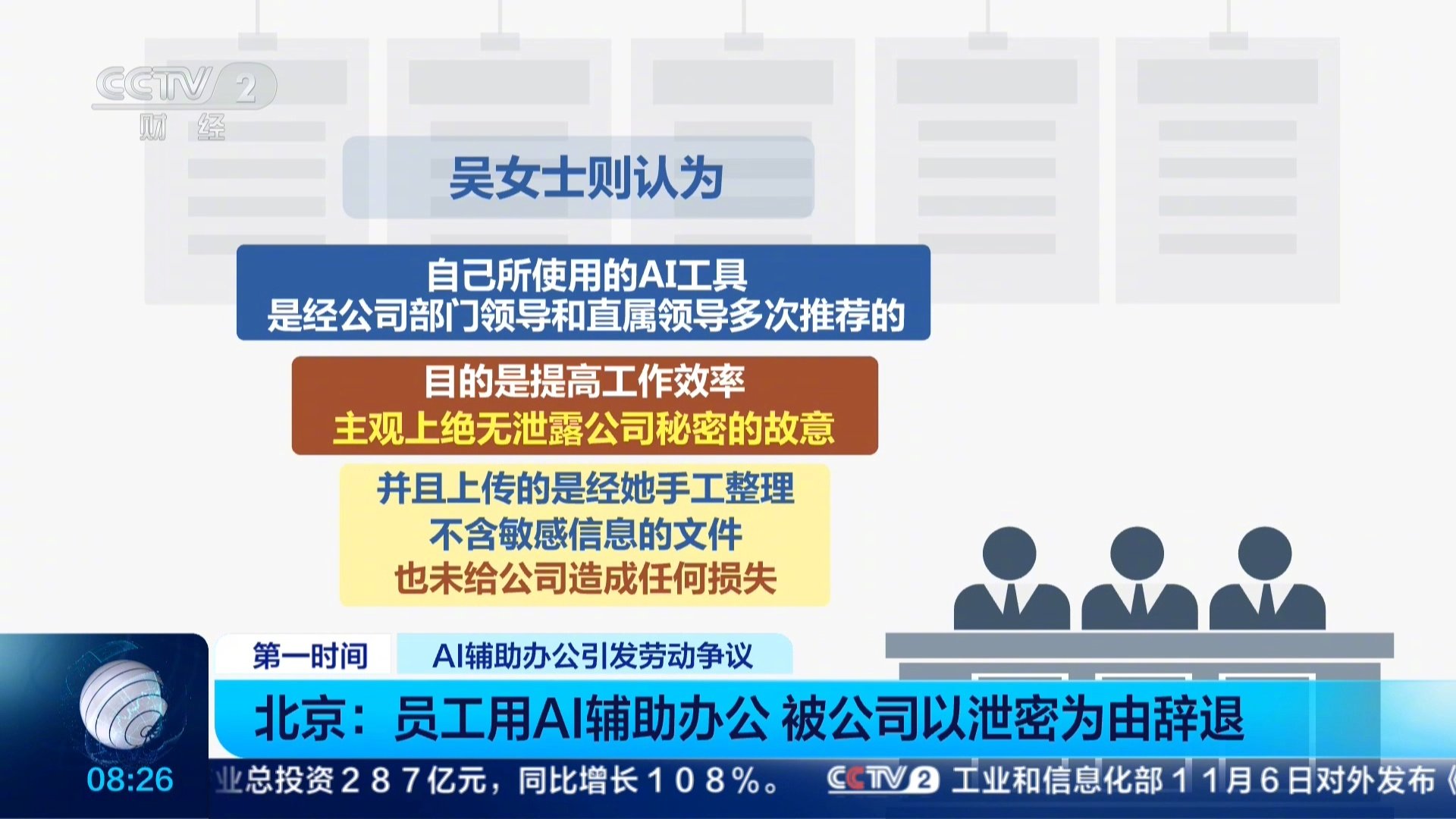
At trial, Ms. Wu said she uploaded the file to work more efficiently, that her managers had recommended the tool, and that she never intended to leak company secrets. The insurance company argued that third-party AI platforms collect and retain user data to train and improve their models — so uploading files externally created a disclosure risk by definition.
The court rejected that assumption of risk. The company had confidentiality rules, information security policies, and signed confidentiality agreements with employees. None of it proved the spreadsheet Ms. Wu uploaded was core confidential information under the law or company policy. Nor could the company show the upload led to any disclosure, financial loss, or reputational harm. Ms. Wu had no subjective intent to leak secrets, the court found, and her conduct did not amount to a serious violation of workplace discipline warranting termination.
The dispute did not end with a single payment. The first-instance judgment annulled the termination notice, ordered the insurance company to continue the employment relationship, and required it to compensate Ms. Wu for lost wages, the difference between her earned and withheld annual bonus, and other losses totaling more than 46,000 yuan. The insurance company appealed; the second-instance court dismissed the appeal and upheld the original judgment, which has taken legal effect. The remaining question is: as AI becomes deeply embedded in everyday work, what boundaries should companies establish in their policies?
Employee Uses Company-Recommended AI Tool, Yet Is Fired
Ms. Wu signed multiple confidentiality agreements. The company had no AI-specific rule and gave no AI-specific training. That gap is what this case turns on.
The company had the right to require her to protect internal information. But the court found that its internal rules did not explicitly prohibit employees from using third-party AI tools, which process information through external AI services. Nor had the company issued dedicated rules or operating guidelines for AI-assisted work.
No specialized training on AI tools either. Nobody told employees which files could be uploaded and which were strictly prohibited. The policy merely stated that “information must be kept confidential,” without explaining what employees could do when using AI to process information. Employees were left without an enforceable red line, facing a set of prohibitions that the company would interpret only after the fact.
Ms. Wu did not find the platform on her own. It had been repeatedly recommended by her department head and direct supervisor. She uploaded an audit-question spreadsheet that she had compiled and processed herself, intending to improve the efficiency of her PowerPoint production and data analysis. A leader’s recommendation of a tool and an organization’s encouragement of efficiency are not equivalent, in terms of the nature of the risk, to an employee independently submitting internal materials to an unknown external platform.
Before every upload, employees face a practical question: Is the spreadsheet in their hands public information, routine internal information, or protected information? If an organization merely states that employees “must not disclose information” without defining document classifications or tool boundaries, employees lack the basis for judgment even if they want to comply. When companies use general policies to pursue accountability after the fact, employees can easily fall into a gray area between improving efficiency and assuming risk.
The existence of management rules does not mean that every risk can be escalated directly into termination of an employment contract. A presumed risk is not proof of a leak. Merely presuming a risk of disclosure based on the third-party AI platform’s general rule of retaining data is not enough to establish that an employee seriously violated the company’s rules and regulations.
This case did not grant a green light to all AI-assisted work. An insurance company may prohibit employees from uploading certain materials, list approved tools, and establish approval, accountability, and disposal procedures. But the rules must be clear first, and evidence is needed to support both risks and accountability. Managing AI cannot consist solely of a blanket instruction to “maintain confidentiality.” How the mechanism should operate and how employees should respond still require further discussion.