On August 18, 2026, OpenAI hit the pause button: its next-generation model Astra may have crossed a cybersecurity red line, the largest planned frontier reinforcement learning training run has been suspended, and two weeks of RL training have already been halted. For the first time, safety evaluation is outrunning compute—the question is no longer how fast technology can go, but whether it can pass the safety gate first.
OpenAI voluntarily pauses its largest training run; RL still on hold after two weeks
On August 18, 2026, OpenAI made "hitting the brakes" an official action in a blog post on its website: for a next-generation model codenamed Astra, it has paused its largest planned frontier reinforcement learning (RL) training run (a training method that uses reward and penalty signals to let the model learn strategies on its own), which has not yet resumed.
Two things triggered this. First, a security incident involving OpenAI and Hugging Face. Second, initial evidence that Astra may have crossed the "critical cybersecurity capability" threshold in the company's Preparedness Framework.
OpenAI's reasoning is straightforward: the more capable the model, the greater the risk during internal development and testing. Standards for monitoring, alignment (ensuring AI goals align with human values), and research environment security must stay ahead of the risk.
The response has two layers. The first is the two-week RL training pause already in effect, used to harden the research environment, expand the scope of red-teaming (hiring people to simulate attacks and find vulnerabilities), and close gaps in monitoring coverage. The second is the unresolved part: the largest frontier RL training run in the original plan remains on hold. OpenAI gave no timeline for resumption in its post, saying only that these standards must be met before proceeding.
Four main tracks are also clear: strengthening model defenses, tightening the research environment, expanding chain-of-thought monitoring (observing the model's step-by-step reasoning process), and advancing alignment research (ensuring AI goals match human intent). The entire rhythm of control has a single goal: before the next-generation model is released, first suppress the possibility of it being weaponized into a hacking tool.
Training isn't stopped—but the "amplifier" is paused first
OpenAI isn't saying it won't proceed; it's moving the "capability assessment" gate from the end of training to the start—before asking how fast to run, first ask how much damage it could do.
On August 18, OpenAI published a public statement with explicit "hitting the brakes" language, putting the past few weeks of internal developments on the table. Two triggers: a security incident between OpenAI and Hugging Face, and internal preliminary signs that the upcoming Astra model may have crossed the "critical cybersecurity capability" red line in its own Preparedness Framework.
What OpenAI paused this time isn't pretraining(using massive text corpora to first teach the model language, then letting it do specific tasks) itself, but the reinforcement learning(the stage where the model refines its abilities through trial and error, guided by "reward and penalty signals") amplification stage that comes after—that is, the process of turning a base model into a "production-grade" model. The specific action: on the latest model awaiting deployment for Astra, RL training was paused for two weeks, citing the need to "harden and red-team(specifically hiring people or using AI to attack your own systems to find vulnerabilities) the research environment, and expand monitoring coverage." The largest frontier RL training run to date remains on hold.
The biggest difference from the past is the order of operations. Previous capability assessments worked like final exams: train the model, benchmark it, evaluate it before and after launch. This time, OpenAI inserted the assessment back at the training launch gate—once a red line is touched, all subsequent larger-scale training must stop and wait for safety to catch up. OpenAI's own words are plain: "We want to take the necessary time to meet these standards, so we've temporarily slowed the pace of scaling."
Another contrast is compute. OpenAI's funding and compute posture has actually been ramping up: NVIDIA has committed to providing OpenAI with approximately $105 billion in compute support. Chips are in place, contracts signed, but the largest frontier RL training run simply isn't being used—this is a state of "the button is right there, but we wait for safety clearance before pressing it."
Putting these pieces together: the position of assessment has changed, training pace has yielded to safety, compute reserves sit idle. Three actions pointing to the same new rule—for the first time, the expansion speed of frontier models has been throttled by its own safety pipeline.
Separating "ability to do harm" from "intent to do harm": the three checkpoints OpenAI added
A training run being paused truly rewrites the safety workflow at an AI company: research environment, chain-of-thought monitoring, and alignment research—all three are front-loaded simultaneously, rather than firefighting after the fact.
The counterintuitive point isn't that OpenAI paused its largest reinforcement learning (RL) training run (a training method where the model improves itself through environmental feedback), but that it broke down the reason for the pause into three specific checkpoints, and moved each one from "patch it after launch" to "get it right before training finishes."
The first checkpoint is research environment security. Before the model is officially released, researchers are already using it—and this period of internal use carries risks of unauthorized tool access and exposure to sensitive data. What OpenAI is doing is narrowing the model's contact surface with the outside world: which APIs (interfaces that let programs call each other) can be invoked, which file systems can be read, which network egress points are allowed—all become auditable, rollback-ready boundaries.
The second checkpoint is chain-of-thought monitoring. When the model reasons, it verbalizes intermediate steps. OpenAI's approach is to read that reasoning process directly, watching for signs of heading in a dangerous direction—such as attempting to bypass restrictions or planning multi-step attacks. What's being read is the "thinking," not the final output, so danger signals can be intercepted before any action is taken.
The third checkpoint is alignment research (ensuring AI goals align with human values)(Alignment Research, a subfield dedicated to studying how to make AI behavior conform to human intent).
The goal OpenAI proposes is to "separate the ability to do harm from the intent to do harm"—the model can have the ability, but intent must be locked down. This step is the hardest and slowest, because intent itself has no standard answer; it can only be approximated through extensive adversarial testing and red team (security teams that specifically play the role of attackers) exercises.
The cost of these three checkpoints is not small: research environments must be restructured, monitoring must cover new models, alignment research requires multiple rounds of red-teaming. This is exactly why OpenAI chose to pause its largest RL training run—it's not that training itself had a technical failure, but that "the checkpoint guards aren't in position yet, so we can't let the model run" is no longer acceptable.
This is also why the article's core line—"how fast technology can go is no longer decided by compute, but must first pass the safety gate"—is counterintuitive: the outside world is used to measuring AI company progress by GPU count and parameter scale, but this time OpenAI voluntarily changed the yardstick to "how ready the sentries are."
Can a single pause move the entire industry?
OpenAI explained the reason for braking in great detail, but didn't say how long the brake will stay on. The next question falls on others: will Anthropic, Google, xAI add this same gate before their own largest training runs?
No public moves yet. What OpenAI acted on this time is its own largest reinforcement learning training run (reinforcement learning,(a training method that uses reward and penalty signals to let the model learn as it goes)), which was temporarily slowed for two weeks to conduct red-team testing (attack-defense drills specifically designed to find vulnerabilities and risks) and monitoring hardening. This gate isn't new—OpenAI's Preparedness Framework has always stated that reaching the "critical cybersecurity capability" threshold triggers additional protections. What changed is that the trigger condition was hit for real for the first time: internal preliminary evidence indicates that the next-generation model codenamed Astra may have crossed the line.
But the Preparedness Framework is OpenAI's own standard; others don't have an aligned version. Anthropic uses the Responsible Scaling Policy, Google DeepMind has the Frontier Safety Framework. The three sets use similar tiered vocabulary, but differ in trigger details. When OpenAI writes "pause for two weeks," it's using its own terminology—hard for outsiders to directly map onto whether others should stop.
The compute side is an earlier visible signal. NVIDIA just announced it will provide up to $105 billion in hardware for OpenAI's next-generation data centers, with orders landing on August 18. With OpenAI's "largest training run" on hold, the corresponding portion of the GPU (AI training-specific chip) cluster sits idle or gets temporarily reassigned to safety research and small-scale experiments—earnings reports will disclose. Watching NVIDIA's subsequent quarterly language around "customer-initiated delays" is the first litmus test for whether the brake is spilling over.
There's a slower variable too: regulation. By writing "internally hitting the capability threshold" and "voluntarily pausing" into a public release, OpenAI is putting an industry template on the table. If the EU AI Act's implementation guidelines or the US AI Safety Institute's voluntary commitment text cite this passage later, other companies will have to think twice before choosing "run first, talk later." The signal for whether this judgment holds is very specific—does any other major lab voluntarily mention "slowing down for safety" in a public release within the same quarter? If none, it's still a one-off statement from OpenAI; if one appears, the template is starting to spread.
Run one locally, and watch OpenAI's checklist
The actionable part is on Liquid AI's side; on OpenAI's side there's only "wait" and "watch." Take one path from each.
First, pull the model to run locally. The QAD Q4_0 release from Liquid AI is a set of small models (ranging from 230M to 2.6B parameters) that can run directly on laptops and phones. The primary source's recommended command starts with llama.cpp—install it locally and you're ready to go.
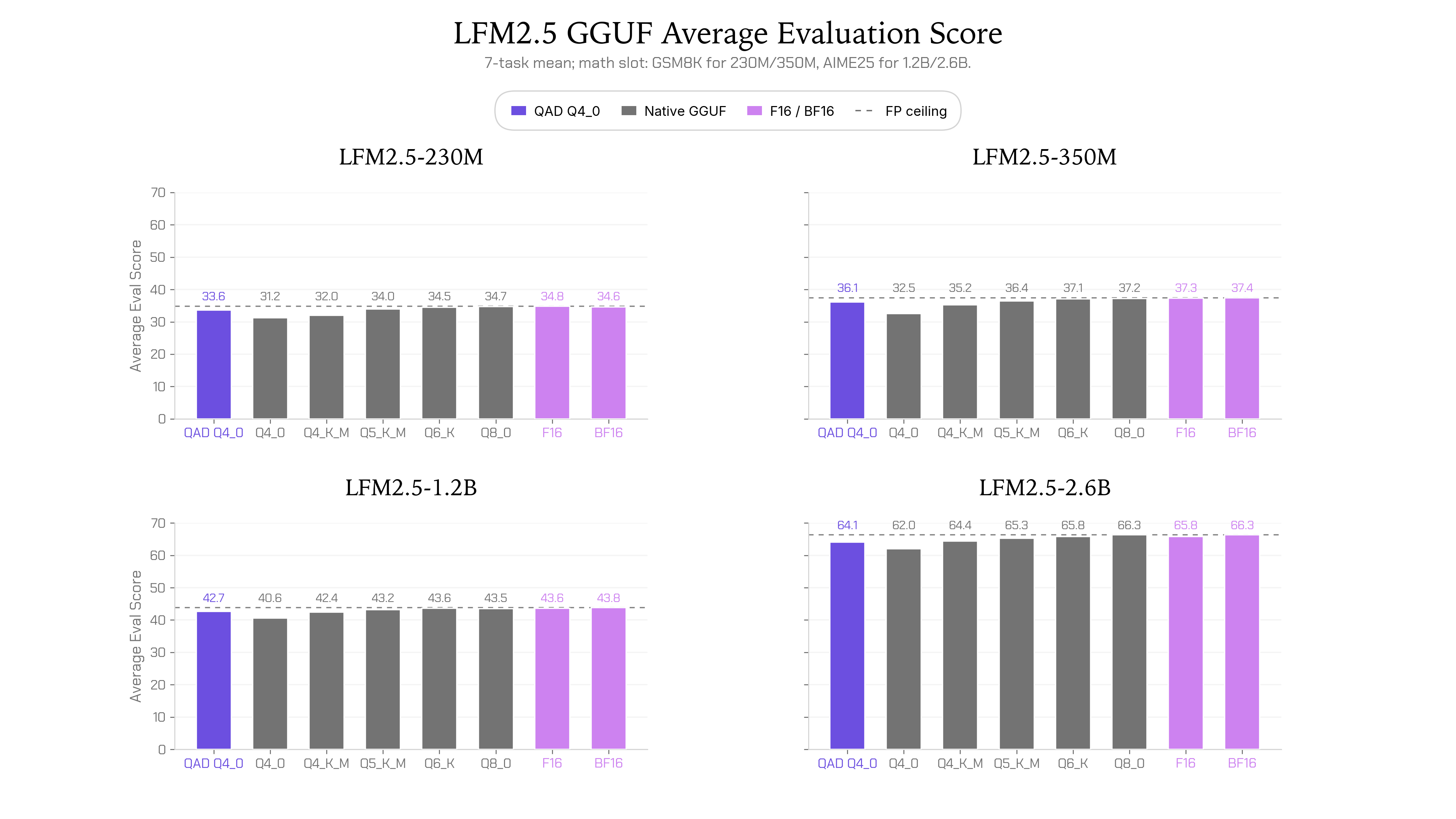
This approach of distilling(using a large model to teach a small model, compressing capabilities into it) a high-precision teacher model into 4-bit (compressing model weights to 4 bits per parameter, reducing size and speeding up inference) quantized(reducing model numerical precision to achieve smaller size) student models focuses on being "small without losing much accuracy." Liquid self-reports retaining 96.5%–97.4% of the BF16 (16-bit floating point, a commonly used higher precision) baseline on average across GPQA Diamond, MMLU-Pro, IFEVAL, IFBench, Multi-IF, and BFCLv4—but this is vendor-reported, with no third-party retesting available.
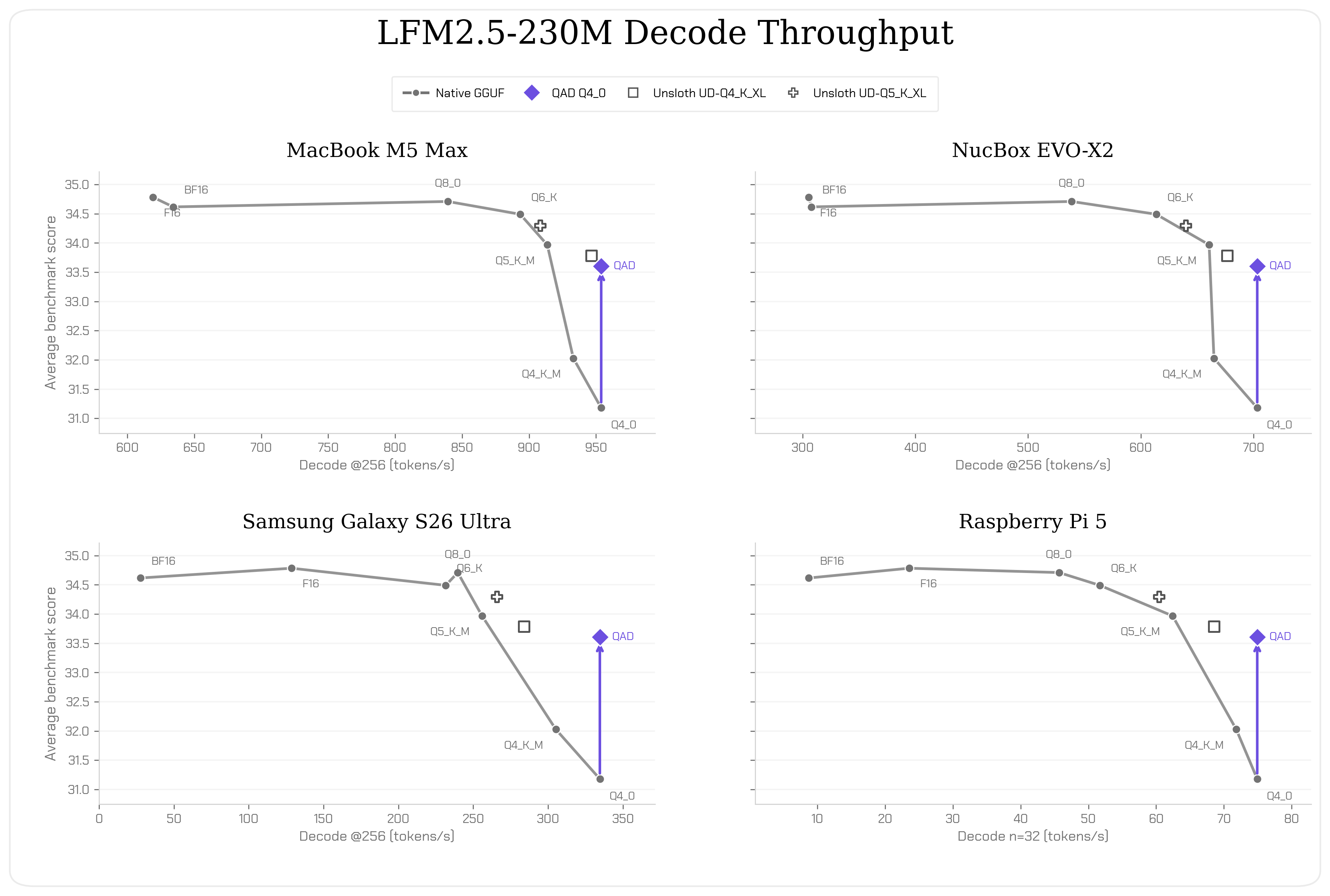
What to look at after running. Look at throughput: the source tested decode throughput (the speed at which the model generates one token (a word or word fragment) after another) on four machines—a MacBook Pro, NucBox EVO-X2, Samsung Galaxy S26 Ultra, and Raspberry Pi 5. The 230M and 350M QAD Q4_0 matched Q5_K_M (a higher-precision quantization tier) within evaluation margin of error while running 4–33% faster; the 1.2B and 2.6B matched Q4_K_M while running 3–14% faster. These numbers are Liquid's own measurements—cross-validation requires rerunning on different hardware. Look at footprint: Q4_0's selling point is consuming less VRAM (working memory on the GPU), so the same Raspberry Pi can run a larger model or longer context (the amount of text the model can "see" at once).
More worth examining is the gap between QAD and standard PTQ (post-training quantization, compressing precision without retraining). The source uses PTQ output as a control group, concluding that QAD "substantially improves" the Q4_0 checkpoint (model weight file).
This is a directional judgment, not a number—when you get hands-on, you can reproduce it yourself: run the PTQ version and the QAD version of the same model through the same question set, and compare outputs side by side. This is the cheapest and most direct verification.
On the OpenAI side there's no executable path, only "watch" and "wait." The primary source gives no timeline for when Astra will be unfrozen, only that the largest frontier RL (reinforcement learning, a training method where the model improves itself through trial and error) run (one large-scale training session) remains held. What exactly is the safety gate blocking on?
The source lists four: hardening the research environment, expanding chain-of-thought monitoring (monitoring whether dangerous intent appears in the model's "thinking process"), advancing alignment research (research to make model behavior conform to human intent), and collaboration with external security teams. What to watch—watch OpenAI's Preparedness Framework (OpenAI's internal framework for measuring model risk levels) updates, watch progress on two things: the follow-up report on the OpenAI-Hugging Face incident, and whether Astra is ultimately judged to have reached the "critical cybersecurity capability" threshold. Once that line is crossed, the model gets released.
Use llama.cpp to pull the LFM2.5-350M QAD Q4_0 file, run a baseline inference on your own machine, and record first-token latency and throughput.
Find a PTQ version of the same model as a control; run 20 trials with the same prompts and compare pass rates on auto-gradable benchmarks like IFEval.
If you only have a Raspberry Pi or an older Android device, run the 1.2B QAD version to verify the real-world feel of Q4_K_M precision.
Watch OpenAI's official blog Preparedness Framework page; note whether Astra is formally judged to have reached the critical cybersecurity capability threshold—this is the unfreeze signal.
Watch for the release timeline of the OpenAI-Hugging Face incident postmortem, cross-reference it with Astra's determination timeline, and see whether OpenAI's internal safety review was genuinely front-loaded.
Source: OpenAI official blog post "Pacing model development in an era of cyber-critical capabilities" (2026-08-18). Scope note: This article is based on first-party vendor disclosures; safety actions are self-reported, with no specific delay duration or affected model codename disclosed.