On November 20, 2026, Google integrated Duplex’s calling capabilities into Tasks in Gemini: book a restaurant, schedule a haircut, give it the details, and it calls the business and negotiates the arrangements on your behalf. The change isn't about whether AI can chat, but about whether you're willing to hand over a real-world conversation.
What calls can Gemini make for me?
Gemini can now do more than leave a message for a restaurant; it can call businesses on the user's behalf and handle everyday real-world tasks such as placing meal reservations and booking haircuts.
Duplex isn't new. Years ago, it was Google's internal technology for enabling AI to hold natural conversations with local businesses before being introduced to several products over time. This time, it has been built directly into Tasks in Gemini.
Tasks in Gemini is positioned as a personal AI assistant that coordinates real-world errands(an AI assistant that handles real-world tasks for you). Its difference from an ordinary voice assistant isn't whether it can dial a number, but what happens after the call connects: it communicates with the business and carries reservation and booking requests through to completion.
The boundary of “making a call” has therefore shifted: previously, you asked the restaurant and Gemini relayed your request; now, you entrust the reservation or appointment to Gemini, which negotiates on your behalf until the matter is settled.
Whether it can understand requests amid a mix of human and AI callers, and respond to unexpected changes, is the real test for this capability.
Why can half a second of silence ruin a call?
Appointment rules may not be complicated, but the challenge is that people continually change the rhythm of a live conversation. AI has to listen, interpret, and respond in a timely manner at the same time.
People rarely follow a script when making phone calls. A business may change its terms mid-sentence, and a newly spoken request may be replaced by a better idea. The other party may also interject, turning a simple confirmation into a series of last-minute changes. AI must do more than recognize fixed questions; it has to use the preceding context to understand what the other party is actually asking for now.
The harder problem is determining whose turn it is to speak. There is no button on a phone to signal a change of speaker, so people often rely on subtle shifts in tone. A pause longer than half a second may lead the other party to think the call has dropped; speaking too early causes both sides to talk at once, instantly turning polite conversation into mutual interruption.
Systems therefore need to control not only what they say, but also when they speak. Simply generating a correct response with a text model and then reading it aloud isn't enough.
High-quality speech recognition, contextual reasoning, and speech generation need to work together within a single low-latency system(a system fast enough to respond and coordinate sound processing). Speech recognition identifies what is being said, contextual reasoning keeps track of changed terms and interruptions, and speech generation chooses the right moment and uses a natural tone.
From making calls to handling tasks on the fly
Duplex's evolution has gradually given a phone system built for a single task the general-purpose ability to understand conversations, respond in real time, and achieve goals.
Early versions of Duplex resembled an operator who followed a fixed workflow. It used a task-specific recurrent neural network(a neural network that processes information in temporal order), with training data drawn from anonymized phone conversations for a particular task. The system could complete work within preset boundaries, but couldn't respond flexibly to every request.
The turning point came in 2022, when Google Duplex began using LaMDA(Google's large language model) in live calls.
LaMDA itself launched in 2018. Four years passed before the model entered a real phone call. During that gap, more than the model changed: the dynamics it had to handle changed too. Variations in a call could come from the other party rather than a predefined test path, meaning the model no longer merely advanced along a task-specific script; it also had to handle unexpected turns and conversational asides.
Google's description of the latest changes is explicit: Duplex has evolved from specialized neural pipelines(models and processing workflows built around particular tasks) into a unified technology stack powered by Gemini(a shared set of underlying capabilities that support different tasks). Capabilities previously built separately for individual tasks are beginning to converge in one system that can support both conversation and task completion.
Gemini adds a layer of division of labor to call handling
Gemini now runs the whole call: it parses what the other party says, works out what the user wants, plans the next turn, and drafts the reply. The error-prone line details go to smaller, specialized models.
It puts multimodal understanding(handling different forms of information, such as speech, at the same time), planning, and conversation in one system. No appointment type needs its own custom dialogue model anymore.
Specialized models handle what sits closer to the live call. Acoustic models pick out speech through background noise, line compression, and bad connections. Conversation-rhythm models manage pauses, interruptions, and turn-taking — deciding whether to keep listening, start talking, or hand the floor back.
Gemini decides what to say. The specialized models decide when to listen and when to speak, tuned to the pace of a real conversation.
Whether that split holds up on real business calls comes down to noise, interruptions, and last-minute changes.
One conversational capability now spans search, maps, and devices
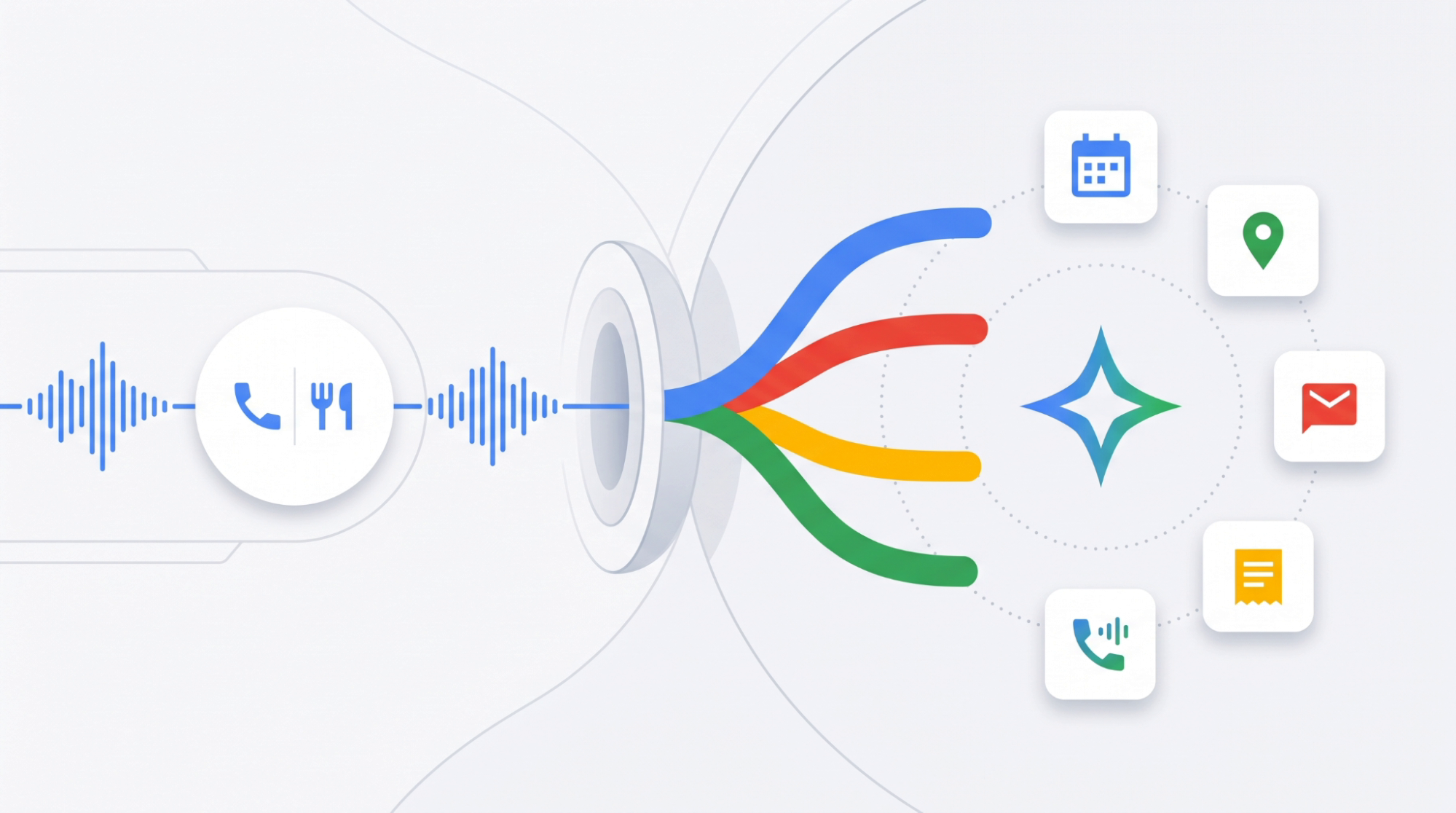
Duplex has reached devices, Search, and Maps, all sharing the same conversational infrastructure. Agents don't just answer questions; they also move real-world tasks forward for users.
This infrastructure was initially used to verify business information. During the COVID-19 pandemic, when opening hours and business services changed frequently, Duplex automatically verified the information and updated business listings in Google Search and Maps. Information obtained solely through calls was displayed in Search and Maps more than 1 trillion times. Information generated by a single call could thus enter the path users take to find a business.
The calling model later entered device use cases, providing the technology behind Call Screen and Hold for Me. Call Screen(a caller-identification and call-filtering feature) helps users manage unfamiliar calls, while Hold for Me(a feature that waits on the user's behalf while a human agent answers) maintains the call while the user waits for a customer-service representative to pick up. Both features rely on real-time processing of speech and conversational state: one guards the entry point of a call, while the other holds the line during the wait.
By 2025 and 2026, foundation models further expanded agentic calling capabilities across Google Search and Ask Maps. The same underlying model capabilities can serve different entry points: managing calls on devices, initiating queries and tasks in Search, and handling location-related requests in Maps. Although the task entry points differ, the underlying capabilities remain reusable.
Our assessment: the capability has passed its point solution validation. Its ability to scale now depends on users being willing to define how far it may go when speaking on their behalf. That premise doesn't automatically hold in situations involving prices, schedules, and commitments.
When AI negotiates arrangements with a business on your behalf, do you know how much authority you've given it to decide?
Source: Google Research, “How Google Duplex evolved to also call businesses for you in Gemini” (November 20, 2026), along with supplementary materials from Gemini Drops, BPDATA, and TideReach. Product capabilities, architectural evolution, and historical display counts are all based on Google's official disclosures; the relevant materials do not include third-party testing.