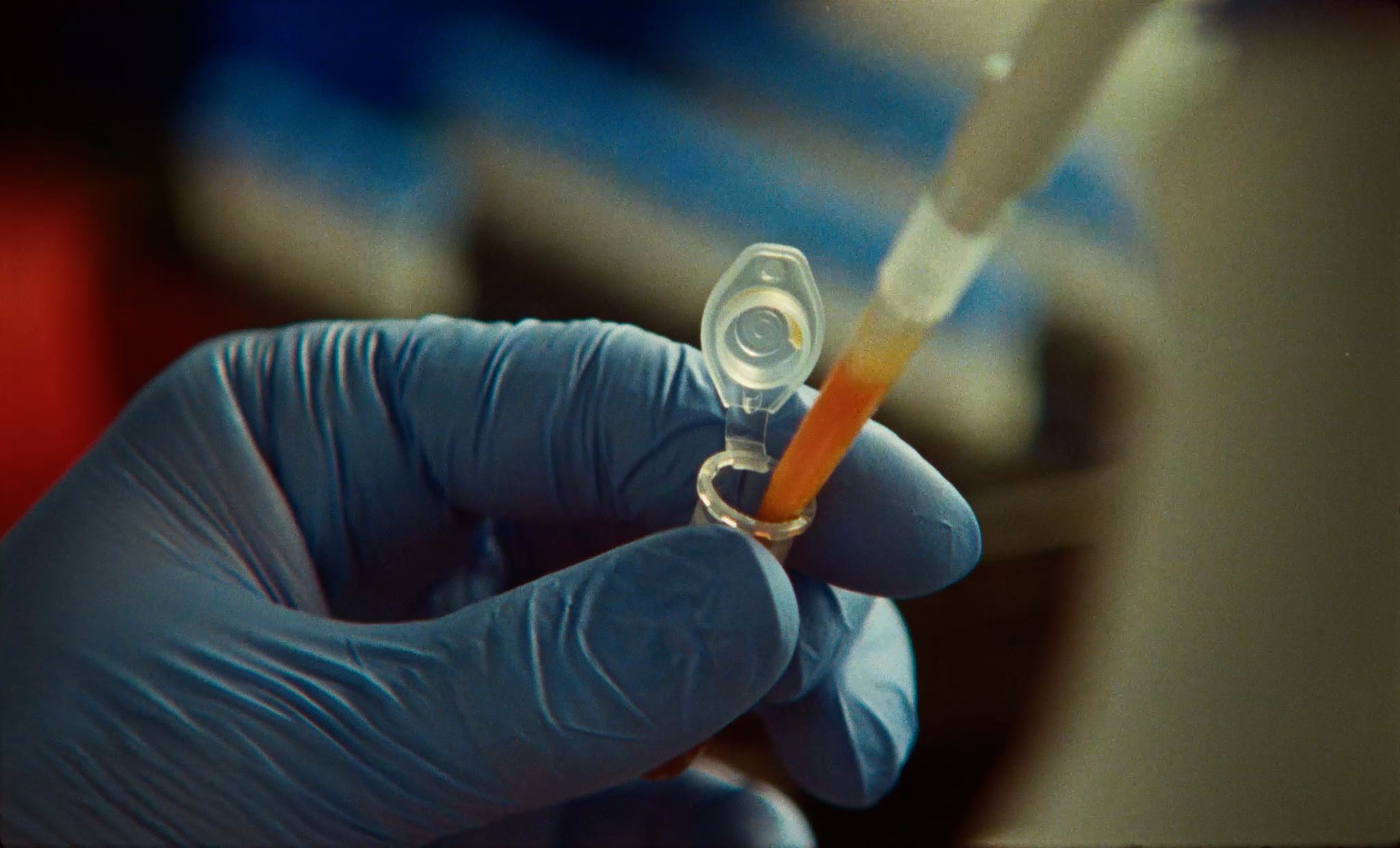
Anthropic founder Dario Amodei announced on X that Claude led the completion of a piece of work he described as something "a PhD student would be proud of": reading literature on its own, scanning genomes, and proposing experimental plans, after which a human team ran the wet-lab work in BSL-1/BSL-2 labs and dug out a molecular machine that may represent an entirely new gene-editing mechanism. But Amodei was blunt about it himself — what exactly this enzyme does, and whether it has any biotech utility, remain unclear.
AI Reads, Scans, Proposes — The Last Step Is Still Human
Anthropic has unveiled an as-yet-unresolved discovery: a molecular machine found under Claude's lead that may represent a new gene-editing mechanism. Its specific function, biotech applications, and ultimate significance — Anthropic itself hasn't clarified any of it.
The division of labor is drawn sharply. Anthropic's life-sciences team first scoped a research direction; Claude digested the relevant literature, scanned a batch of genomic data, dug out something interesting, and then designed verification experiments on its own; finally, the human team went into the lab to run them. Amodei's description: "mostly" done by Claude, immediately followed by "not all of it."
What got unearthed is a molecular machine that Anthropic suspects may represent a new gene-editing mechanism. In the same post, Amodei was straightforward: its specific function, its biotech applications (if any), and how significant this discovery really is — all remain unclear. His framing: "something a PhD student would be proud of" — not "this rewrites the textbook," but "work worth doing."
The division of labor itself isn't new. What's new is that AI, for the first time, has taken ownership of the entire chain — reading literature, scanning genomes, proposing experiments — on the condition that wet-lab work is still done by humans. Amodei placed this on a longer curve: in 2023, models could barely handle ordinary high-school math; by 2024, they were tackling the nation's top high-school math competitions; in 2025, they started solving small open problems; in early 2026, harder open problems; by late 2026, they were already bumping against some of the hardest open questions in mathematics. He sees AI in biology tracking a similar exponential curve. Anthropic has also stated it is expanding its life-sciences team and opening up external research collaborations.
An Enzyme That Works via Reverse Transcription
This discovery isn't part of the CRISPR upgrade lineage — it's a molecular machine that depends on reverse transcriptase. How it works and what it can do, Anthropic itself hasn't spelled out.
The new enzyme belongs to the reverse transcriptase family. Reverse transcriptase (an enzyme that writes RNA back into DNA; HIV replication depends on it too) does the job of reverse-copying RNA sequences into DNA. It originally served as a tool viruses use to shove their genes into host cells, and only in recent years has the academic community started mining it as a new chassis for gene editing.
So what's its relationship to CRISPR? The answer: they work differently — its specialty is writing, while CRISPR is cutting. This enzyme also comes with a stretch of non-coding array that isn't directly translated into protein, and likely plays a role in targeting and recognition.
This line of work didn't appear out of thin air. The trail goes back decades to CRISPR, then more recently to bridge recombinase and VIPR that have emerged over the past few years. The RT family has seen a sharp rise in interest over the past two years, and this discovery falls squarely within that chain.
A Stanford team independently described another RT system with non-coding arrays around the same time, and the two share certain features. The two systems evolved independently — they're not the same thing.
What exactly the enzyme can do, or what tool it could be engineered into — Anthropic offered no numbers, no benchmarks.
Math Climbed to the Top in 4 Years — Will Biology Wait for AI to Pick Up a Pipette?
The root of the skepticism is the "hands-on" barrier: math can be pushed forward on paper, but biology requires experiments, and an AI that can't hold a pipette is destined to hit a ceiling. Anthropic wants to pick that lock with a human-AI collaboration loop.
Amodei lined up AI's capability over time into a curve: in 2023, models stumbled on ordinary high-school math; by 2024, they were handling the nation's top high-school math competitions; in 2025, they could solve small open problems; in early 2026, harder open problems; by late 2026, they were already grappling with "the hardest open questions at the very top of mathematics." Anthropic uses this 4-year curve as an analogy for AI's trajectory in biology.
The difference is "getting hands dirty." Math can be driven purely by reasoning; biology can't — it requires experiments. Amodei was blunt: humans do the experiments, AI iterates, and the loop already works today — Anthropic's life-sciences team sets the broad research direction, Claude reads the literature and genomic data and proposes experimental plans, humans run the wet-lab work in BSL-1/BSL-2 (biosafety level 1/2 labs, handling only microorganisms that pose low risk to healthy adults — no highly pathogenic materials dangerous to humans) labs, key results are verified within weeks, and if the direction is off, they go back and adjust the plan together with AI.
Letting Claude autonomously control equipment to run experiments — Amodei characterized this as "just a matter of time," conditional on appropriate safety mechanisms being in place, which they haven't built yet. Once this loop is running, what Anthropic wants to accelerate is the "basic biology discovery" stage: understanding biology, sharpening tools for biologists, and feeding more candidates into downstream stages like drug targets, new therapies, precision measurement, and faster experimental cycles. More candidates doesn't mean clinical trials themselves get shorter.
The Funnel Gets Wider, But Bottlenecked at the Bottom
Amodei carved biomedicine into five stages: basic discovery → translational research → drug discovery → clinical trials → getting the drug to patients. AI has so far only accelerated the first stage; the remaining four take just as long as before.
He was direct: "This will not in itself speed up clinical trial times." More input, same throughput downstream.
Even if Claude discovers ten more new enzymes tomorrow, the queue for drug candidates entering the clinic, running trials, and waiting for approval — none of that changes. Amodei described the structure as "throughput even though latency remains" (more output, but the delay stays the same).
He drew a lab-safety line: Anthropic's labs operate at BSL-1/BSL-2 and don't handle dangerous samples.
The wet-lab stage is currently stuck within the scope of "routine biology" — still a long way from autonomously controlling lab equipment. Amodei flagged "Claude autonomously operating equipment" as a future matter, explicitly stating "we aren't doing that today."
Outside Anthropic, the RT system independently described by the Stanford team points the same way: several teams nearly simultaneously stumbled onto similar discoveries, suggesting there may be more than one such system. That fits Amodei's own framing — "we're at the very beginning of finding such systems."
Watch points: 1) After Anthropic expands its life-sciences team and opens external collaborations, will a second independent team use Claude to replicate or extend new RT systems; 2) whether any RT-class gene-editing system patents or preclinical data emerge publicly within six months; 3) whether Amodei keeps positioning AI as only accelerating basic discovery — if he does, his "cure most diseases in 5-10 years" goal will likely be pushed back; if instead there are signs AI has entered drug discovery or clinical trial design, the assessment holds.
Where Ordinary People Can Watch That 5-10 Year Curve
Amodei once offered a judgment in "Machines of Loving Grace": cure most diseases in 5 to 10 years — the goal is "barely possible." This time, he hung that statement on Claude's discovery — when AI can first assist, then lead biological discovery, that curve finally has its first stepping stone. Anthropic is currently running two tracks: expanding the life-sciences team on one side, and opening research collaboration applications on the other.
There's a guardrail on the threshold that must be clearly seen: Anthropic's own labs are BSL-1/BSL-2 and don't process samples dangerous to humans. In other words, today's pipeline can only accelerate the "read literature — scan genomes — propose experiments" stage; clinical trial timelines are out of its reach. Amodei himself said that accelerating basic discovery doesn't equate to shortening clinical timelines, but it can feed more promising candidate molecules into the pipeline.
For ordinary people, the original post leaves a narrow opening: either scientists with research collaboration proposals can reach out, or job seekers willing to join the life-sciences team. Beyond that, a more practical move is to fixate on two time anchors — Anthropic's upcoming further explanation of this new enzyme's function, and whether it will eventually be compared side-by-side with Stanford's independently evolved RT system (a family of gene-manipulation tools built around reverse transcriptase).
Whether this curve has truly started isn't measured by the number of discoveries — it's whether they can be independently replicated. The math curve mentioned earlier went from high-school problems to the hardest open questions in just a few years. Biology has just taken its first step — letting AI lead a discovery while humans run wet-lab experiments to verify it. Whether it can be replicated, and whether it can scale to more problems, will determine whether the 5-10 year judgment is "barely possible" or yet another optimistic long-dated IOU.
Follow Anthropic's official account and watch for follow-up explanations of this molecular machine's "function and potential applications."
Search for and track the latest progress on Stanford's independently evolved RT system, and compare whether the two systems are being analyzed together or corroborating each other.
Distinguish between "accelerated basic discovery" and "shortened clinical timelines": scrutinize any claims about clinical trial timeline changes, checking whether they apply only to the basic discovery stage and whether they sidestep discussion of clinical timelines.
For researchers: watch for the channel where Anthropic opens research collaboration applications, and prepare a proposal specific to a problem that can be advanced under BSL-1/BSL-2 conditions before reaching out.
For job seekers: watch Anthropic's life-sciences team hiring announcements and assess how the roles match your background — the most direct entry point into riding this curve.
Source: X — Dario Amodei (@DarioAmodei). Note on sourcing: The content consists of an official announcement from Anthropic's CEO. The enzyme system's function, applications, and scientific significance have not been confirmed, and there is no independent third-party replication data. This represents a first-party claim from the company.